

Hunter eyes vs prey eyes
Hunter eyes vs prey eyes compares two informal descriptions of the eye area. Online, hunter eyes usually means a narrower opening, an outer corner that sits higher, and a compact brow-to-eye gap. Prey eyes usually describes a rounder, more open appearance. Four measurements can help explain that contrast: canthal tilt, upper iris coverage, eye height-to-width ratio and brow-to-eye gap.
If you have read a dozen threads and still cannot place yourself, you do not need to force a choice. This page separates the features, explains each number, and leaves room for mixed or intermediate readings.
These are online appearance descriptions, not clinical categories. A photograph can show eye-area geometry, but cannot establish personality, health or eye-socket depth. Neither label is a condition or a verdict on a face.
What hunter eyes and prey eyes actually mean
Hunter eyes describes an appearance associated online with an elongated opening, positive canthal tilt and little visible upper eyelid skin. A brow close to the eye can contribute. People also say deep-set, but that is a visual description here: a frontal photo and a short brow gap do not measure orbital depth.
Prey eyes describes a more open or rounded appearance, sometimes with a level or downward outer-corner line and a larger brow-to-eye gap. These features need not occur together: someone can have a rounder opening with positive tilt, or a narrow opening with a larger gap.
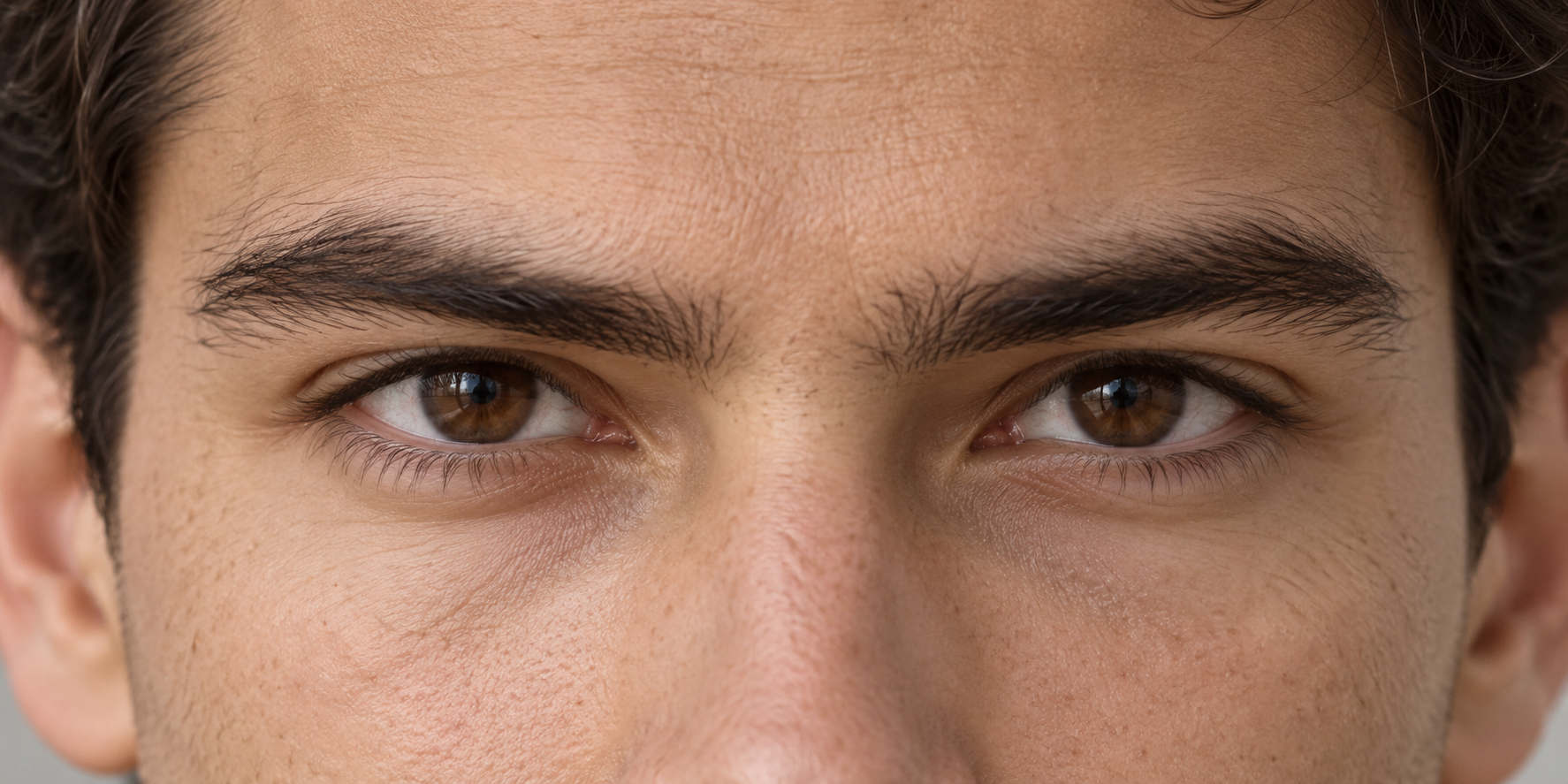
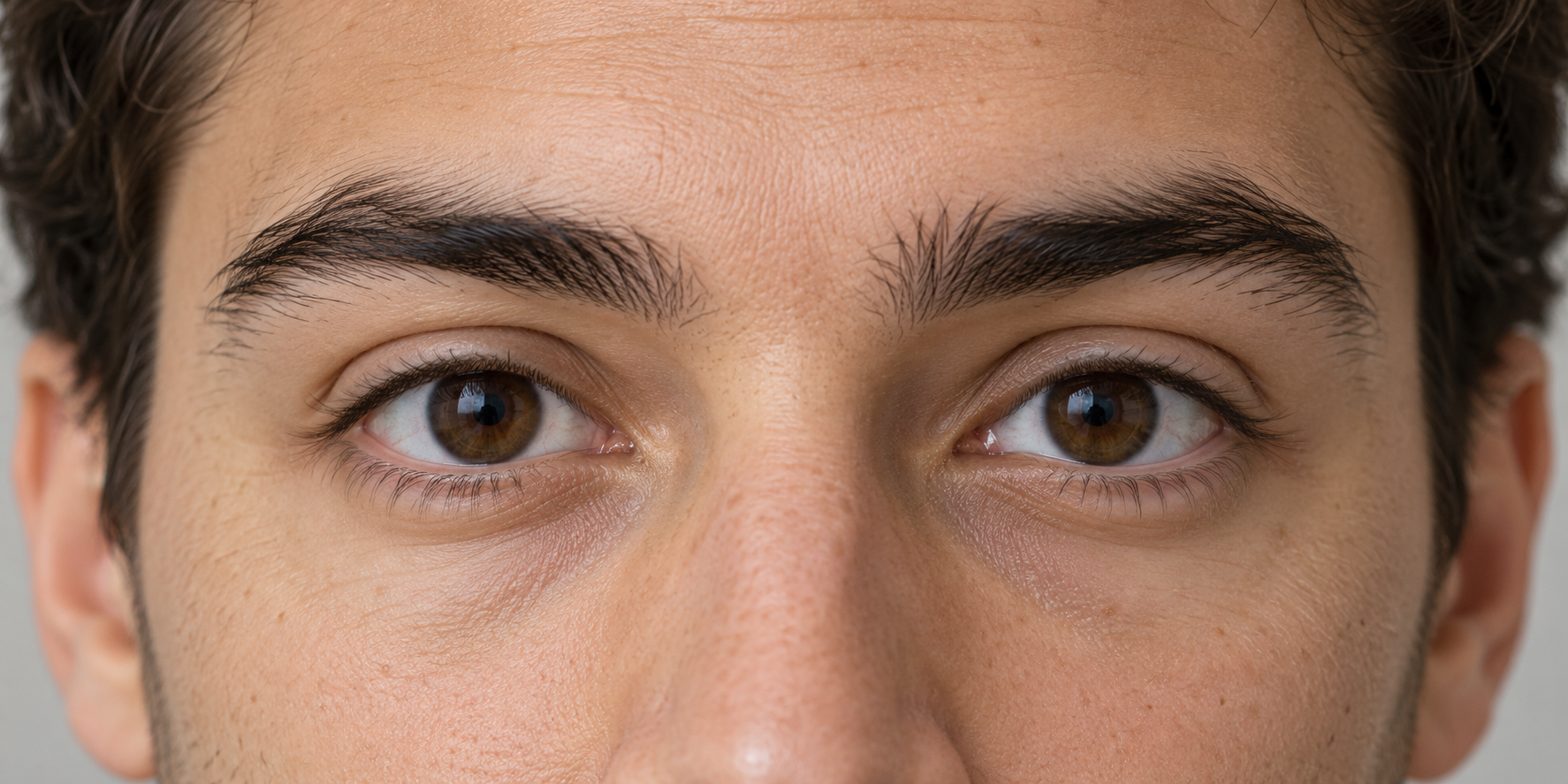
The names invite an animal analogy, but do not establish categories for human eyes. Animal eye placement and pupil shape are different from the outline of a human eyelid opening. This comparison concerns visible features, not hunting ability or behavior.
The terms are descriptive, not evaluative. Prey eyes does not imply illness or weakness; hunter eyes does not imply superiority. The illustrations show the contrast, not measured examples or biological types.
The four measurements that separate them
Four measurements make the hunter eyes vs prey eyes comparison more concrete. Eyelid creases, skin folds, eyebrow shape and lighting remain separate considerations. [1][3][4]
On smaller screens, scroll the table to compare both descriptions.
| Measurement | Hunter eyes reading | Prey eyes reading |
|---|---|---|
| Canthal tiltThe angle from the inner to the outer eye corner, relative to a horizontal reference after correcting image roll. | A positive tilt: the outer corner sits higher. | A level or negative tilt is often included in the online description. |
| Upper iris coverageHow far the upper eyelid covers the estimated iris height, expressed as a percentage of that height. | More upper iris coverage can contribute to a contained appearance. | Less upper iris coverage can contribute to a more open appearance. |
| Eye height-to-width ratioThe central eye-opening height H divided by the corner-to-corner width W. | A lower H/W means a narrower, more elongated opening. | A higher H/W means a taller, rounder opening. |
| Brow-to-eye gapThe two-dimensional gap G from the lower brow boundary to the upper eyelid, divided by eye width W. | A smaller G/W describes a more compact gap. | A larger G/W describes more space above the eye. |
More or less does not always earn a higher score. FaceCoda uses fixed experimental curves with preferred ranges and lower scores at extreme values. Its reading bands and scoring curves are product rules, not clinical standards.
Canthal tilt
Imagine a line joining the corners and compare it with horizontal. A rotated head or camera changes that line. FaceCoda corrects image roll before measuring. Positive describes direction; it does not independently prove hunter eyes or guarantee a maximum score. [1]
The guide to negative canthal tilt explains the downward direction, degree readings and the difference between geometry and the tool’s experimental reference bands.
Upper iris coverage
This estimates covered height, not area. The tool compares the upper eyelid edge with model-estimated iris landmarks, not the eyelid crease or visible skin strip. Upper iris coverage and upper eyelid exposure cannot be substituted for each other. [3][4]
Eye height-to-width ratio
Read the order carefully: height divided by width. An opening 30 pixels high and 100 pixels wide has H/W 0.30. Expression changes the opening, so compare relaxed photos. Central H/W differs from formulas combining several eyelid landmark distances. [1]
Brow-to-eye gap
Dividing by eye width gives a ratio rather than a pixel distance. This projected spacing cannot reveal brow-bone projection, how deep the eye sits in its socket, or underlying bone shape. [2][4]
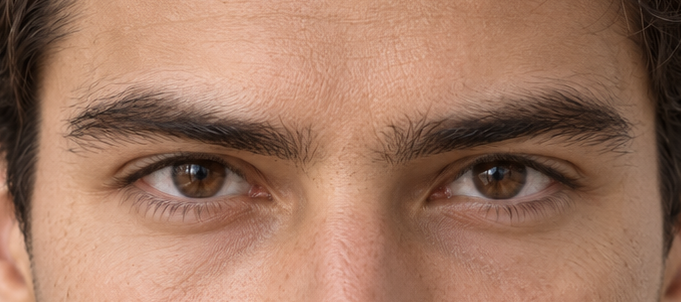
- Canthal tilt+7.23°Inner-to-outer corner angle
- Upper iris coverage18.42%Upper-lid offset / estimated iris height
- Eye ratio H/W0.293Central opening height / width
- Brow gap G/W0.136Brow-to-lid gap / eye width
Hunter eyes vs prey eyes, side by side
Together, hunter eyes vs prey eyes resolves into several visual effects rather than one anatomical switch.
Depth impression
A compact brow gap and shadow can make an eye area look recessed; even lighting can make it look open. Neither shadow nor G/W directly measures orbital depth. Two-dimensional spacing and three-dimensional anatomy are different quantities.
Tilt
A positive angle slopes upward toward the outside. A neutral angle looks level; a negative angle slopes down. The opening and brow also affect appearance, so matching tilts do not make two eye areas identical.
Openness
A taller opening and less upper iris coverage can look more open; a narrower opening and more coverage can look more contained. Neither measures visible eyelid skin: the crease and covering fold are separate features.
Shadow
Light changes the shadows without changing anatomy. A dark upper-eye area does not prove hunter eyes, nor a bright photograph prey eyes. Check the visible boundaries before drawing a conclusion from contrast.
Someone can have positive tilt and a rounder opening, or a compact brow gap with little iris coverage. Mixed readings are valid; one label need not explain every feature.
There is a third answer: normal eyes
There is a third answer: normal eyes. If neither illustration matches, you do not have to choose an extreme. Intermediate values and combinations of features are ordinary human variation, not failed versions of either label.
Normal is not a diagnosis or a fifth tool result. A level corner line, moderate opening or mixed measurements can be described directly without a hunter-or-prey verdict.
FaceCoda shows all four readings and a fixed experimental Hunter Eyes Score. That score summarizes its preset curves; it does not replace the individual measurements or make intermediate features abnormal.
How to tell if you have hunter or prey eyes
Start with a photo that makes the boundaries visible. Consistent conditions help you compare readings; a dramatic angle or expression makes differences harder to interpret.
Fix the photo first
Use a complete, straight-on face with both eyes visible, the head level and the camera near eye height. Choose even front lighting and remove glasses that hide boundaries. Keep your face relaxed: no deliberate squint, raised brows or widened eyes. Avoid filters, strong perspective and cropped-off facial landmarks.
Check what each measurement describes
Compare corner heights for tilt, the upper eyelid edge against the iris for coverage, the opening height against its width, and the brow gap against eye width. Do not use the skin band as iris coverage or a brow shadow as depth. Look at both eyes.
Read the numbers and the summary together
A marked analysis image makes it easier to see what was measured than estimating an angle by eye. Check the boundary placement, then read the values, available experimental bands and score. The existing score uses four continuous curves: 35% canthal tilt, 30% eye ratio, 20% brow gap and 15% iris coverage.
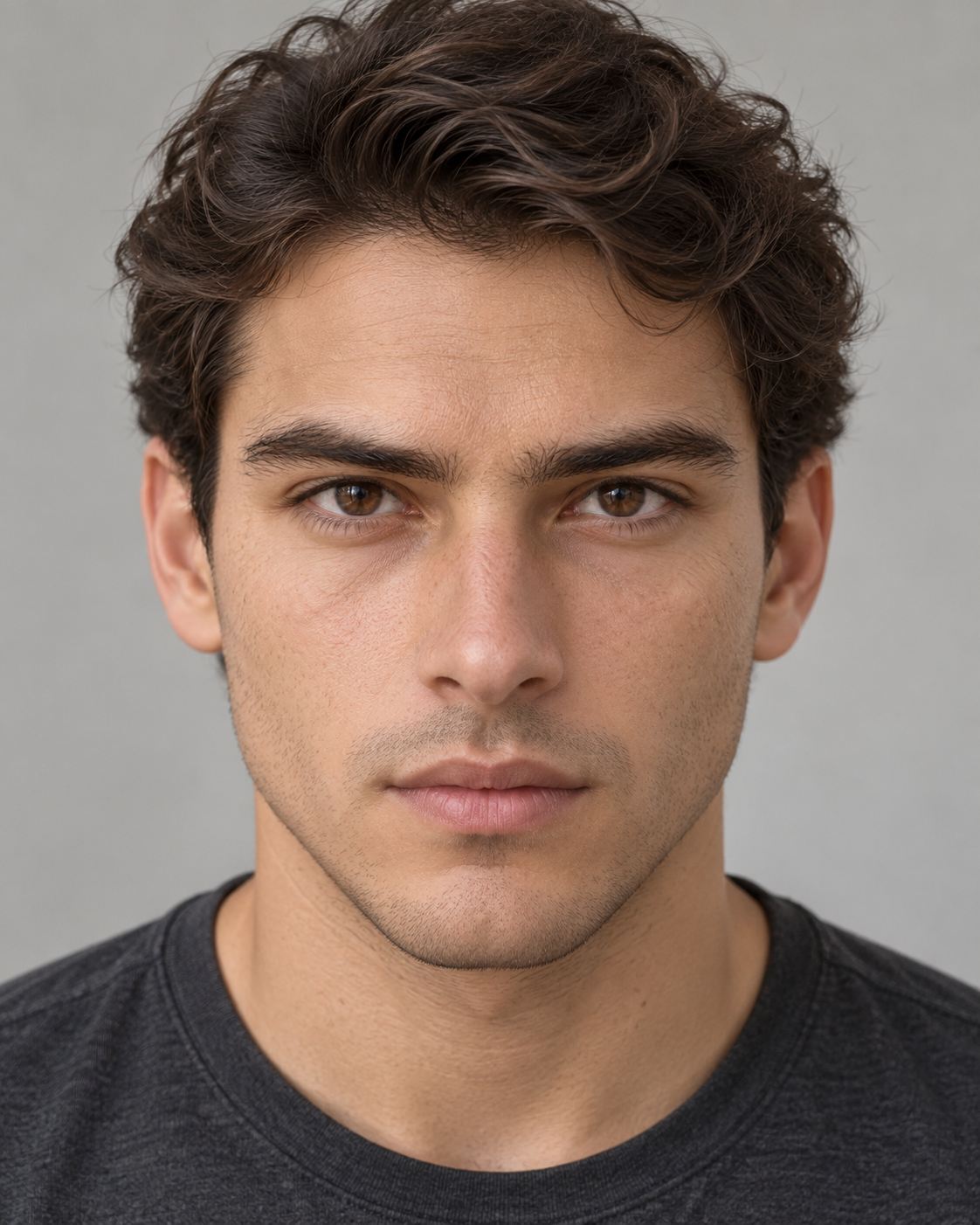
Face the camera, use even front light, and keep your eyes and brow relaxed. The analysis uses the full photo and displays a double-eye crop.
This framing example is AI-generated, using the same saved full-face image as the measured diagram above.If you would rather measure than estimate, our Hunter Eyes Test returns the four readings, cropped analysis images and a 0-100 Hunter Eyes feature-match score. After you choose Measure, your photo is temporarily processed on the server; no sign-up is required. The score is experimental, not a probability, population percentile or attractiveness ranking. Check the diagrams alongside the result.
Why “prey eyes” is not an insult
The word prey can sound like a judgment, and online it is sometimes used as one. Measuring is different. An open eye shape says nothing about courage, confidence, intelligence or social status.
Animal comparisons do not scientifically rank human faces. Eyelid corners, visible iris and brow spacing do not sort people into predator and prey functions. A metaphor is not a biological classification.
Descriptively, prey eyes refers to the open or rounded appearance above. It does not mean weak, tired or lesser. Calling it normal or describing its dimensions is equally valid. Nobody needs the label to understand the numbers.
The same applies to hunter eyes: a strong experimental match does not establish superiority. Visible geometry and explicit product rules cannot turn an internet preference into an objective measure of a person.
What you can and cannot change
Separate anatomy, soft tissue and photography before interpreting a changed result. A different photo does not tell you which changed.
Anatomy is more than a photo ratio
Bone, eyelid tissues and their relationships contribute to appearance; these four numbers do not measure them fully. Anatomy can change with development and aging. Neither a photo nor its score establishes that a habit or exercise moved an eye deeper into its socket.
Soft tissue and expression vary
Eyelid edges and brow positions can differ with expression and temporary changes in surrounding tissues. A reading is a snapshot: it does not establish why an eyelid looks different or diagnose a medical cause.
Photography changes the evidence
Camera distance, head rotation, lighting and expression affect the image and boundary detection. One camera move does not reliably increase or decrease the score. Keep conditions consistent and inspect the analysis images rather than selecting the highest result.
Use the measurements to understand a photograph, not to choose a treatment. This page does not recommend procedures or appearance changes. Concerns about vision, discomfort or a changing eyelid belong with an eye care professional, rather than an online shape comparison.
FAQ
Which is more attractive, hunter eyes or prey eyes?
These measurements cannot determine which is more attractive. FaceCoda's score measures agreement with preset experimental Hunter Eyes curves. It is not a validated face ranking, a measure of personal worth or evidence that one eye type is universally preferred.
How do I know if I have hunter or prey eyes?
Use a straight-on photo with even lighting and a relaxed expression. Check canthal tilt, upper iris coverage, eye height-to-width ratio and brow-to-eye gap together. FaceCoda shows those measurements and an experimental feature-match score. Read them together; mixed or intermediate readings do not require a label. Hunter Eyes Test.
Hunter eyes vs prey eyes vs almond eyes - what is the difference?
They describe different things. Hunter and prey refer informally to a combination of eye-area features, including tilt, opening and brow spacing. Almond describes an opening that tapers toward both corners. An almond-like outline can occur with different tilts and brow gaps, so the descriptions can overlap.
Do these readings differ between men and women?
Anthropometric studies report some differences between groups, with findings depending on the population and measurement. That does not establish how frequently hunter eyes or prey eyes occur in either group. FaceCoda uses the same fixed scoring rules for everyone and does not infer a person's sex from these readings.
Can you change prey eyes to hunter eyes?
These informal labels do not define a condition to change. Expression, temporary tissue changes and photography can alter the visible readings, while underlying anatomy is more complex than the four measurements. A different score does not prove structural change. This page does not recommend treatments, procedures or appearance modification.
Is "prey eyes" a real medical term?
No. Hunter eyes and prey eyes are informal descriptions, not diagnoses or clinical eye-shape categories. They establish neither health nor personality. The dimensions can be measured, but the labels and experimental score remain separate from clinical assessment.