

Negative canthal tilt
A negative canthal tilt means the outer corner of your eye sits lower than the inner corner, so the line joining them slopes downward from nose to temple. The word negative describes a direction. It does not turn that measurement into a diagnosis or a judgment about your face.
This page explains where the angle comes from, how to read degrees, and how to make a photo measurement more useful. It also separates a number taken from one image from the much broader questions people ask about health, aging and attractiveness. The photo-style illustrations are AI-generated, and the diagrams explain the geometry. They are illustrative examples, not measured classifications of real people.
What a negative canthal tilt is
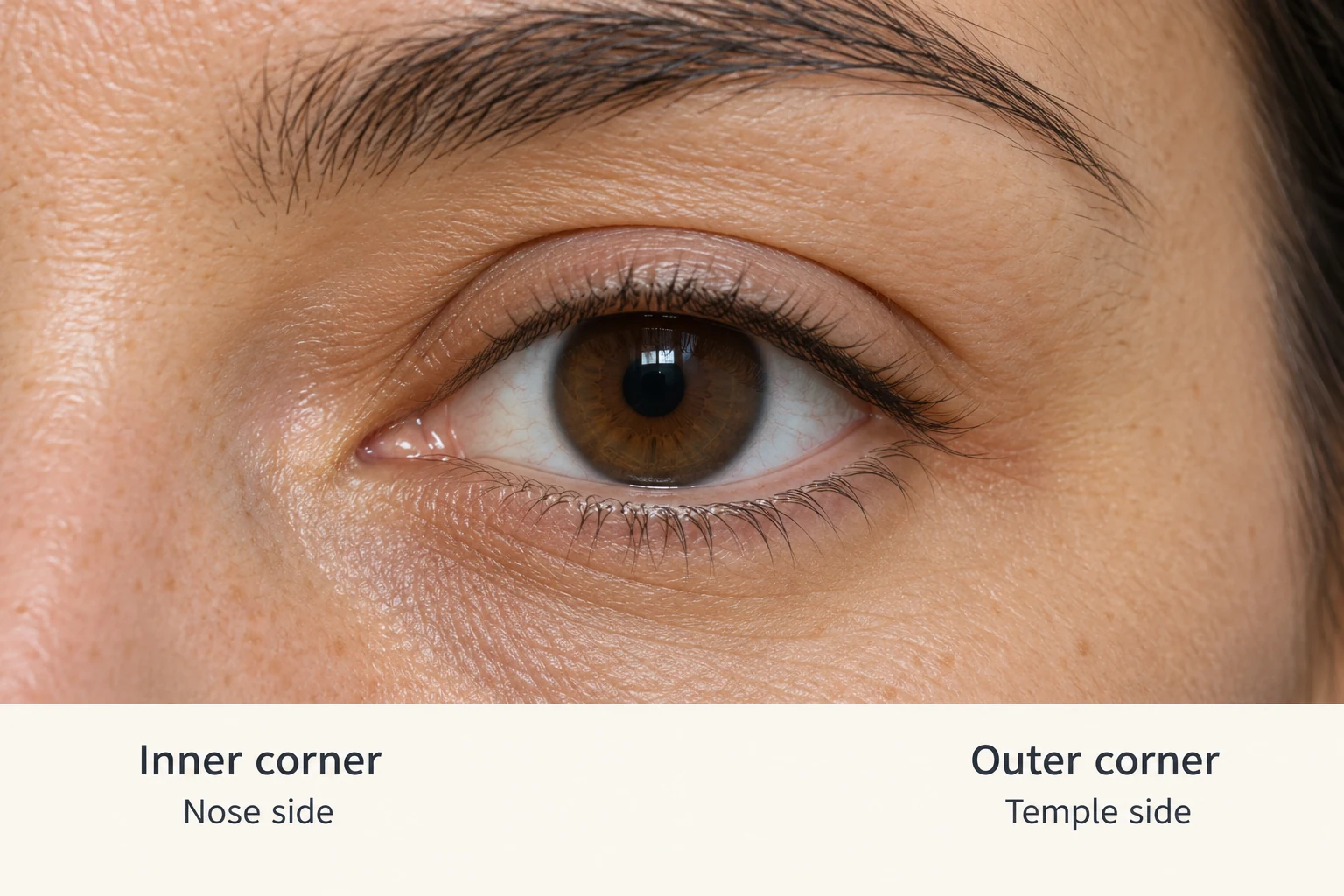
Negative canthal tilt describes a downward direction between the inner and outer eye corners, measured against a stated horizontal reference. The medial canthus is the inner corner near the nose; the lateral canthus is the outer corner near the temple. The opening between the eyelids is called the palpebral fissure. Its corner-to-corner direction is one dimension of the eye area, alongside width, opening height and the position of surrounding tissue. [1]
The corners are the points where the upper and lower eyelid margins meet. They are not the ends of an eyebrow, the eyelid crease, the longest eyelash or a makeup line. Choosing one of those instead changes what you measure, even if the resulting line looks convincing.
 View full-size image ↗
Direction must be defined separately for each eye. In a frontal image, the temple lies to the left for one eye and to the right for the other. A line that rises from left to right across the screen therefore does not have the same meaning on both sides. Always read from inner corner to outer corner.
A slight downward appearance may be part of a person’s usual anatomy. The number alone cannot identify its cause, show how the eyelids function, or rule out a condition. Those are different questions from whether a line in one photograph slopes up or down.
Where negative ends and neutral begins
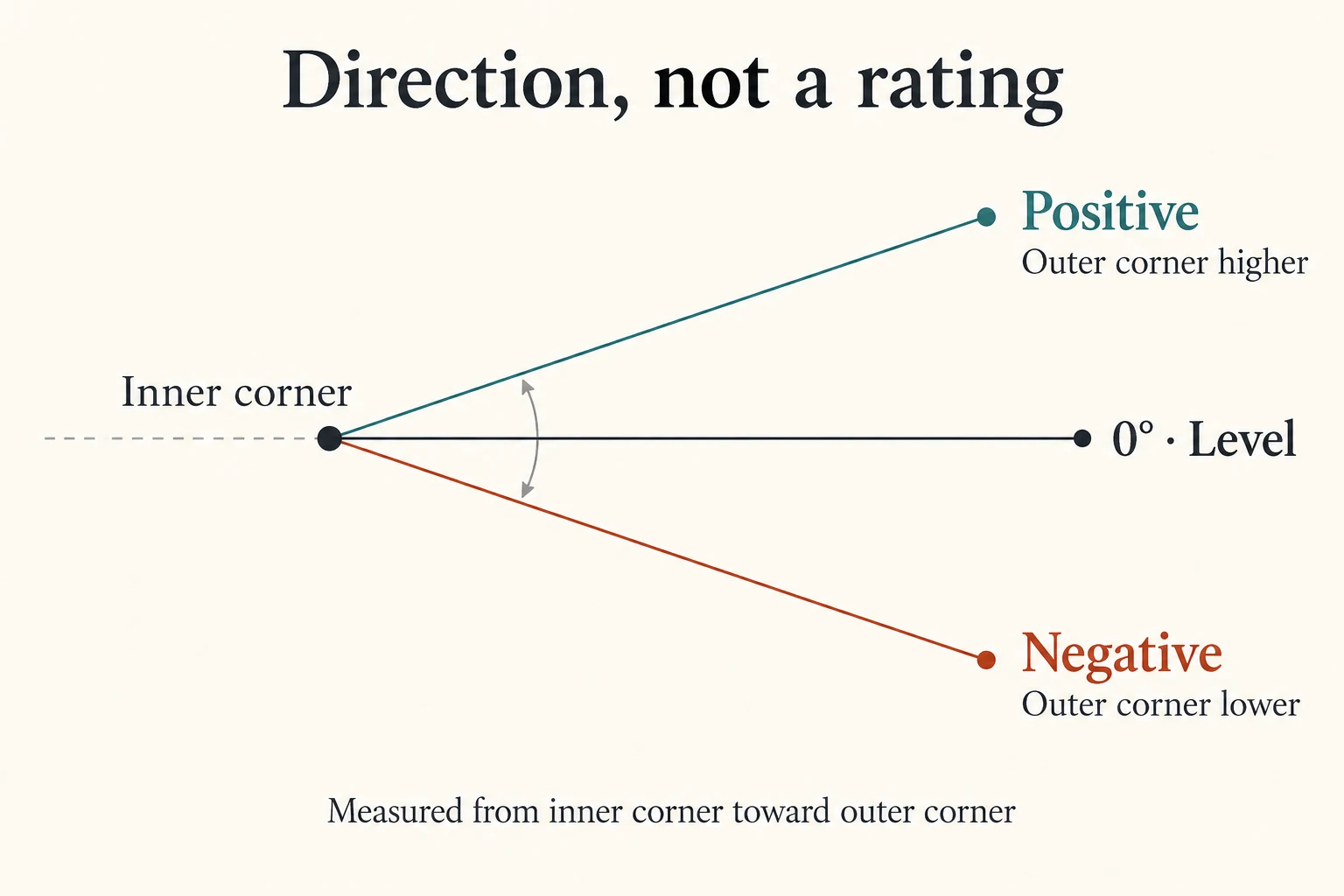
The geometric boundary for negative canthal tilt is zero degrees: below zero slopes downward, zero is level, and above zero slopes upward. These three directions do not establish ideal ranges or medical cutoffs.
| Direction | Angle | Meaning |
|---|---|---|
| Negative | Below 0° | The outer corner is lower than the inner corner. |
| Level | Exactly 0° | The corners lie on the chosen horizontal reference. |
| Positive | Above 0° | The outer corner is higher than the inner corner. |
FaceCoda’s displayed geometry bands use an experimental product reference: Negative below -1°, Neutral from -1° through +1°, and Positive above +1°. For example, -0.5° is mathematically negative but appears as Neutral in the tool’s buffer around zero. These bands are not clinical ranges, and they are separate from the experimental match score.
Neutral is often used informally for an appearance close to level. It should not be taken to mean that every photo can reliably distinguish exactly zero from a small positive or negative value. There is no universal neutral band established by this article, and the table is not a classification of health or attractiveness.
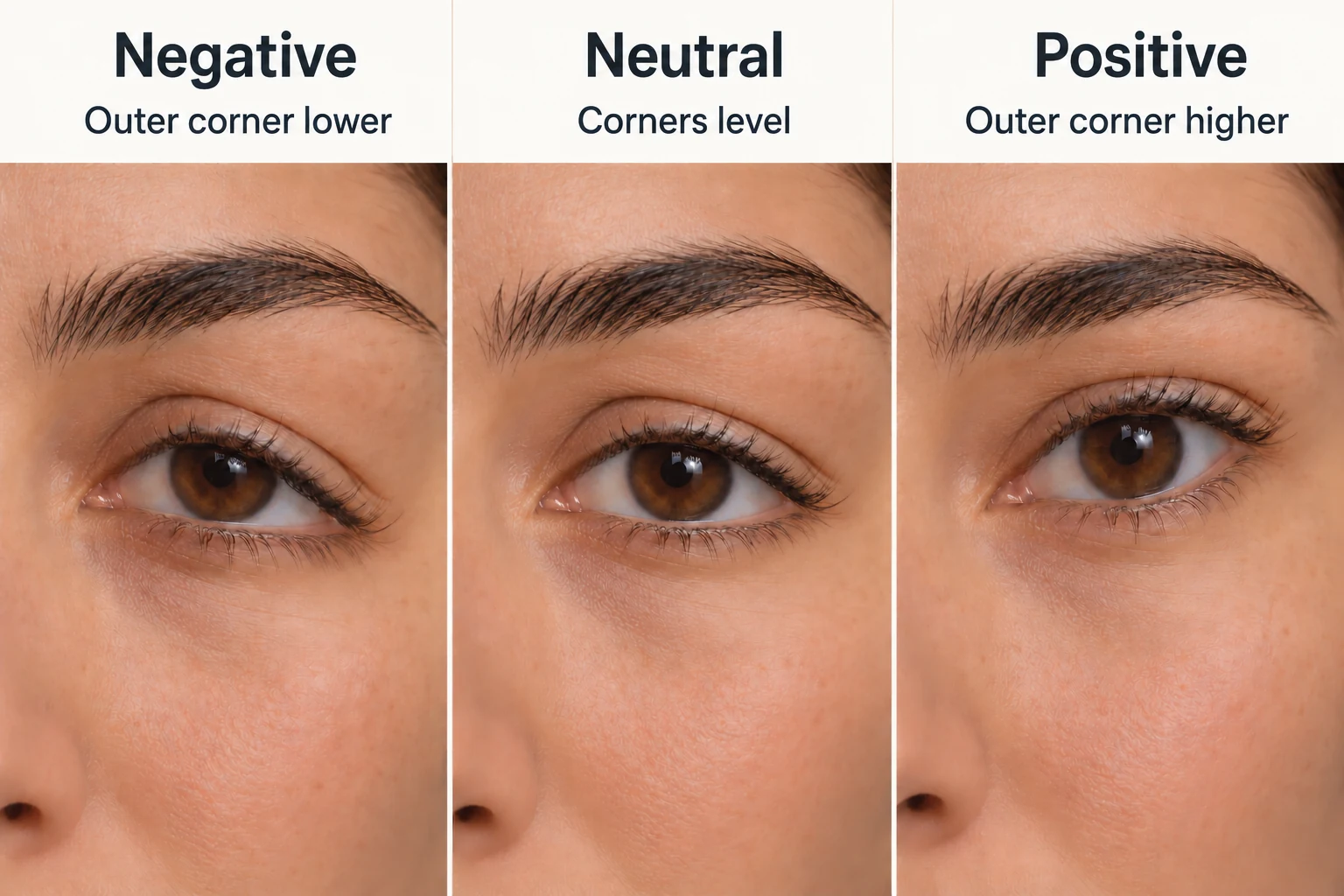
Near-zero readings deserve particular care. Moving a corner marker slightly or choosing a different reference can move a small angle across zero. A displayed decimal does not establish that the measurement is accurate to that decimal. Read the number together with the landmarks and photo conditions.
 View full-size image ↗
Population averages answer a different question. A study of one group, age range or measurement method cannot supply a universal target for every face. An average also does not tell you what proportion of that group has a negative value. [1][2]
For example, a study of 200 South Indian adults aged 18 to 26 reported average palpebral fissure inclinations of approximately 5.05° in men and 6.10° in women. Those are means from that sample, not the limits of a normal range. They cannot tell you how common negative angles are in another population or what an individual should measure. [1]
For the broader appearance vocabulary, the comparison of hunter eyes vs prey eyes explains why tilt is only one of several measurements. Neither informal label follows automatically from the sign of this angle.
How to measure your own canthal tilt
A useful photo reading starts with visible corners, a clear reference and an honest account of what the image cannot show. Measure each eye separately before considering any two-eye average.
1. Make the photograph easier to read
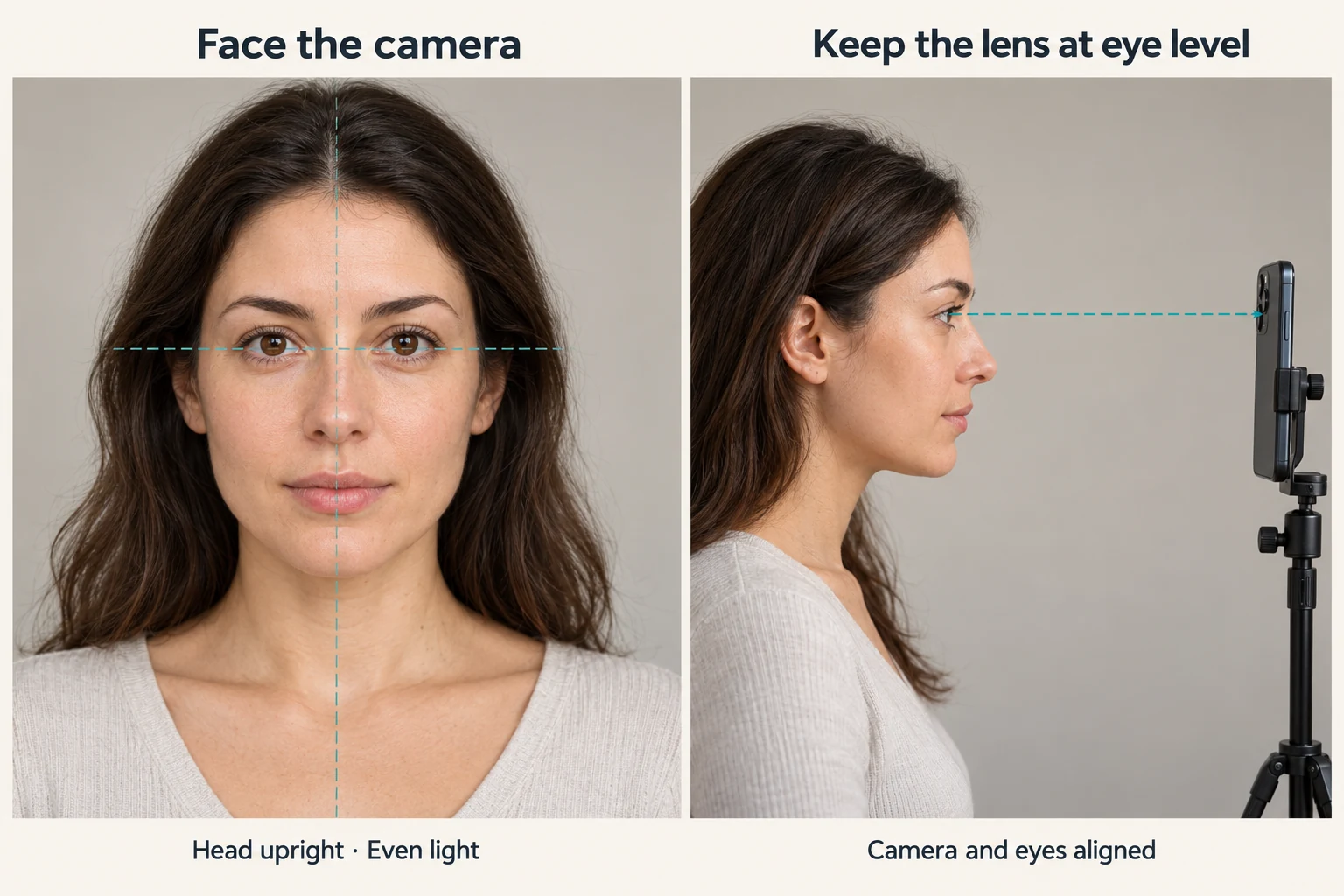
Face the camera straight on, keep it near eye level, and use even light that leaves both corners visible. Keep your head upright without deliberately lifting or dropping one side. Look forward with a relaxed expression and your eyes naturally open. Avoid squinting, raised brows, glasses that obscure landmarks, filters and extreme close-up framing.
These are practical ways to reduce avoidable variation, not a guarantee of an accurate anatomical measurement. Do not force your ears onto a horizontal line as though they were calibrated landmarks. The reference used for measuring the eyes needs its own explanation.
2. Mark the corners and choose horizontal
Place one marker at the inner corner and one at the outer corner of the same eyelid opening. Draw a horizontal reference through the inner marker. For a simple manual demonstration, this can be image horizontal after the photograph has been deliberately leveled. If you use another reference, record it; results using different reference directions need not agree.
Image roll means rotation within the plane of the photograph. It is different from turning your face sideways or looking up or down. A ruler placed across a rotated photograph does not by itself correct that rotation.
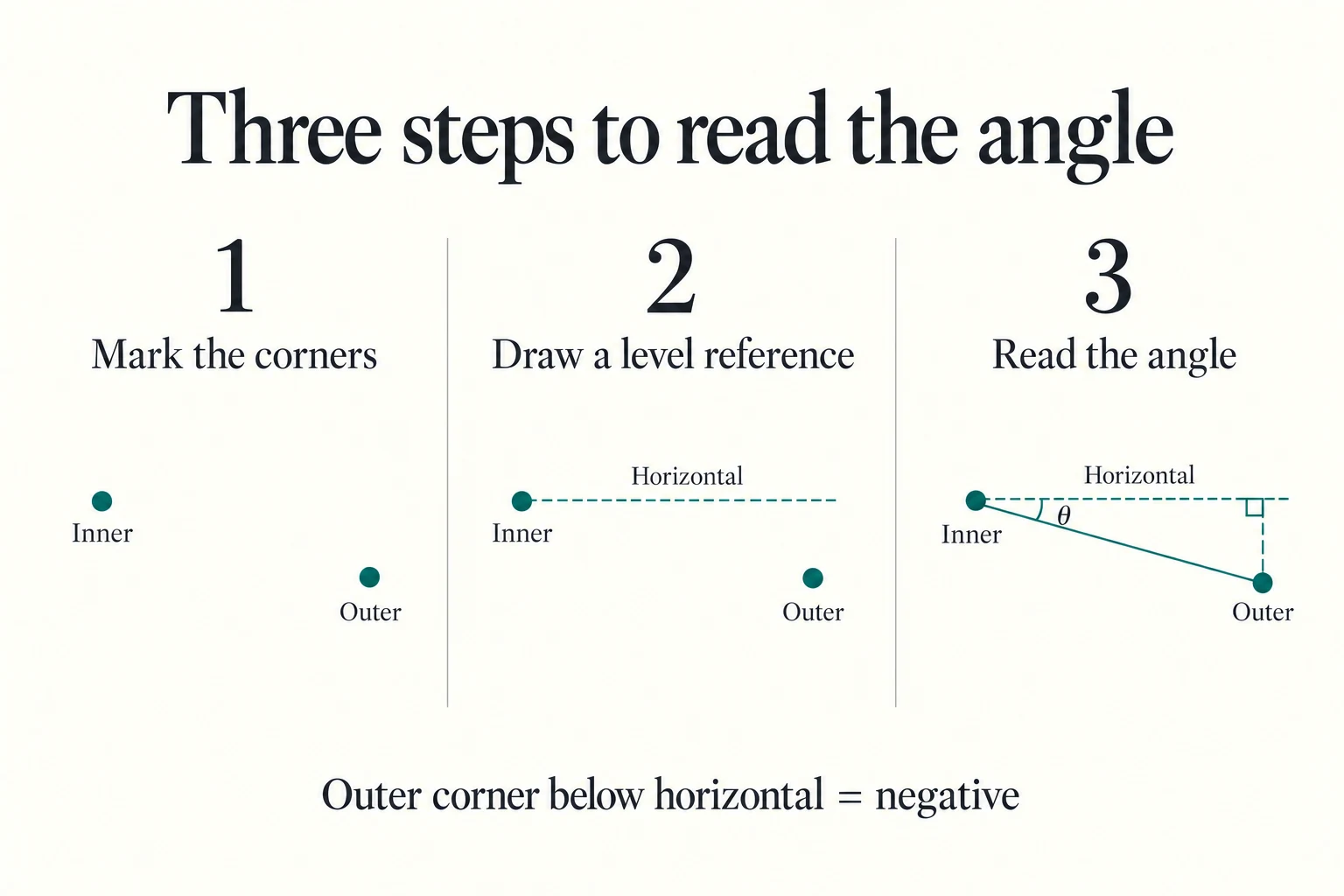
3. Convert the differences into degrees
In ordinary image coordinates, x increases to the right and y increases downward. After leveling the reference, define the horizontal distance as the absolute difference between the corner x coordinates. Define the signed rise as the inner corner’s y coordinate minus the outer corner’s y coordinate.
angle = atan2(y_inner - y_outer, abs(x_outer - x_inner)) × 180 / π
The absolute horizontal distance makes the same sign convention work for both eyes, including a mirrored photo. An outer corner above the inner gives a positive rise; an outer corner below it gives a negative rise. Dividing the vertical difference by the horizontal difference gives a slope, not an angle in degrees.
For example, a schematic outer corner five pixels lower across a horizontal distance of 100 pixels gives approximately -2.86°. That number illustrates the calculation only. It does not demonstrate the precision of a model or define a meaningful cutoff for a face.
The Hunter Eyes Test reports this angle in degrees alongside three other eye-area measurements and an experimental match score. It corrects two-dimensional image roll using estimated iris centers; it does not correct all perspective effects from looking up, down or sideways. Photo checks can reject some unsuitable inputs, but a returned number is not a guarantee that the photograph was ideal.
Choosing a file prepares a local preview. Pressing Measure sends the full photo for temporary server analysis, without requiring an account. The service uses temporary processing files and cleans them up after the request; this is not an analysis that stays entirely on your device. Processing time varies, particularly when the service is starting.
Is a negative canthal tilt bad?
Negative canthal tilt alone is not evidence of an unhealthy eye or a face that needs changing. It describes the positions of two corners relative to a reference. It cannot answer a broader question about how a person looks, feels or functions.
Online rankings often turn positive and negative into good and bad. The mathematical sign does not support that interpretation. A photograph contains expression, lighting, perspective and many other features, while personal preferences differ. Reducing the whole image to one directional label leaves out most of what the viewer is seeing.
FaceCoda’s match score is a separate product rule. It describes agreement with preset experimental curves across four measurements. It is not a percentage probability of having an eye type, a population percentile, an attractiveness rating or a medical assessment. A lower score does not show that a negative angle is a defect.
Reassurance also has limits. An appearance label cannot establish that vision is unaffected, that eyelid function is normal, or that a recent change is harmless. If you notice discomfort, difficulty closing an eye or a new change in lid position, an eye-care professional can assess the symptoms and anatomy directly. That assessment answers a different question from a photo tool. [5]
What causes it: two different stories
A longstanding negative canthal tilt and a newly noticed change need different context, but one photograph cannot establish the cause of either. The eye area includes bone, eyelids, supporting structures and surrounding soft tissue; a two-dimensional angle does not isolate their contributions.
| Question | Longstanding appearance | Newly noticed change |
|---|---|---|
| Useful context | Whether similar features appear in comparable older photographs. | When the change appeared, whether one or both sides changed, and any symptoms. |
| Photo limitation | Different poses and camera conditions can create apparent differences. | An angle cannot distinguish a photographic effect from an anatomical change. |
| What it cannot establish | A particular bone shape or a permanent, unchangeable cause. | An aging diagnosis or a specific tendon or eyelid problem. |
Changes around the eyes can occur with aging, but that does not justify assigning a fixed starting age or predicting the same direction and amount of change for everyone. Adult facial structures are not simply frozen once development ends. Nor does a negative reading tell you which tissue changed. [3][4]
An old and a new photograph can be useful context, provided their differences are acknowledged. Compare framing, expression and reference direction before attributing a different angle to aging. If the concern is a real change in comfort or function, collecting more appearance scores will not explain it.
Why the internet’s celebrity lists don’t agree
Lists of celebrities with negative canthal tilt can disagree because their photographs and classification rules differ, even when the same person appears in both. A red-carpet image, a film still and a close selfie do not provide interchangeable measurement conditions.
One photograph may show a turned head, another a tilted camera, and another an expression that changes how the eyelid opening looks. Makeup or shadow can obscure the actual corners. A caption rarely explains which landmarks were marked or what counted as horizontal.
That is enough to make a confident label difficult to audit. The useful question is whether the particular example provides a suitable image, a documented method and a result that can be checked.
This article uses illustrations instead of assigning a negative canthal tilt to named people. The drawings can make a downward line obvious without pretending to diagnose a face. Their purpose is to help you understand the geometry, not choose someone else’s appearance as a target.
What can and cannot be changed
A changed reading does not by itself prove that the anatomy changed. Separating the photograph from the person is the most useful starting point.
Photographic conditions can change. Camera position, perspective, expression and landmark visibility can affect the estimate. Correcting image roll addresses one source of variation, not all of them. Repeating a photo under similar conditions is more informative than comparing unrelated selfies, but it still does not establish clinical accuracy.
The eye area can change over time. Anatomy and soft-tissue appearance are more complex than a fixed angle or a simple bone-versus-skin distinction. A photograph cannot tell you which structure is responsible for a difference, whether it is temporary, or what would happen next. [3][4]
An exercise claim needs evidence of its own. A different before-and-after picture does not prove that massage, taping, a facial habit or a change in posture altered the eye corners. Lighting, expression and camera placement must be accounted for before attributing a new number to a proposed intervention. This article does not recommend those methods.
Clinical procedures involving eyelid support exist, but a negative angle alone does not establish a reason to pursue one. Questions about symptoms, treatment or risks require an individual assessment by a qualified clinician. [5] For the purposes of this page, the angle remains a limited description of a photograph, not a treatment target.
FAQ
What does negative canthal tilt mean?
It means the outer eye corner sits lower than the inner corner relative to the chosen horizontal reference. The line slopes downward from nose to temple. Negative describes the direction of an angle, not a grade for a person's face.
Is a negative canthal tilt bad?
A negative angle alone does not establish a health problem or an unattractive face. A photo reading also cannot rule out an eye or eyelid condition. New changes, discomfort or trouble closing an eye deserve an assessment based on symptoms rather than an appearance label.
What degree counts as a negative canthal tilt?
Geometrically, an angle below 0° is negative, exactly 0° is level, and an angle above 0° is positive. Near-zero photo readings need caution because landmark placement and the reference direction affect the result. These directions are not clinical categories or ideal ranges.
Can you change a negative canthal tilt?
Changing a photo, expression or camera position can change a reading without demonstrating an anatomical change. The angle alone cannot tell you what contributes to the appearance or whether treatment is appropriate. This page does not recommend exercises, procedures or appearance modification.
Is negative canthal tilt more common in men or women?
The sources used here do not establish a universal prevalence comparison. Group averages from a particular sample do not show how common negative angles are in everyone. Population, age and measurement method matter, and a group average cannot classify an individual.
Is negative canthal tilt a medical term?
The angle and the position of the inner and outer eye corners are anatomical measurements discussed in clinical literature. A negative angle describes direction; it is not a diagnosis on its own. Online good-or-bad rankings add a judgment that the number itself does not provide.