
Hooded eyes
Hooded eyes have a fold of upper eyelid skin that partly or fully covers the crease when the eyes are open. The description concerns a fold, rather than eye size, beauty or a diagnosis. It can be part of someone’s usual appearance, but a new change needs a different kind of attention.
This guide helps you separate a covered crease from a deep eye socket, a monolid and a downward outer corner. The photo-style illustrations are AI-generated educational examples, not photographs of participants or clinical cases.
What hooded eyes are
Hooded eyes describe an upper eyelid fold that overlaps the crease and reduces the visible strip of lid above the lashes. The crease is the line along which the upper lid folds; the mobile lid is the surface between that crease and the lash line. With a relaxed, open eye, an overlying fold may conceal only the outer part or most of this surface.
A crease can therefore exist without being obvious in a frontal photograph. Anatomical descriptions distinguish a visible crease, a low or hidden crease and an eyelid without an externally visible crease. These appearances form a varied landscape, rather than a clean division into two kinds of people. [1]
Hooding does not mean small eyes. A person can have a wide eyelid opening and little visible mobile lid, or a narrower opening with a clearly visible crease. Those observations describe different features. Neither tells you how well the eye sees or how the eyelid functions.
It also does not simply mean puffiness. Swelling may temporarily change the appearance around a fold, while a familiar skin-fold pattern can remain over years. Do not assume that new swelling, discomfort or a sudden change is just your usual eye shape.
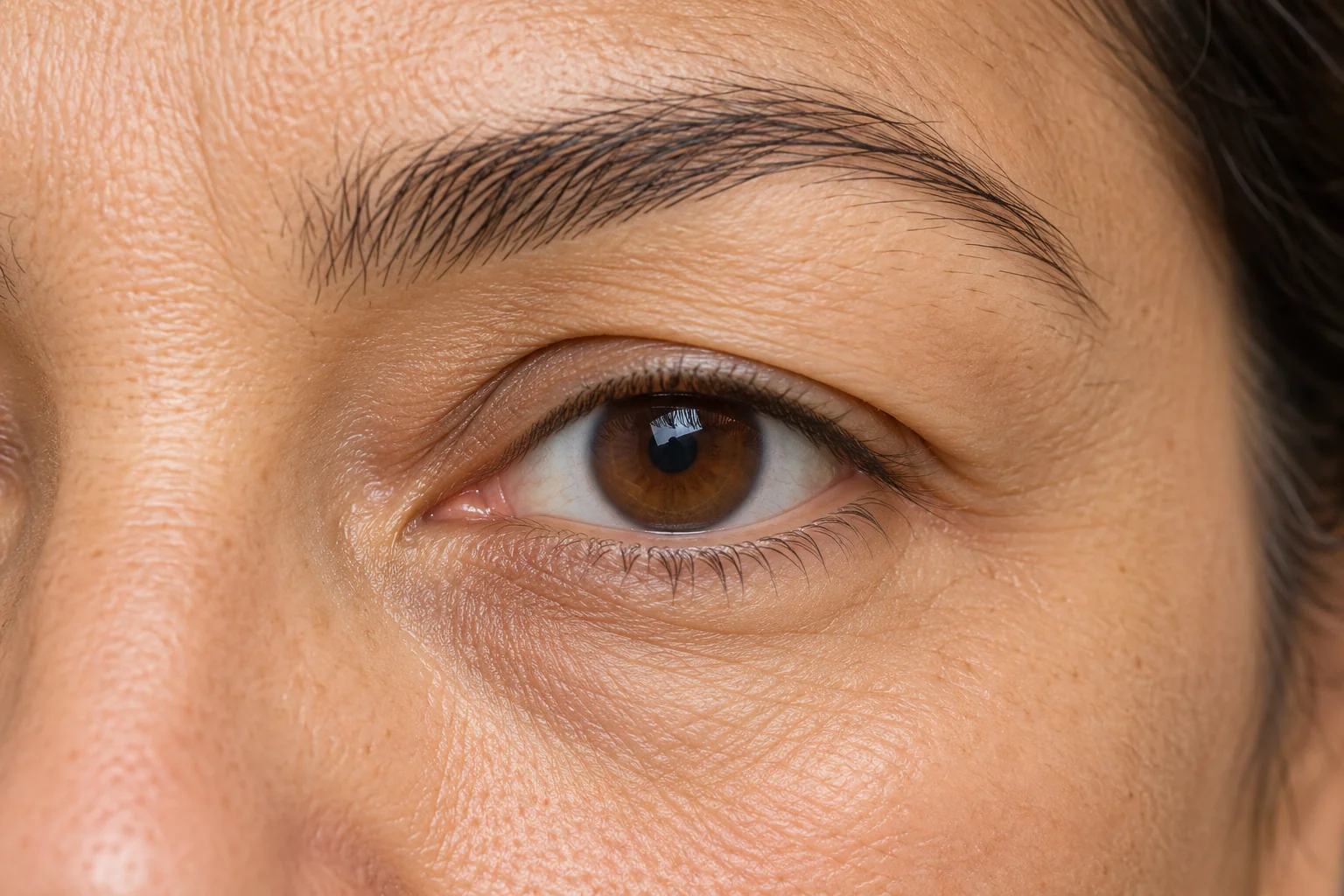
For a useful description, name the feature you can actually see: a fold hiding the outer crease, for example. Keep that observation separate from eye depth, corner direction and the position of the lash-bearing lid edge. That separation is more informative than trying to fit every eye into one label.
How to tell if you have hooded eyes
A clear photograph can help you notice a covered crease, but it cannot diagnose an eyelid condition. The aim is to observe the fold without confusing a shadow, expression or camera angle with anatomy.
1. Make the photograph easier to read
Face the camera straight on with your head upright and the lens near eye level. Use soft, even light from the front. Keep your eyes naturally open and relax your eyebrows; deliberate squinting or raising the brows changes the visible lid surface. Avoid filters, makeup lines that hide the crease, extreme close-ups and glasses that obscure the upper lid.
Use the ears as a general framing cue, not as a calibrated horizontal ruler. Natural asymmetry means their positions need not match perfectly. If one image is unclear, take another in steadier light instead of forcing a classification.
2. Find the crease and the overlying fold
Look just above the lashes for a separate crease, then notice whether skin from above overlaps it. Compare the inner and outer portions rather than judging only the darkest line. Looking gently downward may make a crease easier to notice, but it changes the view and is not a substitute for the relaxed, straight-on image.

3. Describe what remains uncertain
A visible inner crease with an outer overhang can be described directly. If no crease can be seen, a hidden crease and a monolid may be difficult to distinguish in that photograph. Do not pull or press on the eyelid to turn this into a home diagnostic test. An uncertain image should produce an uncertain description.
4. Separate other eye-area features
Check depth and corner direction independently of the fold. For additional geometry, the Hunter Eyes Test reports canthal tilt, upper iris coverage, eye height-to-width ratio and brow-to-eye distance. It does not measure crease coverage or determine whether eyes are hooded.
Selecting a photo creates a local preview; choosing Measure sends it for temporary server analysis without an account. These measurements cannot diagnose ptosis, establish normal vision or guarantee that a photograph was suitable. Use the fold observation and the separate measurements for different questions.
Hooded vs deep-set, monolid, almond and downturned
Hooded, deep-set, monolid and downturned describe different features that can overlap in the same person. The most useful comparison asks which feature each word refers to, rather than which single box your whole face belongs in.
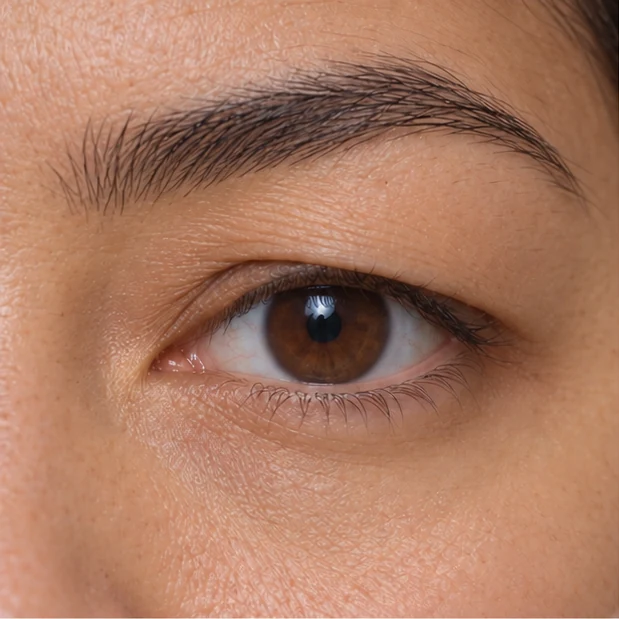
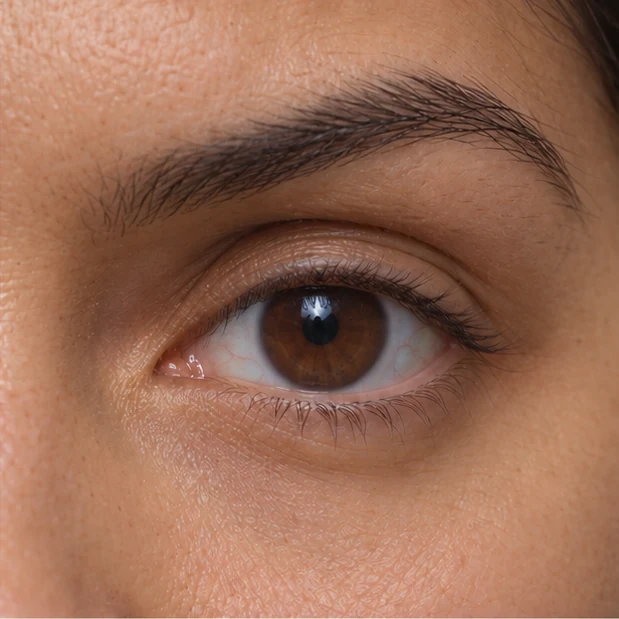
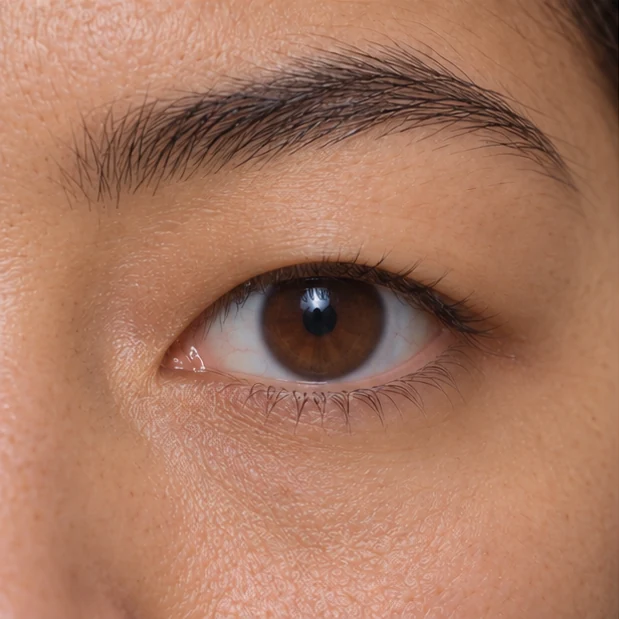
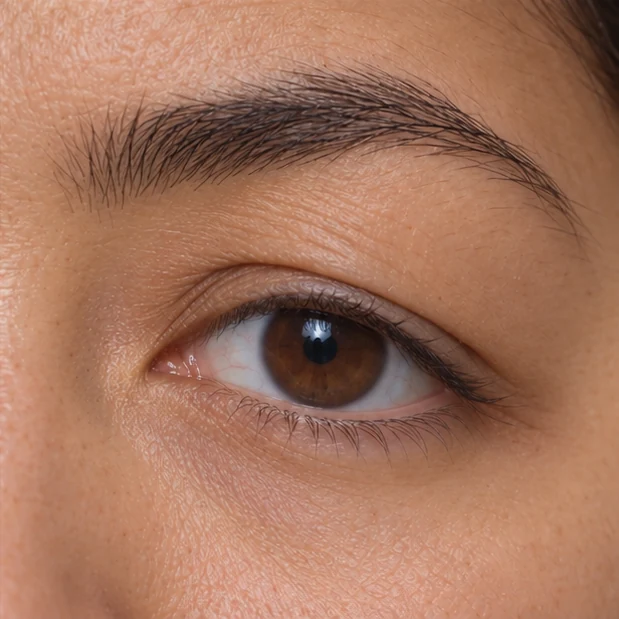
AI-generated educational illustrations show isolated concepts under matched framing. Markers indicate a feature to notice, not a measurement. These are not real samples, clinical classifications or evidence that the features are mutually exclusive.
In the hooded example, the skin overlap is the feature to notice. In the deep-set example, the brow-to-eye transition looks more recessed while a crease and mobile lid remain visible. Even in a real photograph, a frontal view does not measure the depth of the bony socket. The monolid example removes a separate visible crease. The downturned example changes the corner direction while retaining a visible crease. Each illustration emphasizes one observation, so none represents every possible combination.

Swipe the table to compare all four columns.
| Crease and description | Upper lid skin | Eye depth | Common confusion |
|---|---|---|---|
| HoodedA crease is partly or fully covered. | An overlying fold obscures some mobile lid. | Not determined by hooding. | A hidden crease can resemble a monolid in a single view. |
| Deep-setA crease may remain visible or may also be covered. | Overlap is a separate question. | The eye appears farther back within the surrounding socket. | A brow shadow can be mistaken for a skin fold; hunter eyes vs prey eyes discusses other separate measurements. |
| MonolidNo separate crease is externally visible. | The upper lid looks continuous rather than divided by a visible crease. | Not determined by the visible crease. | A very low or hidden crease can be hard to distinguish from this appearance. |
| DownturnedThe crease does not define this description. | May be covered or visible. | Not determined by corner direction. | The outer corner sits lower; negative canthal tilt explains that separate directional measurement. |
These are descriptive labels, not clinical categories.
Hooded is a covered crease, deep-set is a deep eye with a clear crease, monolid is no crease at all, and downturned is an outer corner that travels downward. These are different dimensions, and more than one can be true of the same eye.
Read that memory aid as a simplified comparison, not a diagnostic rule. In particular, a clear crease is shown to isolate depth in this illustration; it is not required for an eye to be deep-set. A deep-set eye can also have a covered crease. Here, no crease means no externally visible, separate crease, rather than a claim about every underlying tissue attachment. [1]
Almond describes the overall outline of the eyelid opening, usually an elongated shape that narrows toward the corners. It does not state whether a crease is visible, how far the eye sits back or whether the outer corner rises or falls. That is why it belongs in this paragraph rather than as a competing row in the comparison: an almond-shaped opening can be described alongside a hooded upper lid.
For a careful self-description, start with the fold, then add depth and direction only when you can see them clearly. If the brow creates a dark area but the crease remains visible, do not rename that shadow hooding. If the corners slope downward, do not infer anything about the crease. Keeping those observations separate avoids the common mistake of using one feature as proof of another.
What causes hooded eyes
A hooded appearance can reflect a longstanding fold pattern, gradual tissue changes or the position of the brow above the lid. Those explanations concern different structures and timelines, and a photograph alone cannot establish which contributes most.
| Factor | What may change the appearance | How to interpret it |
|---|---|---|
| Individual anatomy | The arrangement of a crease, overlying skin and surrounding tissue. | A familiar pattern may be visible in photographs over many years. |
| Changes with age | Reduced skin elasticity and changes in supporting tissue can increase an overhang. | The amount and timing vary; there is no birthday cutoff. |
| Brow position | A lower brow can bring more tissue toward the upper lid. | Brow position and lid-margin position need separate assessment. |
Dermatochalasis is the clinical term for loose, redundant eyelid skin. It is associated with aging and can involve several surrounding tissues, rather than skin alone. Family predisposition also matters. The word hooded is broader and more informal, so using it does not establish that diagnosis. [2]
Comparing older and newer photographs may reveal a gradual change, but first compare the pictures themselves. An overhead light, a raised eyebrow or a different camera distance can alter how much crease is visible. A changed photograph is not automatically evidence of changed anatomy.
There is no universal age at which hooding begins, and an individual fold pattern should not be assigned to a sex or ethnicity from appearance alone. Descriptions from one population or clinical sample do not provide a reliable frequency estimate for everyone.
Timing is more useful than guessing a cause from a label. A gradual, familiar appearance and a newly drooping eyelid are different situations. New swelling, a sudden change or a change affecting vision belongs in an assessment of symptoms, even if the crease also looks covered. [4]
Are hooded eyes attractive?
A covered crease does not determine whether a face is attractive. It describes where skin sits, without providing a scale for beauty or a reason to change a face.
A photograph also includes expression, gaze, lighting, skin texture and the rest of the face. People respond to those features together and bring different preferences to the image. Extracting one lid fold and declaring it an advantage or a flaw is an opinion, not a conclusion supplied by this description.
Styling advice often gives the word an unnecessarily negative tone. A technique designed around a large visible mobile lid may look different when a fold covers that surface. That difference concerns the technique’s assumptions. It does not turn the underlying fold into a defect, nor does difficulty following a tutorial establish anything about attractiveness.
The same caution applies to lists that praise a feature as an ideal. Replacing a negative ranking with a positive ranking still treats one detail as a verdict about a person. This guide does neither, and it does not use named faces as evidence.
A more useful question is whether the word accurately describes the visible crease. Once that is clear, you can use it as ordinary vocabulary without treating the label as a score. Health questions should be considered from symptoms and function, rather than from whether an appearance is currently popular.
Types of hooded eyes
Partial and full hooding are descriptive reading bands for how much of a crease appears covered, not standardized diagnoses. They help describe an image while leaving room for an uncertain view.
| Reading band | Observation | Limit |
|---|---|---|
| Partly covered | An inner crease is visible while an overlying fold hides another portion. | The overlap may differ between the two eyes. |
| Mostly or fully covered | Little or no separate crease is visible with the eye naturally open. | A hidden crease and a monolid can look similar. |
| Uncertain view | Shadow, expression or framing obscures the skin overlap. | Use a clearer image rather than assigning a category. |
These bands are our own reading bands, not a medical standard.
Hidden crease describes visibility and can overlap with the first two bands; it is not a separate cause. The table has no percentage thresholds, severity score or treatment implication. Descriptions may change with gaze and photograph conditions, so they should not be treated as permanent classifications of a person.
Hooded eyes vs ptosis: the difference that matters
Hooding concerns an overlying skin fold, while ptosis concerns a lowered upper eyelid margin; they can occur together. The margin is the edge from which the lashes grow, and its position is separate from the visibility of the crease.
In ptosis, that margin sits lower over the eye than it should. The upper eyelid may droop a little or cover enough of the pupil to affect vision. There are different causes and timelines, which an eye examination helps distinguish. [3]

Excess skin can also interfere with the upper or side field of vision. It is therefore incorrect to say that only ptosis can affect sight or that a hooded appearance never needs assessment. A person may have both a skin overhang and a low lid margin, or another explanation for a new change. [2]
Do not use a fingertip lift, an edited image or an online comparison as a test that rules out ptosis. Moving skin can also move surrounding tissue, and a photograph does not establish lid-muscle function, pupil responses or a visual field. When there are symptoms, the next step is an appropriate assessment rather than a more confident appearance label.
When the change needs medical attention
- Sudden onset: a newly drooping eyelid, especially over hours or days, needs urgent medical advice.
- A new change on one side: have a newly asymmetric or one-sided droop assessed; do not assume it is ordinary hooding.
- Vision interference: a fold or lid edge that obstructs sight, or difficulty opening or keeping an eye open, needs assessment.
- Other symptoms: drooping with new double vision, eyelid or facial weakness, weakness elsewhere, or difficulty chewing or swallowing needs prompt medical attention.
Seek emergency help immediately for sudden face or arm weakness or trouble speaking, and for severe or worsening breathing or swallowing difficulty. Do not wait for a routine eye appointment, even if sudden neurological symptoms improve. These examples are not a checklist for excluding a serious cause. [4][5][6]
This page cannot diagnose the reason for a low-looking lid, and the generated illustrations do not show clinical cases. A familiar crease pattern should not be used to dismiss a new symptom. An eye-care professional can assess skin, brow, lid margin, eye movements and vision together, which is more than an appearance comparison can establish.
Makeup and surgery: what this page does not cover
This page explains eyelid appearance; it does not teach makeup techniques or recommend any surgical procedure. Those subjects require different expertise and, for medical decisions, an individual assessment.
A covered crease can change the surface available for a styling technique. That is enough to explain why a tutorial may not translate between different lids. No eyeliner instructions, product suggestions or beauty-treatment links are provided here.
A description is also not a treatment indication. Knowing that a fold covers a crease does not tell you whether an intervention is needed, appropriate or likely to achieve a particular result. Symptoms and questions about eyelid function belong with a qualified clinician.
The purpose is narrower: identify the visible feature, distinguish the commonly confused terms and recognize when a new change is outside a guide’s scope. For the broader context, the FaceCoda face-geometry overview explains the separate features our tools describe. No measurement should replace an assessment of a symptom or turn ordinary variation into a flaw.
FAQ
Hooded eyes describe a covered crease, not a diagnosis or an attractiveness grade.
What is the difference between hooded eyes and deep-set eyes?
Hooded describes skin covering an upper eyelid crease, while deep-set describes the eye's position in the socket. A deep-set eye may have a visible crease or may also be hooded. Brow shadow alone does not establish either description.
Do I have hooded eyes or monolids?
A monolid has no externally visible, separate upper eyelid crease. A hooded eye has a crease that an overlying fold partly or fully hides. A single photograph may not distinguish a hidden crease from an absent visible crease, so an uncertain result should stay uncertain.
Are hooded eyes rare?
A covered crease is a variation of eyelid appearance, not evidence that your eyes are abnormal. The sources used here do not establish a worldwide prevalence rate for the informal label hooded eyes. Definitions, age and the population studied matter when interpreting frequency claims.
Can hooded eyes change over time?
Yes. Gradual changes in skin elasticity, supporting tissue and brow position can change how much of the crease is visible. Lighting, expression and camera position can also change a photograph without changing anatomy. Sudden or newly one-sided drooping needs medical assessment.
Are hooded eyes the same as ptosis?
No. Hooding describes an overlying skin fold; ptosis describes a lowered upper eyelid margin. They can coexist, and either excess skin or a low lid margin may affect vision. A photo or appearance label cannot rule out an eyelid condition.
How do I know if my eyes are hooded?
Look at a clear, straight-on photograph with your head upright, eyes naturally open and brows relaxed. Notice whether upper eyelid skin overlaps and hides a separate crease. Compare the crease with the fold, rather than judging brow shadow or corner direction. This is an observation of appearance, not a diagnosis.