

Almond Eyes: What They Are and How to Tell
Almond eyes are wider than they are tall, taper to softly pointed inner and outer corners, and usually sit level or very slightly lifted at the outer corner. Here is what that looks like in measurements, how to check your own eyes, and how almond eyes differ from round and upturned eyes.
Measure your eye tilt from a photo →Free, in your browser. Your photo is not uploaded.
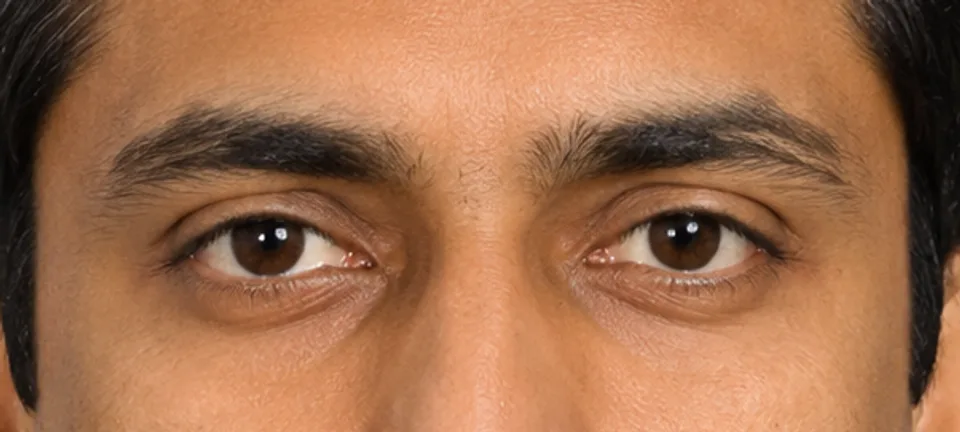
AI-generated example. Measured tilt +4.0°, eye ratio 0.33.
- Eye opening about a third of the eye's width
- Inner and outer corners taper to a point
- Iris touches or nearly touches both lids
- Corners level or the outer corner slightly higher
What are almond eyes?
Almond eyes take their name from the nut: an elongated oval that narrows to a point at both ends. The eye is clearly wider than it is open, the lids curve gently from corner to corner, and the corners themselves are pointed rather than rounded. In most almond eyes the iris touches the upper lid, the lower lid or both, so little white shows above or below it.
Almond is the most frequently described eye shape in makeup and beauty guides, partly because it is a broad category. It overlaps with other descriptions: an almond eye can also be upturned, hooded or deep-set, because those terms describe the angle, the lid and the depth rather than the outline.
How to tell if you have almond eyes
Look straight into a mirror or a front camera at eye level, with a relaxed face:
- Compare how wide each eye is from corner to corner with how open it is at its tallest point. Almond eyes are roughly three times as wide as they are open.
- Look at the corners. Almond eyes narrow to a point at both ends instead of curving round.
- Check how much white shows around the iris. If the iris touches both lids, the eye leans almond; if white shows all around it, it leans round.
- Imagine a line from the inner to the outer corner. If it is level or rises slightly toward the temple, the eye is almond; if it rises clearly, it is also upturned.
Almond eyes next to the other eye shapes
Each example eye was measured by the same analyzer our tools use. Tilt is the angle from the inner to the outer corner, levelled on the line between the irises; the eye ratio is how open the eye is compared with its width; brow-to-lid space is the distance from the lower edge of the brow to the upper lid, also compared with the width.
| Measurement | Almond eyes | Deep-set eyes | Downturned eyes | Upturned eyes |
|---|---|---|---|---|
| Corner-to-corner tilt | +4.0° | +4.0° | −1.9° | +9.9° |
| Eye ratio (opening ÷ width) | 0.33 | 0.31 | 0.23 | 0.39 |
| Brow-to-lid space ÷ width | 0.46 | 0.34 | 0.72 | 0.64 |
Almond vs round and upturned eyes
Round eyes are more open: the lids arch higher, the corners are softer, and white often shows above or below the iris. Almond eyes are longer and narrower for the same width.
Upturned eyes describe an angle, not an outline. An almond eye whose outer corner sits clearly above the inner corner is both almond and upturned. The example on this page measures +4.0° from corner to corner, close to the few degrees most adults show, which is why it reads as almond rather than strongly upturned.
Makeup and glasses for almond eyes
Because almond eyes are already balanced in length and opening, makeup guides treat them as a shape that suits most techniques: winged liner that follows the upper lash line, shadow blended into the crease, or a simple tightline. The common advice is to follow the eye's natural taper rather than change it.
For glasses, most frame shapes work. Frames whose top edge follows the brow line keep the eyes centred in the lens.
What a photo can and cannot tell you
A photo shows the outline and the angle of the eye, which is enough to judge almond against round and to measure tilt. Expression changes both: smiling narrows the eyes and lifts the lower lids, and looking up or down changes how much of the eye shows. For a reading you can compare, look straight into the camera at eye level with a relaxed face. The Hunter Eyes Test measures your eye shape ratio, and the canthal tilt calculator measures the corner-to-corner angle of each eye.
Frequently asked questions
01What does it mean to have almond eyes?
It describes the outline of the eye: wider than it is tall, tapering to pointed corners, usually level or slightly lifted at the outer corner. It is a description of shape, not a measure of attractiveness.
02Are almond eyes rare?
No. Almond is one of the most commonly described eye shapes. There is no reliable population count, because eye shape categories are informal and overlap.
03Can you have almond eyes and hooded eyes at the same time?
Yes. Almond describes the outline of the eye; hooded describes a fold of skin over the upper lid. Many people have both. See hooded eyes for how to tell.
04What is the difference between almond and upturned eyes?
Almond describes the outline, upturned describes the angle. An almond eye whose outer corner sits clearly higher than the inner corner is both.