

Upturned Eyes: What They Are and How to Tell
Upturned eyes have outer corners that sit noticeably higher than the inner corners, so the eye slants up toward the temples, a look often called cat-eye. Here is how upturned eyes measure, how to check your own, and how they differ from almond eyes.
Measure your eye tilt from a photo →Free, in your browser. Your photo is not uploaded.
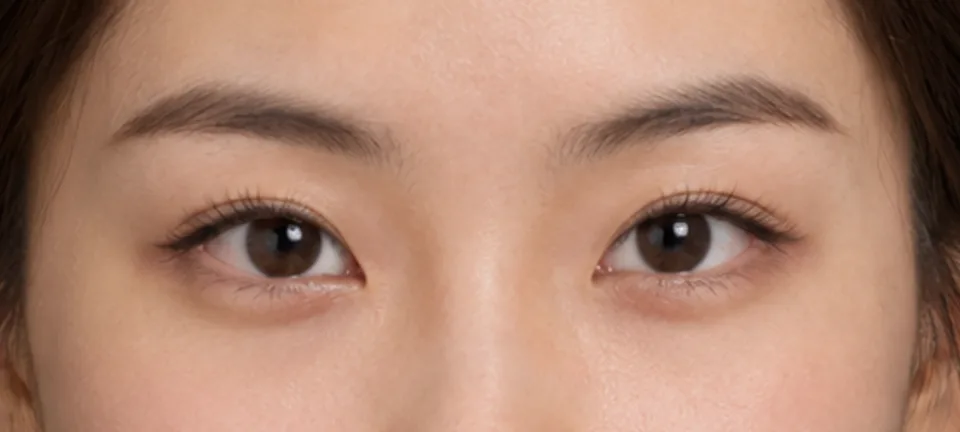
AI-generated example. Measured tilt +9.9°, eye ratio 0.39.
- Outer corner clearly above the inner corner
- Lower lash line curving up toward the temple
- A positive corner-to-corner angle well above average
- Often described as cat-eye or lifted
What are upturned eyes?
An eye is upturned when its outer corner sits clearly higher than its inner corner, so a line from corner to corner rises toward the temple. The lower lash line often curves upward at the outer end, which is the easiest way to spot the shape. In measurement terms it is a strongly positive canthal tilt.
Because most adults already have outer corners a few degrees above the inner corners, upturned describes eyes where that lift is noticeably larger than usual. It is an angle, not an outline, so upturned eyes can also be almond, round, hooded or deep-set.
How to tell if you have upturned eyes
Look straight into a mirror or a front camera with your head level:
- Find the inner and outer corner of one eye and imagine a line between them.
- If the outer end rises clearly above the inner end, and the lower lash line curves up toward the temple, your eyes are upturned.
- If the line rises only slightly, your eyes are in the common range and may be better described by their outline, such as almond.
- For a number, the canthal tilt calculator measures each eye's angle from a photo and corrects for head tilt.
Upturned eyes next to the other eye shapes
Each example eye was measured by the same analyzer our tools use. Tilt is the angle from the inner to the outer corner, levelled on the line between the irises; the eye ratio is how open the eye is compared with its width; brow-to-lid space is the distance from the lower edge of the brow to the upper lid, also compared with the width.
| Measurement | Almond eyes | Deep-set eyes | Downturned eyes | Upturned eyes |
|---|---|---|---|---|
| Corner-to-corner tilt | +4.0° | +4.0° | −1.9° | +9.9° |
| Eye ratio (opening ÷ width) | 0.33 | 0.31 | 0.23 | 0.39 |
| Brow-to-lid space ÷ width | 0.46 | 0.34 | 0.72 | 0.64 |
How upturned eyes measure
The example on this page measures +9.9°, about twice the angle of our almond example (+4.0°) and far from the downturned one (−1.9°). Published studies report average adult tilts of a few degrees positive, so a reading near ten degrees is clearly lifted.
Head position matters for small angles. Tilting the head sideways tips both eyes, which is why our tools level the measurement on the line between the irises. Smiling also pushes the lower lids up and can make eyes look more upturned than they are at rest.
Upturned vs almond eyes
Almond describes the outline: an elongated eye tapering to pointed corners. Upturned describes the angle: how far the outer corner rises. An eye can be both, and many upturned eyes are almond-shaped. The difference is the lift: almond eyes sit level or slightly lifted, upturned eyes clearly slant up.
Makeup and glasses for upturned eyes
Upturned eyes already carry lift, so makeup guides often suggest balancing it: liner that follows the lower lash line at the outer corner, or shadow that extends outward rather than sharply upward. Strong upward wings add to the lift and give a dramatic cat-eye look, which is a matter of taste.
For glasses, frames with a straight or gently curved top edge balance the slant; cat-eye frames emphasise it.
Frequently asked questions
01What do upturned eyes mean?
The outer corners of your eyes sit noticeably higher than the inner corners, so the eyes slant up toward the temples. It is a measurable angle, a strongly positive canthal tilt.
02Are upturned eyes rare?
A small lift is normal for most adults; a clearly upturned angle is less common. There is no reliable population count, since studies use different methods and populations.
03Are upturned eyes attractive?
That is a matter of taste rather than measurement. Upturned eyes are often described as lifted or cat-like; FaceCoda measures the angle and does not rate it.
04Can eyes become less upturned with age?
Yes, slightly. As the tissues around the eyes relax with age, the outer corners can drop a little, so the tilt tends to decrease over time.