
Face shape guide
Oblong Face Shape: How to Tell If Your Face Is Long
An oblong face, also called a long or rectangular face, is clearly longer than it is wide, with a forehead, cheekbones and jaw of similar width and fairly straight sides. Here is how it measures, how to check your own face, and how to tell it apart from oval and square.
Measure your face shape from a photo →Free, in your browser. Your photo is not uploaded.
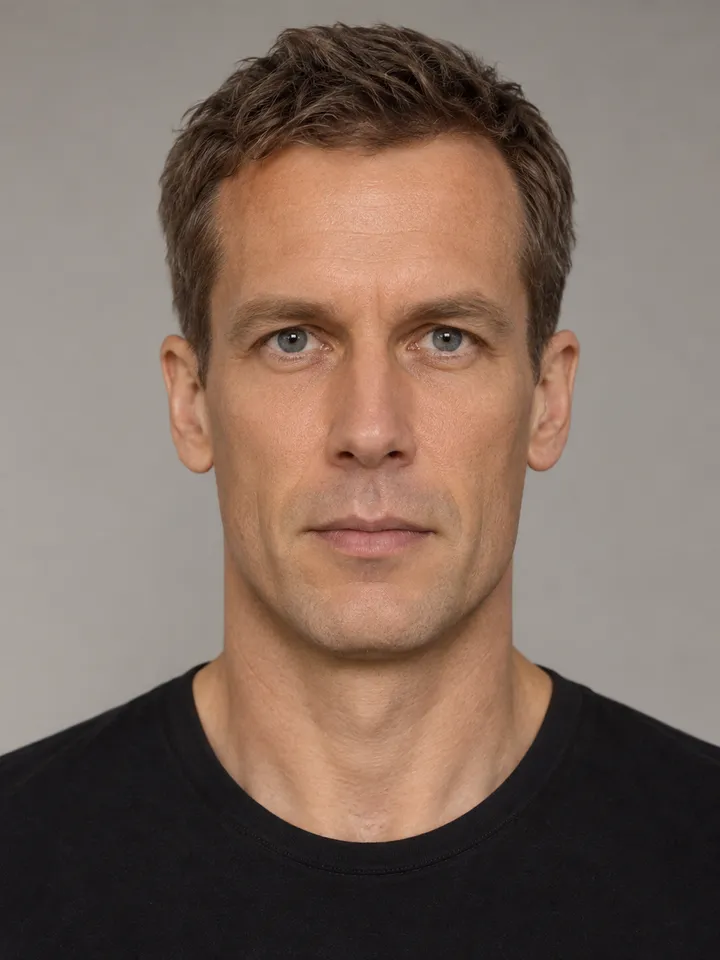
AI-generated example. Our detector reads it as 71% oblong.
- Face length well above cheekbone width
- Forehead, cheekbones and jaw close in width
- Fairly straight sides from cheekbones to jaw
- Longer chin; jaw corners may be soft or defined
What is an oblong face shape?
Oblong faces are defined by length. Measured from the top of the forehead to the chin, an oblong face is clearly longer than it is wide, and the widths do not change much from the forehead down to the jaw. The result is a face with fairly straight sides and, often, a longer chin and lower face.
Oblong is sometimes split into two versions. With soft jaw corners it looks like a long oval; with defined corners it looks like a long rectangle and is sometimes called rectangular. In both cases the length is what sets it apart.
How a oblong face measures
These are the measurements our face shape detector treats as typical of each shape. Widths and length are divided by the cheekbone width, so they compare faces of any size. Real faces vary around these values, and a face between two columns reads as a blend of both shapes.
| Measurement | Oblong | Oval | Square |
|---|---|---|---|
| Face length ÷ cheekbones | 1.31 | 1.23 | 1.19 |
| Forehead ÷ cheekbones | 0.86 | 0.86 | 0.86 |
| Jaw ÷ cheekbones | 0.79 | 0.78 | 0.83 |
| Jaw corner angle | 154° | 155° | 149° |
| Chin angle | 113° | 116° | 122° |
How to tell if your face is oblong
With your hair pulled back, take four measurements in a mirror or from a straight-on photo:
- Forehead width at the upper temples, cheekbone width at the widest point, and jaw width just above the jaw corners.
- Face length from the top of the forehead to the bottom of the chin.
- If the length is clearly the largest number and the three widths are close to each other, your face is likely oblong.
- If the jaw is clearly narrower than the cheekbones and the chin is rounded, compare with the oval face shape instead.
- If the face is long but the chin is narrow and pointed, the reading may lean toward heart or diamond.
Oblong vs oval and square
Oval faces have similar proportions but are shorter and taper more below the cheekbones. If you have to look closely to decide whether your face is long, it is probably oval leaning oblong; a truly oblong face looks long at a glance.
Square faces have the same even widths and often the same defined jaw corners, but they are much shorter. The difference is mostly length: put the same jaw on a shorter face and it reads square, on a longer one it reads oblong.
Hairstyles and glasses for an oblong face
Styling advice for oblong faces aims to add width and avoid adding length. Fringes and bangs shorten the forehead visually; waves, curls and layers that add volume at the sides widen the face; and cuts that end around the jaw or collarbone draw the eye across rather than down. Very long, straight hair and a lot of height on top tend to make an oblong face read even longer.
For glasses, deeper frames that cover more of the face vertically, and frames with decorated or contrasting temples, add width. Small, narrow frames can make the face look longer. Treat these as ideas to try, not rules.
See seven hairstyles for an oblong face, for women and men →
Why a photo might read oblong when you are not
Photos taken from slightly below the face stretch the lower face and chin, and a raised chin makes the face look longer. A high hairline or a receding hairline can also add to the measured length. On the other side, a close-up selfie widens the middle of the face and can hide an oblong shape. Take the photo at eye level, from arm's length or farther, with a neutral expression, and check the result with the face shape detector.
Frequently asked questions
01Is an oblong face the same as a long face?
Yes. Oblong, long and rectangular are used for the same group of faces: clearly longer than wide, with similar widths from forehead to jaw.
02What is the difference between oblong and oval?
Length and the sides. An oblong face is longer, and its jaw stays close to the cheekbone width, so the sides look straight. An oval face is shorter and narrows more toward a rounded chin.
03Can an oblong face look shorter?
The underlying shape does not change, but hairstyles change how long a face looks. Fringes, side volume and cuts that end near the jaw make an oblong face read shorter; height on top makes it read longer.
04Why does my face read oblong in some photos and oval in others?
Camera angle and distance change the measured length. Photos from below or with the chin raised make a face look longer. If your readings switch between the two, your face is close to the boundary and both descriptions fit.