Face shape guide
Oval Face Shape: How to Tell If Your Face Is Oval
An oval face is longer than it is wide, slightly narrower at the forehead than at the cheekbones, and tapers gently to a softly rounded chin. Here is what that looks like in measurements, how to check it on your own face, and how it differs from the shapes it is most often confused with.
Measure your face shape from a photo →Free, in your browser. Your photo is not uploaded.
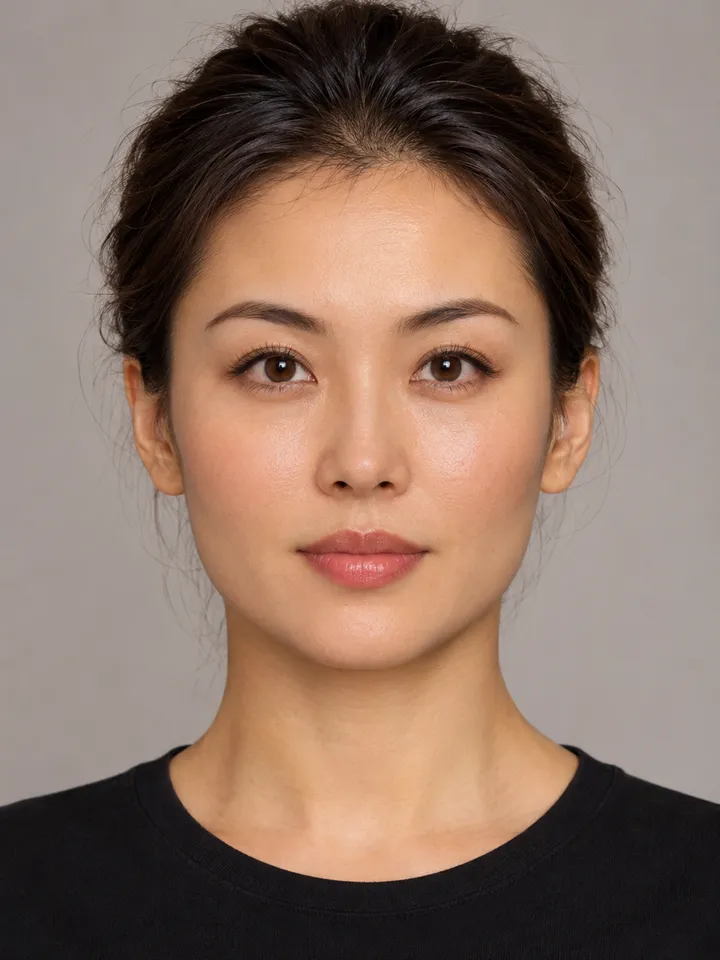
AI-generated example. Our detector reads it as 32% oval.
- Face length clearly greater than cheekbone width
- Cheekbones the widest part; forehead a little narrower
- Jaw narrower than the cheekbones, with no sharp corners
- Chin rounded, neither pointed nor broad
What is an oval face shape?
The oval face is defined by balance rather than by any one strong feature. The face is longer than it is wide, the cheekbones are the widest line across it, and from there the outline narrows smoothly in both directions: a little toward the forehead and more toward the chin. There are no sharp corners at the jaw and the chin is softly rounded.
Because none of the widths stand out, oval is the shape most faces drift toward when the measurements are close to average. That is also why it is the most common answer from a face shape detector, and why a reading of oval often comes with a runner-up: many oval faces lean slightly toward oblong, heart or diamond.
How a oval face measures
These are the measurements our face shape detector treats as typical of each shape. Widths and length are divided by the cheekbone width, so they compare faces of any size. Real faces vary around these values, and a face between two columns reads as a blend of both shapes.
| Measurement | Oval | Oblong | Diamond |
|---|---|---|---|
| Face length ÷ cheekbones | 1.23 | 1.31 | 1.21 |
| Forehead ÷ cheekbones | 0.86 | 0.86 | 0.83 |
| Jaw ÷ cheekbones | 0.78 | 0.79 | 0.77 |
| Jaw corner angle | 155° | 154° | 155° |
| Chin angle | 116° | 113° | 113° |
How to tell if your face is oval
You can check it with a mirror and a soft tape measure, or from a straight-on photo:
- Pull your hair back fully so the hairline, temples and jaw are visible.
- Measure across your forehead at the upper temples, across your cheekbones at their widest, and across your jaw just above the jaw corners.
- Measure the length from the top of your forehead to the bottom of your chin.
- Oval faces have the cheekbone width as the largest of the three widths, the jaw clearly narrower than the cheekbones, and a length well above the cheekbone width.
- If your length is far above your width and the sides look straight, compare with the oblong face shape. If your length and width are close, compare with the round face shape.
Oval vs oblong, diamond and heart
Oval and oblong share the same overall proportions, but an oblong face is longer and its sides run straighter, so the jaw stays close to the cheekbone width. An oval face tapers more below the cheekbones.
Diamond and heart faces are also widest at the cheekbones, but their chins are narrower and more pointed. A diamond face has a narrower forehead than an oval face; a heart face has a wider one. If your reading splits between oval and one of these, look at your chin: a soft, rounded chin points to oval.
Hairstyles and glasses for an oval face
Styling guides usually describe oval as the most versatile shape, because its proportions do not need balancing. Most haircut lengths work, from short crops to long layers, and fringes are optional rather than corrective. The main thing to watch is volume: a lot of height on top makes an oval face read longer, and heavy volume at the sides makes it read rounder.
For glasses, frames about as wide as the broadest part of the face keep the proportions as they are. Very narrow frames can make the face look longer; oversized round frames can make it look shorter. None of this is a rule; it is a starting point for trying frames on.
Why a photo might not read oval
An oval face can be read as round in a close-up selfie, because a wide-angle phone lens held near the face makes the middle of the face look wider. It can be read as oblong when the photo is taken from slightly below, which stretches the lower face. Hair over the forehead hides the forehead width and can push the reading toward diamond. For a fair reading, use a photo taken at eye level from arm's length or farther, with your hair pulled back, and compare two or three photos with the face shape detector.
Frequently asked questions
01Is an oval face shape the ideal face shape?
No face shape is ideal. Oval is often called balanced or versatile in styling guides because many haircuts and frames suit it. That describes how easy it is to style, not how attractive it is.
02Is the oval face shape common?
Oval is one of the most frequent results from measurement-based face shape tools, partly because faces with average proportions fall into it. There is no reliable population count, because studies and tools use different definitions.
03Can a face be both oval and another shape?
Yes. Many faces sit between two shapes. A detector that reports a share for every shape will show this, for example 45% oval and 30% heart. Advice that suits both shapes is a safe choice.
04How do I know if my face is oval or oblong?
Compare your face length with your cheekbone width and look at the sides of your face. An oblong face is noticeably longer and the jaw stays close to the cheekbone width; an oval face is a little shorter and narrows more toward the chin.