

Deep Set Eyes: What They Are and How to Tell
Deep-set eyes sit further back in the eye sockets, so the brow bone looks more prominent and often casts a soft shadow over the upper lids. Here is how to recognise deep-set eyes, what a photo can and cannot show about them, and how they differ from hooded eyes.
Measure your eye tilt from a photo →Free, in your browser. Your photo is not uploaded.
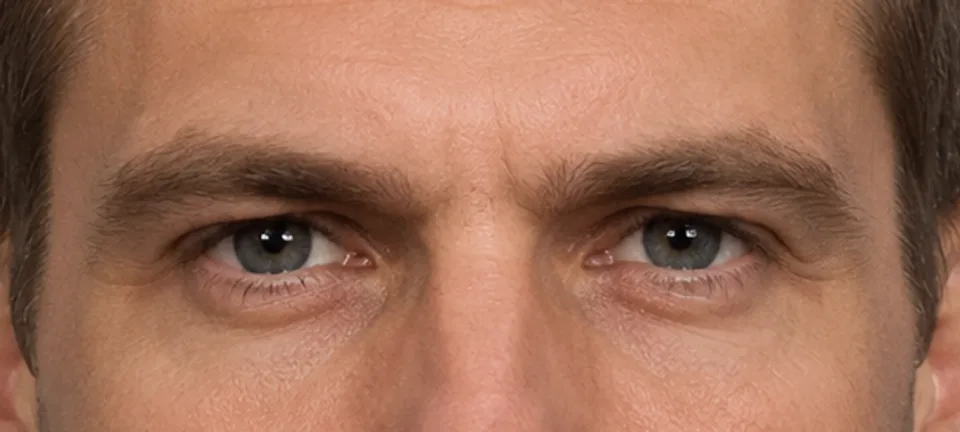
AI-generated example. Measured tilt +4.0°, eye ratio 0.31.
- Prominent brow bone above the eyes
- Upper lid partly hidden or shadowed under the brow
- Little visible space between brow and lid
- A hollow just below the brow, especially in side light
What are deep-set eyes?
Deep-set eyes are set further back in the skull relative to the brow bone and cheekbones. The brow bone projects forward over them, so the upper lid sits in a recess and often in shadow, and the eyes can look smaller or more intense than their size alone would suggest.
Deep-set is about depth, not outline. A deep-set eye can be almond, round, upturned or downturned at the same time. It is the opposite of prominent or protruding eyes, which sit further forward and show more of the lid.
How to tell if you have deep-set eyes
Use a mirror in even light, then repeat with light from the side:
- Look at your brow bone in profile. If it clearly projects past the front of your eyes, your eyes are set back.
- Look straight ahead and check how much of your upper lid you can see. Deep-set eyes show little lid between the lashes and the brow, and what shows is often in shadow.
- Turn so the light comes from the side. A visible hollow under the brow bone points to deep-set eyes.
- If a fold of skin covers the lid but the brow bone does not project, compare with hooded eyes instead.
Deep-set eyes next to the other eye shapes
Each example eye was measured by the same analyzer our tools use. Tilt is the angle from the inner to the outer corner, levelled on the line between the irises; the eye ratio is how open the eye is compared with its width; brow-to-lid space is the distance from the lower edge of the brow to the upper lid, also compared with the width.
| Measurement | Almond eyes | Deep-set eyes | Downturned eyes | Upturned eyes |
|---|---|---|---|---|
| Corner-to-corner tilt | +4.0° | +4.0° | −1.9° | +9.9° |
| Eye ratio (opening ÷ width) | 0.33 | 0.31 | 0.23 | 0.39 |
| Brow-to-lid space ÷ width | 0.46 | 0.34 | 0.72 | 0.64 |
Why a photo cannot measure depth
A straight-on photo is flat, so it cannot measure how far back an eye sits. What it can measure is related: the space between the lower edge of the brow and the upper lid, divided by the eye's width. Deep-set eyes tend to have less of that space, because the brow sits close above a recessed lid. The example on this page measures 0.34, the smallest of our four examples, against 0.46 to 0.72 for the others.
That reading is a clue, not proof. A low brow, a heavy brow, a hooded lid or a frown also shrink the space without the eyes being set back. Use the profile and side-light checks above to tell them apart.
Deep-set vs hooded eyes
Both can hide the upper lid, which is why they are often confused. Deep-set eyes hide it because the brow bone projects and the eye sits back; hooded eyes hide it because a fold of skin from below the brow drapes over the lid. A deep-set eye has a hollow under the brow; a hooded eye has a soft fold there instead. Some people have both.
Makeup and glasses for deep-set eyes
Makeup guides for deep-set eyes usually aim to bring the lid forward: lighter, satin or shimmer shades on the lid, a slightly deeper shade placed above the natural crease rather than in it, and thin liner close to the lashes. Very dark shadow in the socket tends to make the eyes look more recessed.
For glasses, lighter or thinner frames, and frames whose top edge sits at or just below the brow, avoid adding more shadow over the eyes.
Frequently asked questions
01What does it mean when you have deep-set eyes?
Your eyes sit further back relative to your brow bone, so the brow projects over them and the upper lids look recessed. It is a normal variation in facial structure.
02Are deep-set eyes rare?
They are common, and more noticeable in faces with a strong brow bone. There is no reliable population count, because the category is informal.
03Can a photo tell if my eyes are deep-set?
Not reliably. A front photo can measure the space between the brow and the lid, which tends to be small in deep-set eyes, but a low brow or a hooded lid gives the same reading. A profile view shows depth better.
04Do deep-set eyes change with age?
They can look more deep-set with age, as the fat around the eyes thins and the brow and lids change. The bone structure itself changes little.