

Downturned Eyes: What They Are and How to Tell
Downturned eyes have outer corners that sit lower than the inner corners, so the eye slopes gently down toward the temples. Here is how downturned eyes measure, how to check your own, and how they relate to negative canthal tilt and hooded eyes.
Measure your eye tilt from a photo →Free, in your browser. Your photo is not uploaded.
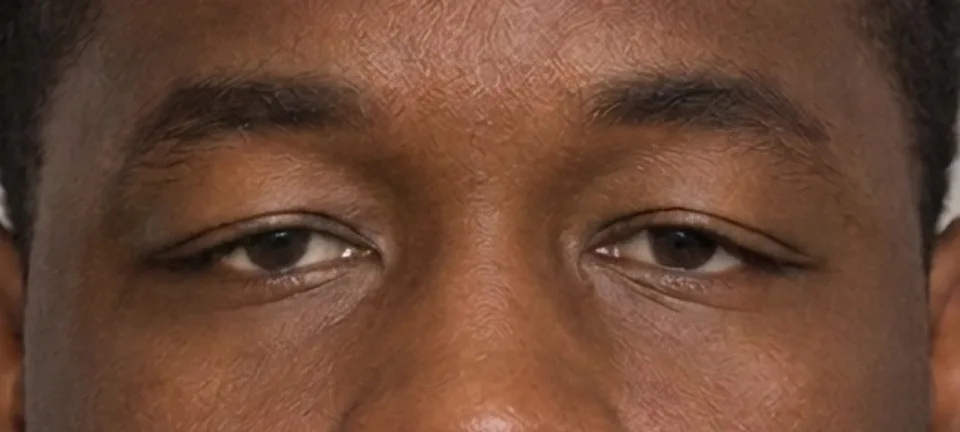
AI-generated example. Measured tilt −1.9°, eye ratio 0.23.
- Outer corner below the inner corner
- Lids slope down toward the temples
- A negative corner-to-corner angle
- Often a softer, relaxed look
What are downturned eyes?
An eye is downturned when its outer corner sits lower than its inner corner. Drawn as a line from corner to corner, the eye slopes down toward the temple, and the lids usually follow that slope. In measurement terms this is a negative canthal tilt: the angle of that corner line below level.
The term is also used more loosely in makeup guides for eyes whose outer lid or lashes droop even when the corners are level, for example when a hooded lid hangs lower at the outer end. On this page, downturned means the corners themselves, because that is what can be measured.
How to tell if you have downturned eyes
Look straight into a mirror or a front camera with your head level:
- Find the inner and outer corner of one eye, where the upper and lower lids meet.
- Imagine a line between them, or hold a thin straight edge across. If the outer end sits lower than the inner end, the eye is downturned.
- Check both eyes; a difference of a degree or two between them is normal.
- For a number, the canthal tilt calculator measures each eye's angle from a photo and corrects for head tilt.
Downturned eyes next to the other eye shapes
Each example eye was measured by the same analyzer our tools use. Tilt is the angle from the inner to the outer corner, levelled on the line between the irises; the eye ratio is how open the eye is compared with its width; brow-to-lid space is the distance from the lower edge of the brow to the upper lid, also compared with the width.
| Measurement | Almond eyes | Deep-set eyes | Downturned eyes | Upturned eyes |
|---|---|---|---|---|
| Corner-to-corner tilt | +4.0° | +4.0° | −1.9° | +9.9° |
| Eye ratio (opening ÷ width) | 0.33 | 0.31 | 0.23 | 0.39 |
| Brow-to-lid space ÷ width | 0.46 | 0.34 | 0.72 | 0.64 |
How downturned eyes measure
Most adults have outer corners a few degrees above the inner corners, so a level or negative angle stands out. The example on this page measures −1.9° on both eyes. Our tools treat anything below −1° as negative, between −1° and +1° as neutral, and above +1° as positive, so this example reads as negative, or downturned.
Generating this example took several attempts: image models tend to draw lifted eye corners, so the downturned portrait was made by editing a near-level one and then checking that the measured angle was really negative. For more on the angle itself, read negative canthal tilt.
Downturned vs hooded eyes
Hooded eyes have a fold of skin over the upper lid. When the fold is heavier at the outer end, it can make level eyes look downturned. The corner line tells them apart: in downturned eyes the corners themselves slope; in hooded eyes the corners can be level while the fold droops. See hooded eyes for how to check.
Makeup and glasses for downturned eyes
Makeup guides for downturned eyes usually aim to lift the outer corner visually: liner that thickens and flicks upward at the outer third rather than following the lower lash line down, curled lashes with more length at the outer edge, and shadow blended up and out instead of down. Heavy liner along the outer lower lash line tends to emphasise the downward slope.
For glasses, frames with an upswept outer edge, such as soft cat-eye shapes, add lift. These are styling choices, not corrections: downturned eyes are a normal variation.
Frequently asked questions
01What does it mean when your eyes are downturned?
The outer corners of your eyes sit lower than the inner corners. It is a normal variation in eye shape, measured as a negative canthal tilt.
02Are downturned eyes attractive?
Attractiveness is not something a measurement can decide. Downturned eyes are often described as soft or gentle; whether that is appealing is a matter of taste, and FaceCoda does not rate it.
03How rare are downturned eyes?
Less common than slightly lifted corners, since most adults measure a few degrees positive, but far from rare. Published averages differ by population and method, so there is no single figure.
04Can you fix downturned eyes?
They do not need fixing; they are not a health problem in themselves. Makeup and frames change how the angle reads. Surgical procedures exist, but that is a medical decision for a qualified specialist, and a change in eyelid position over time is worth having checked.