

Big forehead
A big forehead usually describes an upper facial band - from the eyebrows to the hairline - that looks taller than the middle or lower bands of the face, or sits higher at the temples. In facial anthropometry, researchers measure true forehead height from the midline hairline (trichion) to the brow ridge (glabella) or nose root (nasion), and adult averages span roughly 5 to 7.5 cm across healthy populations. Because hairline height, hairline contour and camera distance all shape how tall the upper face looks, everyday impressions depend as much on framing as on bone length.
This guide explains how anatomical studies measure forehead height, why the popular finger rule fails, how high forehead, small forehead and the slang term fivehead compare, and how FaceCoda handles the forehead in photo analysis. It also covers hairstyle balance and when a changing hairline warrants a medical check. AI-generated educational illustrations are used throughout instead of photographs of real people.
Do I have a big forehead? What measurements actually show
In everyday conversation, “big forehead” and “high forehead” mean the same thing: a larger expanse of skin between the eyebrows and the start of the scalp hair. Online slang sometimes calls a tall upper forehead a “fivehead” (a joke on fitting five fingers instead of four), whereas “small forehead” or “low forehead” describes a shorter gap where the hairline sits close above the brows. None of those labels is a clinical category.
To measure the forehead consistently, craniofacial researchers use two vertical definitions: Forehead Height I runs from the midline hairline point (trichion, tr) to the glabella (g, the smooth point between the brows), while Forehead Height II runs from the trichion to the nasion (n, the bridge of the nose). [2][3] The second measure corresponds to the classical “upper facial third,” which Renaissance canons idealized as equal to the middle third and lower third. [1][2]
Large anthropometric surveys show that real faces rarely obey equal thirds, and forehead height varies widely across healthy adults. In a classic North American study of 153 young adults, Farkas and colleagues found that the vertical profile canons held in very few subjects because individual facial sections varied freely. [1] Across international cohorts summarized in comparative tables, mean upper-third height (trichion to nasion) measured 67.1 mm in North American white men and 63.0 mm in women, 67.1 mm in Chinese men and 64.1 mm in women, 64.7 mm in Saudi men and 65.5 mm in women, and 72.0 mm in African American men and 67.1 mm in women. [2]
On smaller screens, scroll the table to see every column.
| Study and cohort | Landmark definition | Reported average |
|---|---|---|
| Al-Sebaei, 2015 · 168 Saudi young adults [2] | Trichion to nasion (upper third, caliper) | 64.71 ± 7.51 mm in men; 65.46 ± 6.90 mm in women |
| Virdi et al., 2019 · 72 Kenyan young adults [3] | Trichion to nasion (upper third, caliper) | 72.2 ± 2.3 mm in men; 67.5 ± 2.9 mm in women |
| Salinas et al., 2023 · 60 white celebrities [4] | Trichion to glabella (central forehead, photo) | 5.77 cm in men; 5.86 cm in women (no significant difference) |
| Jokar et al., 2025 · 225 Persian women [6] | Trichion to glabella (ages 20–50, photo) | 48.99 mm (20s) rising to 51.46 mm (40s) |
Three practical takeaways come from these numbers. First, an “average” adult forehead varies by more than a centimeter depending on whether you measure to the brow ridge or the nasal bridge, and by population background. [2][3] Second, having an upper third taller than the middle third is actually common: in Al-Sebaei’s sample of 168 young adults, 81.7% of men and 88% of women had an upper third longer than their middle third. [2] Third, central forehead height often changes slowly with age as hairlines shift subtly upward, as seen in the Iranian female cohort where mean trichion-to-glabella height rose from 48.99 mm in the 20s to 51.46 mm in the 40–50 group. [6]
Why the finger rule and hairline shape change perception
One of the most repeated internet shortcuts is the “four-finger rule”: pressing four fingers horizontally between the eyebrows and hairline to decide whether your forehead is small (three fingers), average (four fingers) or big (five fingers or “fivehead”). There is no anatomical basis for that rule.
Four adult fingers can span anywhere from roughly 5.5 cm on someone with slender hands to more than 7.5 cm on someone with broad fingers. Because two adults can have identical 6.5 cm foreheads and get completely opposite “finger” answers, the test measures your hand as much as your forehead. It also ignores overall face length: a 6.5 cm forehead looks compact on a tall, long face and prominent on a shorter face.
Hairline geometry shapes perception just as strongly as midline height. In a 2025 photographic survey of 568 adult Chinese women, researchers classified natural frontal hairlines into five distinct shapes: rectangular (44.19%), M-shaped (23.24%), bell-shaped (15.84%), triangular (8.63%) and round (8.10%). [5] An M-shaped hairline recedes slightly at the temple corners while staying lower at the center, which makes the upper forehead look wider and taller at the sides even when midline height is average.
Sex-typical lateral hairline patterns add to that impression. In an analysis of 60 white male and female public figures, central forehead height (trichion to glabella) showed no statistically significant difference between men and women (5.77 cm vs 5.86 cm), yet lateral forehead height above the brow peak and outer brow was significantly taller in men (5.55 cm vs 4.34 cm above the brow peak) because the female hairline sloped downward at the sides while the male hairline sat more horizontally. [4] Side-to-side width and temple contour explain why two people with the exact same center forehead measurement can perceive their foreheads very differently.
How FaceCoda measures the upper third (and why it skips the hairline)
If you test your face in FaceCoda’s Golden Ratio Face Test, you may notice that the upper facial third looks shorter than classical textbook diagrams. That is deliberate, and understanding why prevents misreading your score.
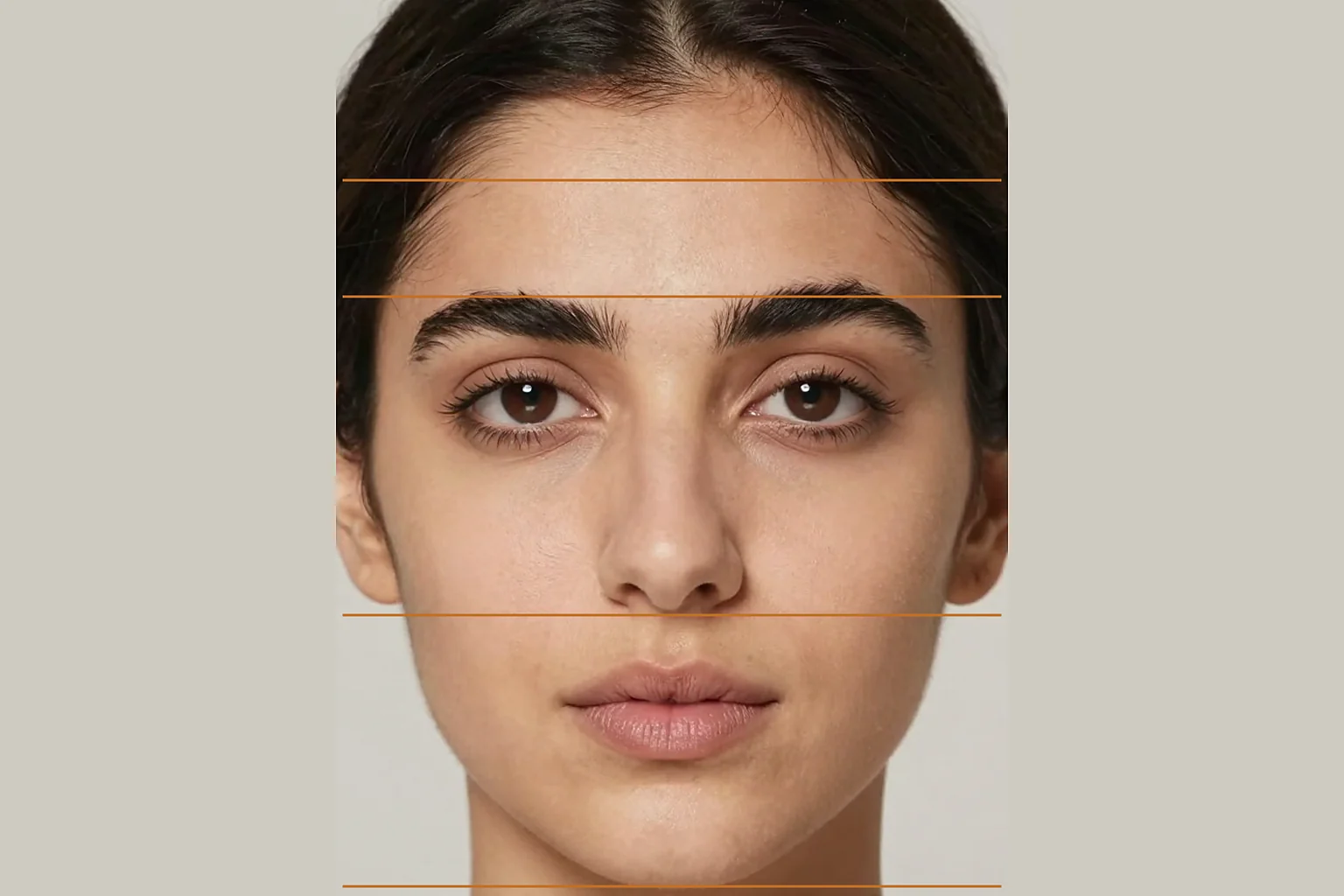
The four lines above show what FaceCoda’s thirds actually measure using Google’s MediaPipe Face Landmarker (478 landmarks) in your browser: top of the visible forehead, brow line, nose base and chin. They do not mark the anatomical scalp hairline (trichion), because bangs, baby hairs, hairlines and hats vary endlessly in photos, so FaceCoda starts its upper band at the visible top of the forehead instead. As a result, FaceCoda’s facial thirds reference is 18% for the visible upper band, 41% for the middle band (brows to nose base) and 41% for the lower band (nose base to chin).
That choice has two honest consequences for anyone checking a big or small forehead:
- It does not measure hairline height directly: Because the top landmark sits below the true hairline, the 18% upper third will not flag a high hairline or M-shaped temples.
- Use middle and lower thirds for context, and check width proportions: The Face Shape Detector compares forehead width across the upper temples against cheekbone width and jaw width across six shapes (oval, round, square, oblong, heart and diamond).
- Watch camera angle and distance: Tilting your chin down toward the camera tilts the forehead forward and makes it look larger, while tilting your chin up shrinks it. In a camera distance study of 12 volunteers, taking a smartphone photo at 8 inches stretched central facial features by 18% compared with a 60-inch full-frame reference, and by 12% at 12 inches. [7] Always hold the phone at eye level and at arm’s length or farther, with hair pulled back.
For the full breakdown of how thirds are scored and how to photograph them cleanly, see our dedicated guide to facial thirds.
Hairstyles for a big forehead vs a small forehead
A haircut cannot alter forehead bone or hairline position, but it changes where someone’s eye places the top edge of your face. That is why styling guides match forehead height with face shape rather than using a single haircut for everyone.
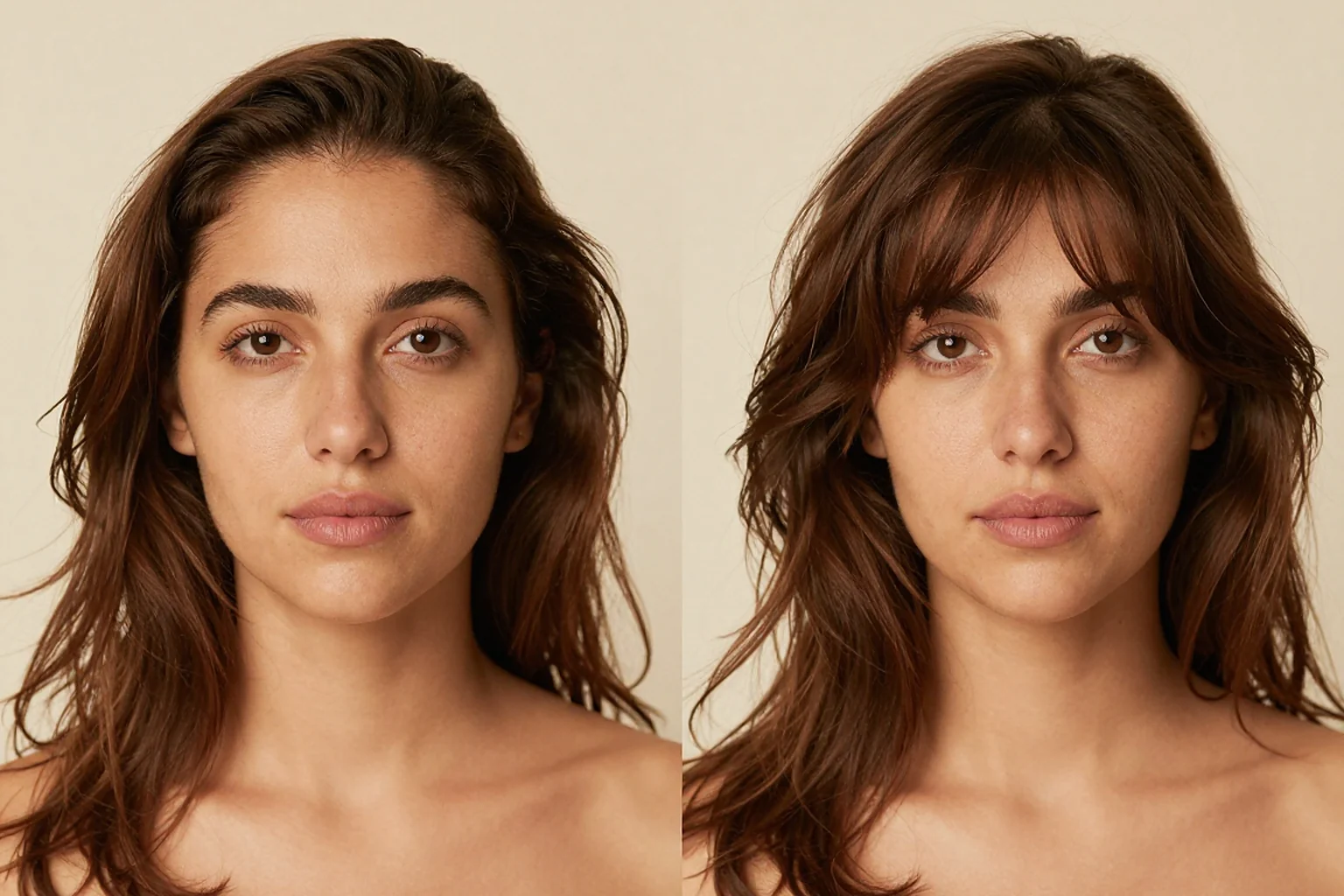
- Soft fringes and curtain bangs: Wispy bangs, curtain bangs or textured side-swept fringe that grazes the temples visually bring the top edge of the face down toward the brows without forming a heavy block across the eyes.
- Side parts and temple volume: Deep side parts break up wide, flat horizontal hairlines, while soft layers around the cheekbones balance a forehead that feels wider than the jaw (a common pattern in heart face shapes).
- Cuts that leave the forehead open: On a smaller or lower forehead, pulling hair off the face, adding crown height or wearing a clean middle part opens up vertical space above the brows, whereas heavy blunt bangs can compress the upper face further.
- Match the whole face outline: A tall forehead on a long oblong face benefits from horizontal cheek width and brow-skimming fringe, while a tall forehead with a broad jaw behaves differently.
You can explore seven cuts each for women and men across all six shapes in FaceCoda’s hairstyle guides. If you want to preview how bangs or crown volume sit on your own proportions before visiting a salon, the Full Face Report adds four AI hairstyle try-ons generated from your photo alongside your full measurement breakdown.
When a changing hairline needs medical advice
A naturally tall forehead or mature hairline pattern you have had for years is simply normal facial variation. A hairline that is actively moving backward, thinning rapidly or changing texture is a different question that a facial proportion tool cannot evaluate.
When to speak with a doctor
- Sudden or patchy hair loss: The NHS notes that while losing 50 to 100 hairs a day is normal, you should see a GP if hair loss is worrying you, appears in bald patches or follows an illness, weight loss or stress so the underlying cause can be checked before visiting commercial clinics. [8]
- Patterned hairline recession: Male and female pattern hair loss are common hereditary causes of a rising hairline or widening temples; a GP or dermatologist can discuss safe, evidence-based options rather than relying on photo guesses. [8]
- Scalp pain, scarring or brow loss: Redness, itching, smooth scarring along the frontal hairline or thinning eyebrows need a dermatologist’s exam, because scarring conditions require early clinical diagnosis.
Remember that FaceCoda measures surface proportions from one picture and never diagnoses hair or skin conditions. For related proportion guides, check long philtrum for lower-third balance, wide-set eyes for horizontal fifths or all six face shapes.
FAQ
Forehead height reflects bone shape and hairline placement across populations, not a defect or a single ideal standard.
Do I have a big forehead?
A forehead looks large when the distance from the eyebrows to the hairline is noticeably taller than the middle third (brows to nose base) or when the hairline sits higher at the temples. Published adult averages for midline forehead height (trichion to nasion) generally fall between 60 and 72 mm depending on sex and population, so wide variation is normal.
Does the four-finger forehead rule actually work?
Only as a rough mirror habit, not as a reliable measurement. Adult finger widths vary substantially from person to person, and the rule ignores overall face length, head tilt and hairline shape. Measuring against your middle and lower face gives clearer context than holding fingers against your brow.
What is the difference between a big forehead, a high forehead and a fivehead?
Big forehead and high forehead are everyday terms for the same appearance: a taller distance between brows and hairline. Fivehead is internet slang playing on the word forehead for a taller upper face. None of the three is a medical diagnosis or a formal anatomical category.
What is considered a small forehead?
A small or low forehead means the hairline sits closer to the eyebrows than the rest of the face, making the upper band shorter than the middle or lower bands. Like a tall forehead, it is an ordinary variation shaped by frontal bone height and hairline contour.
How does FaceCoda measure the forehead?
FaceCoda's Golden Ratio Face Test measures the upper facial third from the visible top of the forehead detected by facial landmarks, not from the hairline. Because that point sits lower than the hairline, FaceCoda uses a reference of 18% for the upper band and 41% each for the middle and lower bands. Open the Golden Ratio Face Test.
Which hairstyles suit a big forehead?
Hairstyles that bring soft hair across part of the forehead - such as curtain bangs, textured fringe or a deep side part - visually shorten the upper band without hiding your eyes. If you want tailored haircut ideas for your face shape, browse FaceCoda's hairstyle guides or try styles on your own photo in the Full Face Report. Browse hairstyles by face shape.