

Facial thirds
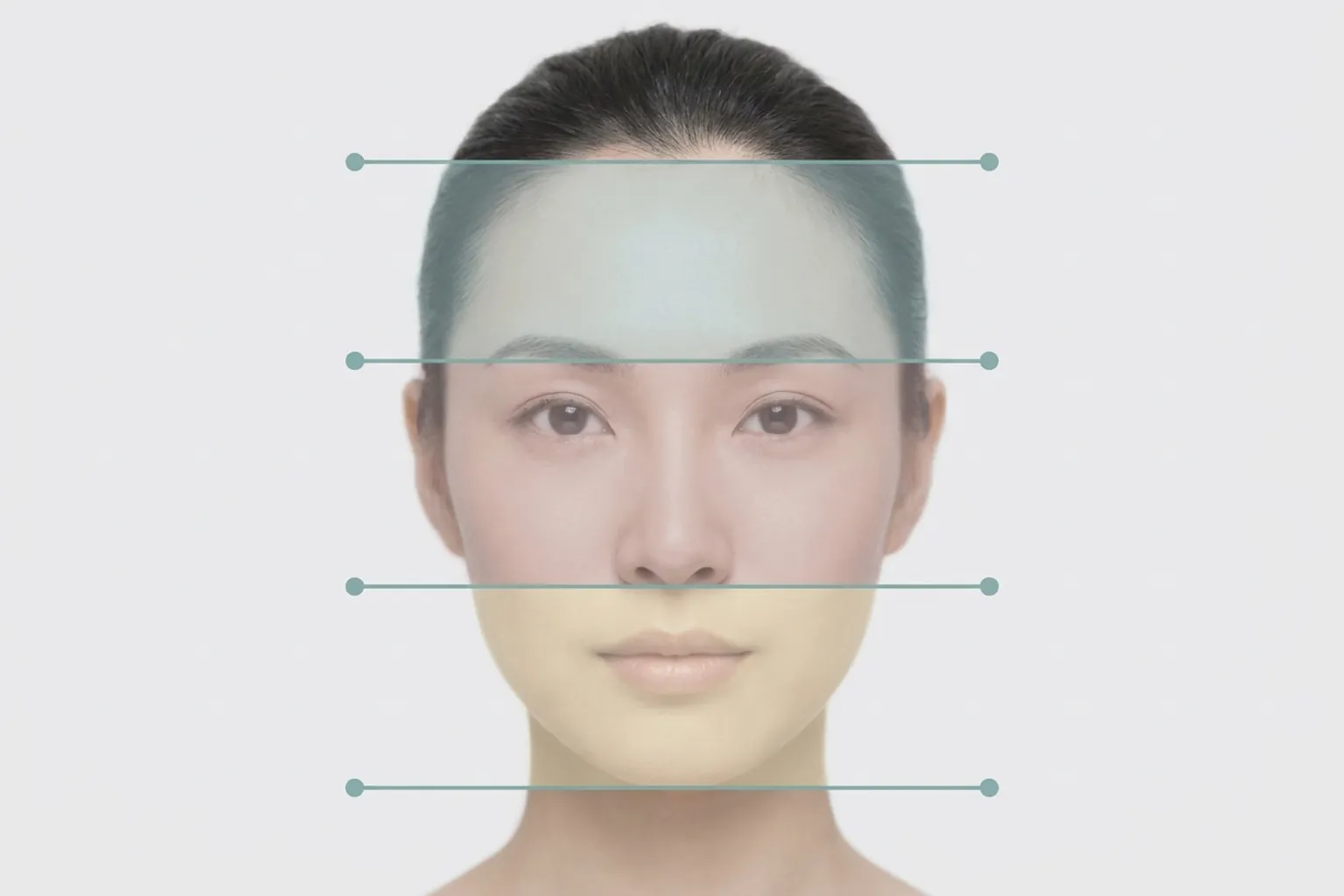
Facial thirds divide the face from top to chin into three vertical bands: top of the forehead to the brow line, brow line to the base of the nose, and base of the nose to the chin. In the classical canon the three bands are equal. FaceCoda measures them from the visible top of the forehead, so its reference is 18% for the upper band and 41% for each of the other two.
This guide explains where the canon comes from, how to photograph your face for a fair measurement and what a difference from the reference does and does not mean. It also covers how the thirds feed into the 0 to 100 geometry score. The photo-style illustrations are AI-generated educational examples, not photographs of real people.
What the facial thirds are
The thirds are three vertical sections of the front of the face. The upper third runs from the top of the forehead or hairline to the brow line. The middle third runs from the brow line to the base of the nose. The lower third runs from the base of the nose to the chin.
A companion rule, the facial fifths, divides the face horizontally. It cuts the width of the face into five parts of about one eye-width each: the outer side of the face, an eye, the gap between the eyes, the other eye and the other outer side. A paper on southern Chinese faces describes the rule of fifths as dividing the face in the transverse dimension into five equal parts. [4]
Together the thirds and fifths are a quick way to describe where features sit. They describe proportions in a picture, not the quality of a face. The rest of this guide returns to that distinction.
Where the canon comes from
The idea is old. A history of facial measurement traces measurements of the face to the Greek era and notes the influence of Greek proportion theory, the golden proportion and the canons of important Renaissance artists on modern anthropometry. [2]
One well-known example is a Leonardo da Vinci sheet of about 1490 in the Royal Collection. Its catalogue note says that the eye is at the midpoint of the head and that the face is divided into three equal sections, from the base of the chin to the base of the nose, then to the brow and then to the hairline. The same note says the practical difficulties of using such principles would have been apparent to Leonardo, and that he soon abandoned his proportional studies. [1]
Later writers carried the rules on. A paper on neoclassical canons says that Renaissance artists, among them Leonardo, Vitruvius, Bergmüller and Dürer, set down these proportions, and that medical artists, anatomists and aesthetic surgeons adapted them and still use them. [4]
The history review adds an important caution. It says the main difference between measurement in classical times and modern anthropometry is that earlier canons showed human forms the way the artist or scientist preferred, not how they objectively were. [2] The thirds are therefore a drawing convention that was later turned into a clinical yardstick. They did not start as a measurement of how faces actually are.
The landmarks, and why FaceCoda does not use the hairline
Classical thirds need four landmarks. They are the hairline or top of the forehead, the brow line, the base of the nose and the chin. Clinical papers use named points, for example trichion, which one study defines as a point on the hairline in the midline of the forehead. [4]
The hairline is the weak point. In a photograph, hair, a fringe, a hat or a hairstyle can hide it. Even when it is visible, its shape varies widely. A study of 568 Chinese women sorted hairline contours into five groups: round (8.10%), bell-shaped (15.84%), M-shaped (23.24%), rectangular (44.19%) and triangular (8.63%). [7] A single trichion point is hard to define across contours that differ this much.
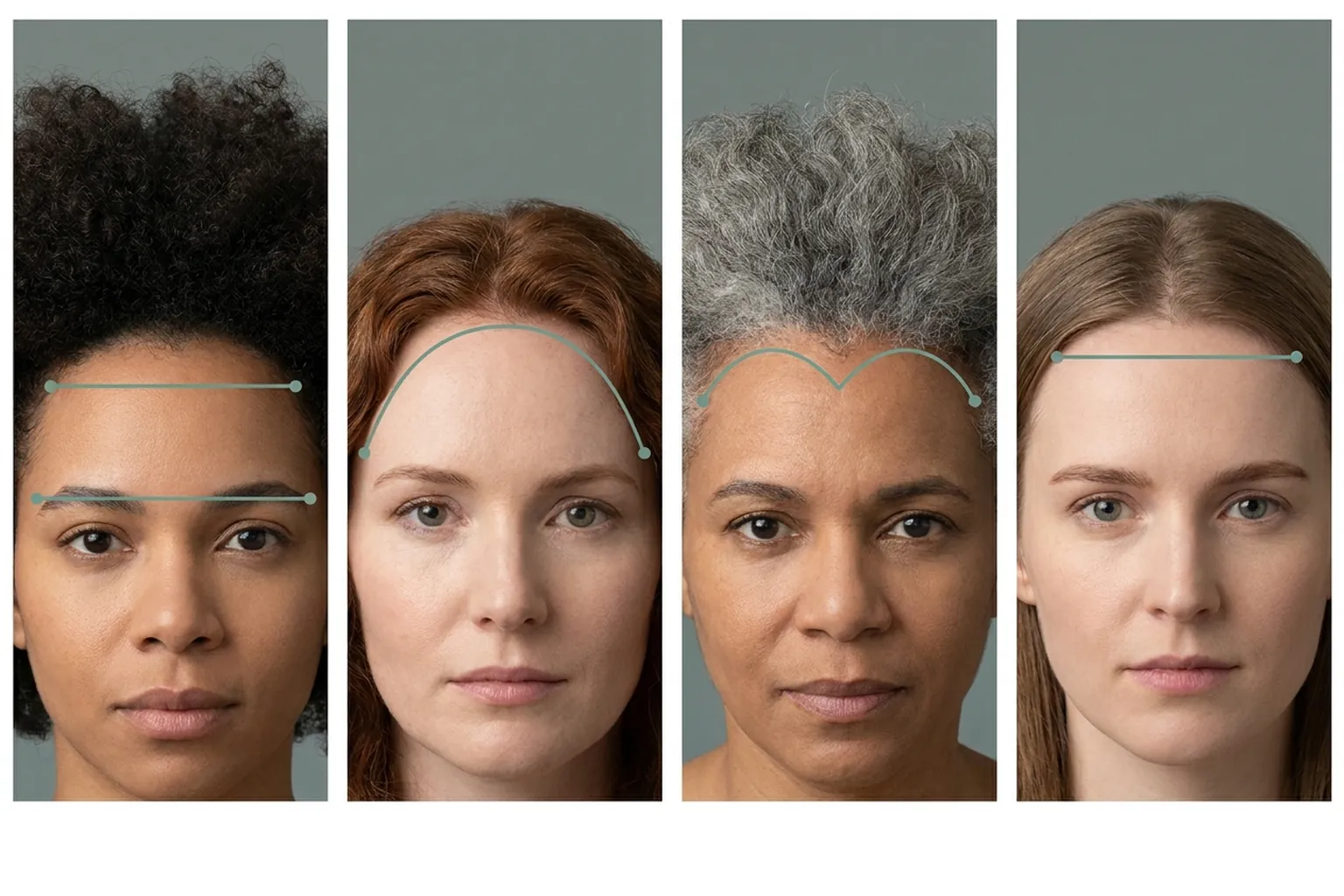
So FaceCoda starts the upper third at the visible top of the forehead, as found by its landmark model, and not at the hairline. That makes the upper band shorter than a hairline-based measurement would, and it is why the reference is 18% for the upper band and 41% for each of the middle and lower bands. The three references add up to 100%, and the fifths reference is 20% for each of the five bands at eye level.
The consequence is simple. Do not compare a FaceCoda upper third with a number from a paper or a clinic that measured from the hairline. The two start at different points and mean different things. The middle and lower bands are the safer ones to compare with each other, because they use the same landmarks in any method.
| Band | From | To | Classical canon | FaceCoda reference |
|---|---|---|---|---|
| Upper | Hairline | Brow line | One third | 18%, from the visible top of the forehead |
| Middle | Brow line | Base of the nose | One third | 41% |
| Lower | Base of the nose | Chin | One third | 41% |
The fifths are measured along a path across the face at eye level, from the cheek to the outer eye corner, across both eyes and out to the other cheek. Each of the five segments is given as a share of the total path.
How to photograph your face for a fair measurement
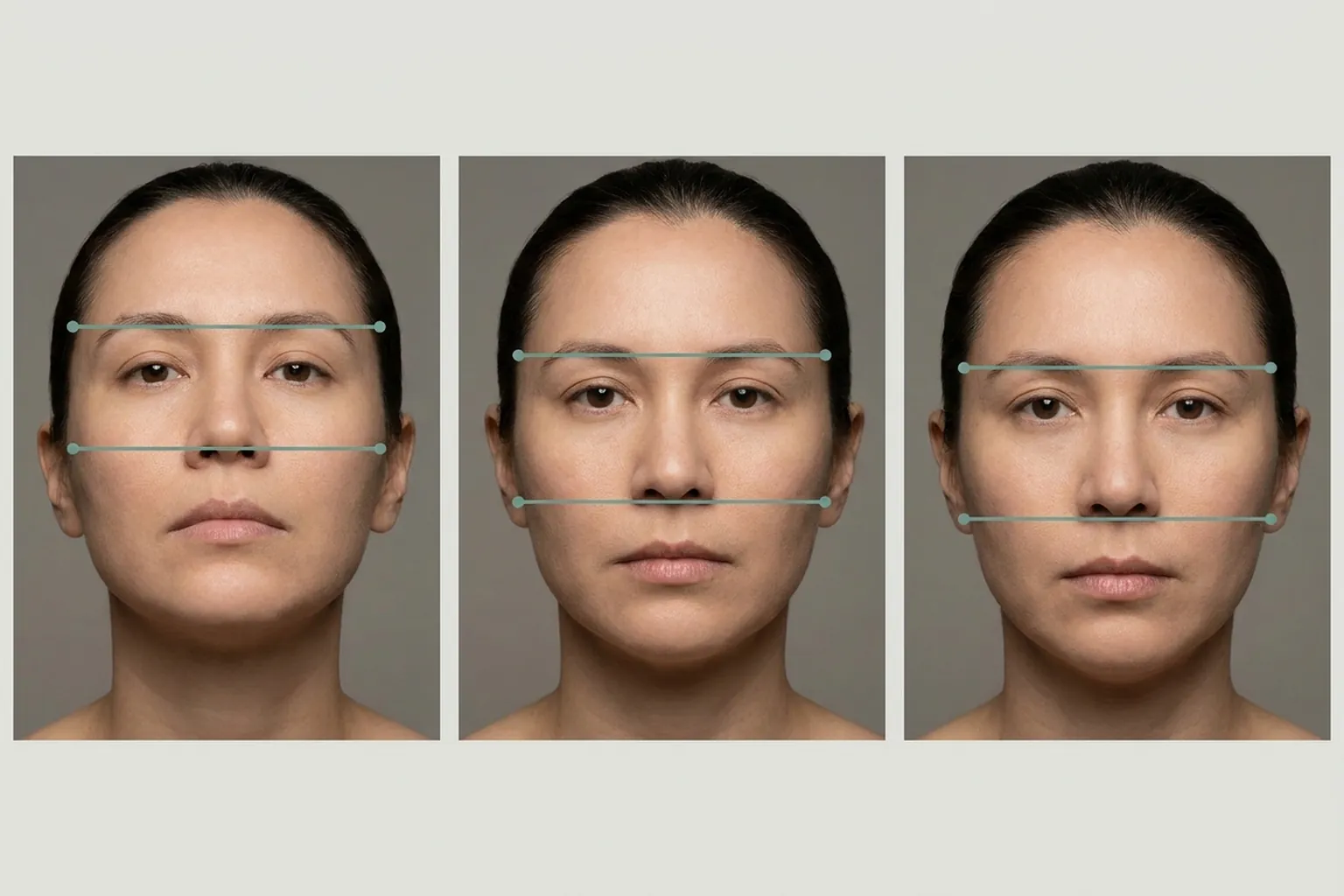
The thirds are measured from the distances between landmarks in the picture, so the picture needs to be consistent. A change of angle or distance can alter the numbers more than any real difference in the face.
1. Keep your head level
Look straight at the camera with your chin level, because a tilt up or down changes every vertical band. One study that analysed photographs of 249 young people took them in the natural head position, which standardizes head posture. [5] Use a plain position that you can repeat.
2. Step back from the camera
Hold the phone at arm’s length or farther. In a study of 30 volunteers, nasal length measured 6.4 percent longer in selfies taken at 12 inches, and 4.3 percent longer at 18 inches, than in photographs taken at five feet. [8] The middle third is largely the length of the nose, so a close camera is the most likely source of an unfair reading.
3. Show the forehead and relax the face
Pull your hair back so the top of the forehead is visible. Keep your mouth closed and your brows relaxed, because raising the brows moves the brow landmark. Use soft light from the front and no filters.
4. Compare like with like
Take two or three photos the same way and compare them with each other. A difference of a few percentage points between photos is more likely to come from the setup than from your face. Compare only photos taken the same way.
What a deviation does and does not mean
A measured difference from equal thirds is the usual result. In 1985, researchers tested nine neoclassical formulas of facial proportion in 153 young adult North American Caucasians. They found that the poorest correspondences were in the vertical profile proportions, which showed equality of no more than two parts of the head and face. [3] Their conclusion was that while some canons may fit a few cases, they do not represent the average facial proportions, and using them as a prescription for ideal proportions must be tested. [3]
Later studies found the same in other groups. In 103 young adults from Hong Kong, a facial three-section canon with exactly equal thirds was found in none of them. [4] In 249 adolescents and young adults in Croatia, significant deviations from the canons were observed in 55 to 65 percent, and the authors concluded that the canons were not valid for most of them. [5] A review of 27 articles from every continent except Antarctica and Australia found that no ethnic or gender group consistently approximated the ideal for both the canons and the golden ratio, and it called the utility of the canons limited. [6]
Three points follow from that. A deviation from equal thirds is ordinary population variation, not a flaw. The canons are a historical reference, not a norm, and they were not built from measurements of all populations. A reading says nothing about attractiveness, health or ability, and it should never be used to rank a face.
| Reading | What it describes | What it does not mean |
|---|---|---|
| A band above its reference | That band takes a larger share of the measured height in this photo. | It does not mean a feature is too large or out of place. |
| A band below its reference | That band takes a smaller share of the measured height in this photo. | It does not mean a feature is too small. |
| All three near their references | The bands are close to the fixed references in this photo. | It does not mean the face is balanced, ideal or attractive. |
| Different results in different photos | The setup, expression or angle changed. | It does not mean your face changed. |
As a purely arithmetic example, a photo that gives 20% for the upper band against an 18% reference puts the upper band 2 points above it. The reading says only that this band is a little larger in that picture. Do not take more from it than that.
How the thirds feed into the score
The thirds are one of four inputs to the FaceCoda geometry score on the attractiveness test. The score is a number from 0 to 100, shown with a plus or minus range, and it uses symmetry, facial thirds, facial fifths and face ratio. The weights of each part are shown on the product page.
The score compares proportions with fixed references. It is not a ranking, not a beauty standard and not a medical assessment, and it makes no claim about how people see you. It measures how close the geometry in one photo is to the references the tool uses.
The same thirds and fifths appear separately in the golden ratio test, where they are drawn on your photo. That test also reports four ratios against the golden ratio, 1.618, as another historical reference. Because the photo, not the person, is the thing being measured, a single reading is a starting point and not a verdict.
Reading your result alongside other measurements
Thirds describe vertical proportions only. Other tools describe other features, and none of them combines into a judgement of a face.
The face symmetry test compares the left and right halves, and the asymmetrical face guide explains what that reading does and does not show. The face shape detector compares forehead, cheekbone and jaw widths and face length with six shapes, and the face shapes pages describe each one. The canthal tilt calculator measures eye-corner angle in degrees, and the positive canthal tilt guide covers the positive side of that scale.
The tools overview and the guides show how the free tools and articles fit together. The tools linked here run in your browser and need no account. Use them to describe what you can see, and keep any numbers as numbers about one photo.
FAQ
Facial thirds describe proportions in one photo. They are not a norm and not a grade.
What are the facial thirds?
The facial thirds divide the face vertically into three bands. The upper band runs from the top of the forehead or hairline to the brow line. The middle band runs from the brow line to the base of the nose, and the lower band runs from the base of the nose to the chin.
Should the three facial thirds be equal?
The classical canon says they should, but measurements of real faces do not support it as a rule. Studies of young adults in North America, Hong Kong and Croatia found that the classical canons rarely held for real faces. Unequal thirds are the common case.
Why does FaceCoda not use the hairline for the upper third?
A hairline is hard to locate in a photo because hair, a fringe or a hat can cover it, and hairline shapes vary a lot. FaceCoda starts the upper band at the visible top of the forehead, so its reference is 18% for the upper band and 41% for each of the other two.
How do I photograph my face for a fair measurement?
Face the camera with your head level, hold the phone at arm's length or farther and keep a relaxed expression with your mouth closed. Pull hair back so the forehead is visible. Take every photo you want to compare the same way.
Are my facial thirds ideal?
The word ideal comes from historical canons, not from a standard that real populations follow. A measured difference from the reference describes your photo and does not say whether your face is good, bad, attractive or unattractive.
How do facial thirds affect the FaceCoda score?
The 0 to 100 geometry score uses facial thirds, facial fifths, symmetry and face ratio. It compares proportions with fixed references and is not a ranking, a beauty standard or a medical assessment. The weights are on the product page. See the score on the product page.