

Positive canthal tilt
Canthal tilt is the angle of the line that joins the inner and outer corners of an eye, measured against a horizontal reference. A positive canthal tilt means the outer corner sits higher than the inner corner, so the line rises toward the temple. In the adult studies cited here, the group average tilt is above zero, between about 4.7° and 8.8°, and individual values spread several degrees around those averages.
This guide explains how the angle is defined and measured, which degrees studies report and for whom, and why a head tilt or camera angle can change a reading. It also covers how to photograph your own eyes, how the angle relates to eye shape words, and how to measure each eye’s angle in degrees with the Canthal Tilt Calculator. The photo-style illustrations are AI-generated educational examples, not photographs of real people.
What canthal tilt is, and what positive means
The canthi are the two corners where the upper and lower eyelid meet. The medial canthus is the inner corner near the nose, and the lateral canthus is the outer corner near the temple. Canthal tilt is the direction of the line from the first to the second. Clinical papers usually call it palpebral fissure inclination, and one calls it the slant of the palpebral fissure. [1][3]
The sign comes from comparing the two corners. When the outer corner is higher, the tilt is positive. When the two corners are level, it is zero, and when the outer corner is lower, it is negative. The same rule applies to each eye separately, reading from the inner corner to the outer one.
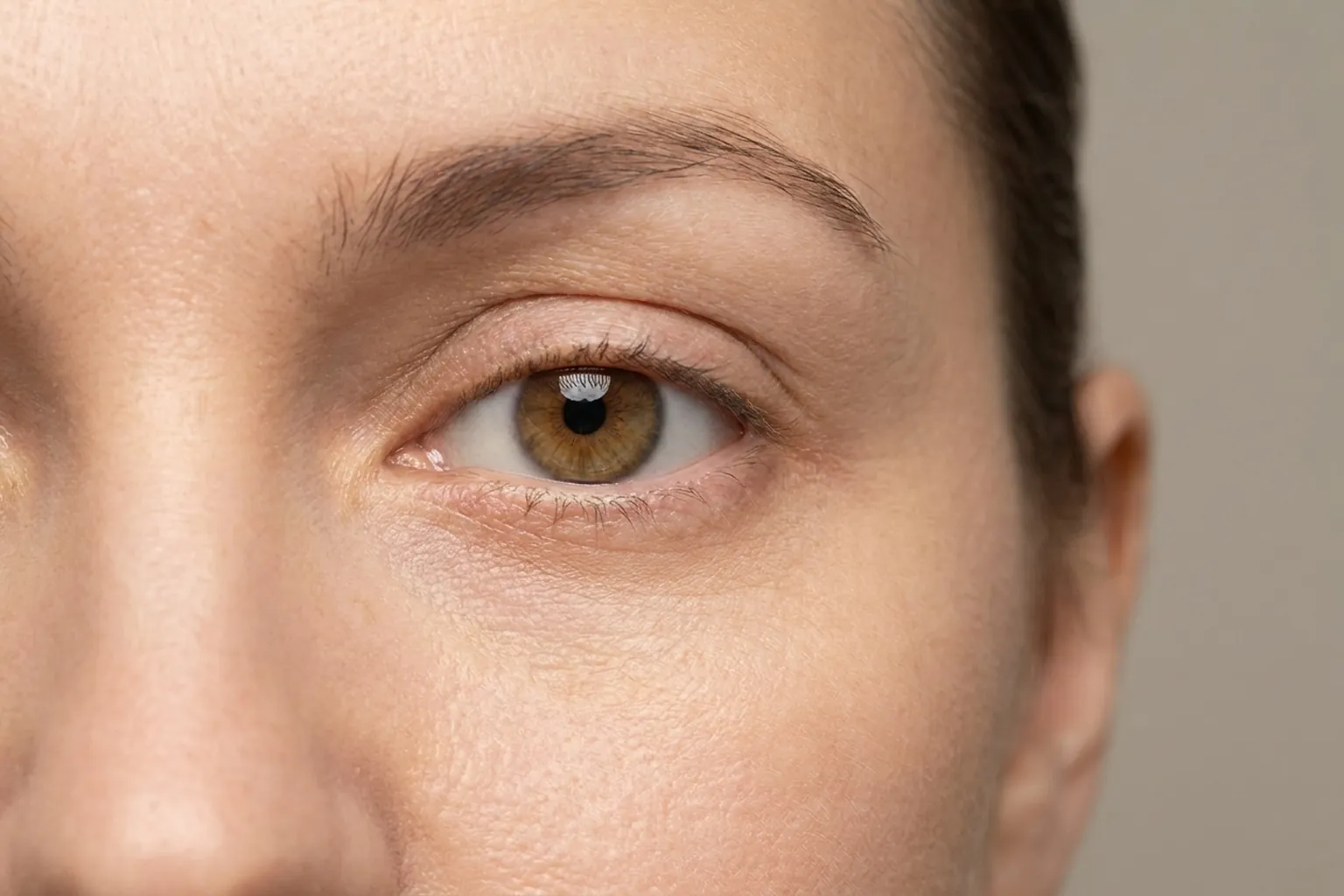
Positive does not mean better, and it does not mean the eye is open or large. Tilt is a direction. Other features, such as the height of the opening, the lid position and the brow gap, vary independently of it.
How canthal tilt is measured
The method has three parts: mark the corners, draw a reference line and read the angle between them. The corners must be the points where the upper and lower lid margins meet, not the end of a makeup line or an eyelash.
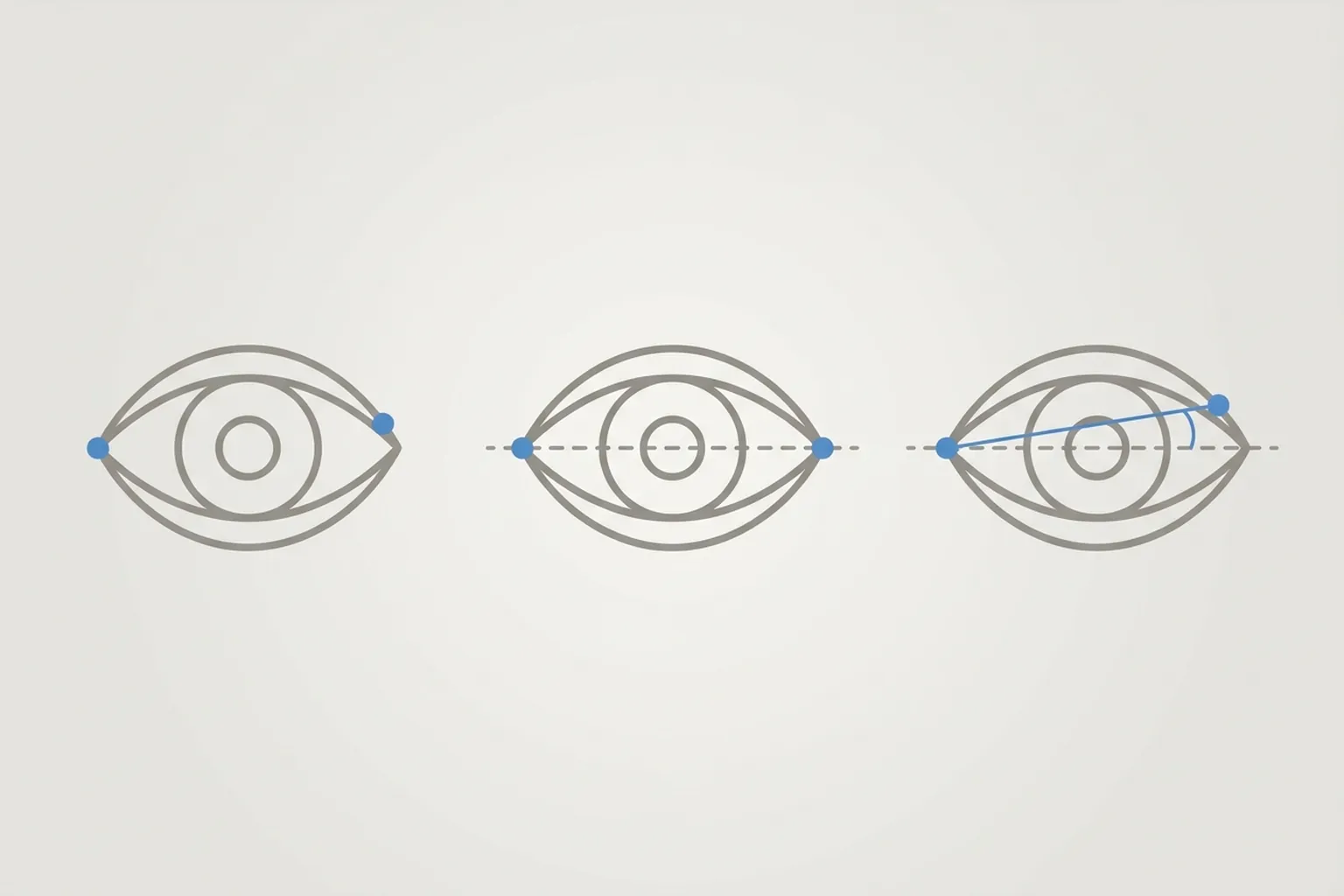
Studies differ in the reference they use. One photogrammetry study defined the angle between a horizontal reference line and the line drawn through the outer and inner corners of each eye. [2] Another measured the angle between the corner line and a line perpendicular to the midline of the face, using frontal photographs taken in the natural head position. [4] Both give an angle that is positive when the outer corner is higher, but they need not agree to the decimal.
Conventions also differ more than the reference line. A study of Caucasian adults that measured angles on two-dimensional photographs reports an inclination of about 88° in a young group and 90° in an older group, because it measures from a different reference line. [5] A three-dimensional study of young Caucasian and Chinese adults defines canthal tilt as a three-point angle at the inner corner. [6] Numbers from papers with different definitions cannot be placed on one scale, so always check how a value was defined.
The step-by-step arithmetic, including the formula for turning pixel coordinates into degrees, is in the guide to negative canthal tilt. The calculation is the same for a positive angle.
What degrees studies report
Published studies measure the angle in healthy or clinic-based groups and report averages by sex. The table lists studies that use a corner-to-corner angle against a horizontal-type reference, with the group each one measured.
On smaller screens, scroll the table to see every column.
| Study and group | Method | Reported average |
|---|---|---|
| 200 South Indian adults aged 18 to 26 [1] | Standardized frontal photographs. | 5.05° in men, 6.10° in women. |
| 300 Malaysian South Indian adults aged 18 to 26 [2] | Frontal photographs; angle from a horizontal reference line. | 4.72° in men, 7.04° in women. |
| 234 Asian men and 264 Asian women, adult means [3] | Slant of the palpebral fissure. | 7.9° ± 2.4° in men, 8.8° ± 2.3° in women. |
| 76 Korean patients, mean age 23.12 [4] | Frontal photographs; reference perpendicular to the facial midline. | 8.45° ± 3.53° right eye, 8.42° ± 3.81° left eye. |
These are group averages from different populations and methods. They are not normal ranges, ideal targets or cutoffs for any label. Where a value follows a plus-or-minus sign, it is the study’s standard deviation.
Three points follow from the table. First, every average is above zero, so a positive tilt is the usual finding in these samples. Second, the spread is wide: standard deviations of 2° to 4° mean that individuals sit several degrees either side of the average, and an average does not show how many people in a group read below zero. Third, averages differ by group and by sex, and women’s averages are higher than men’s in the three studies that report them separately. [1][2][3]
The Korean study also split its participants into classes: 0° to 5° (class I), above 5° (class II) and below 0° (class III). None of the 76 participants fell in class III. [4] Those are that paper’s own research categories, not a standard for everyone.
Age adds a further caution. A three-dimensional study of 68 young and 73 older Caucasian volunteers found that the positions of the inner and outer eye corners shift with age, with both tending to move downward. [5] A reading from one photo at one age is a snapshot, not a fixed trait.
Why head tilt and camera angle change the reading
A photo is a flat view of a curved, moving face, and canthal tilt is a small angle. Anything that rotates or foreshortens the face in the picture can change it.
Head roll
Rolling your head toward a shoulder rotates the whole face in the picture. That rotation adds to the angle of one eye and subtracts the same amount from the other, because the inner-to-outer direction points in opposite ways on the two sides. Rolled by 5°, one eye reads 5° higher and the other 5° lower than the true angle. Averaging both eyes cancels most of that error, but the per-eye numbers are then misleading.
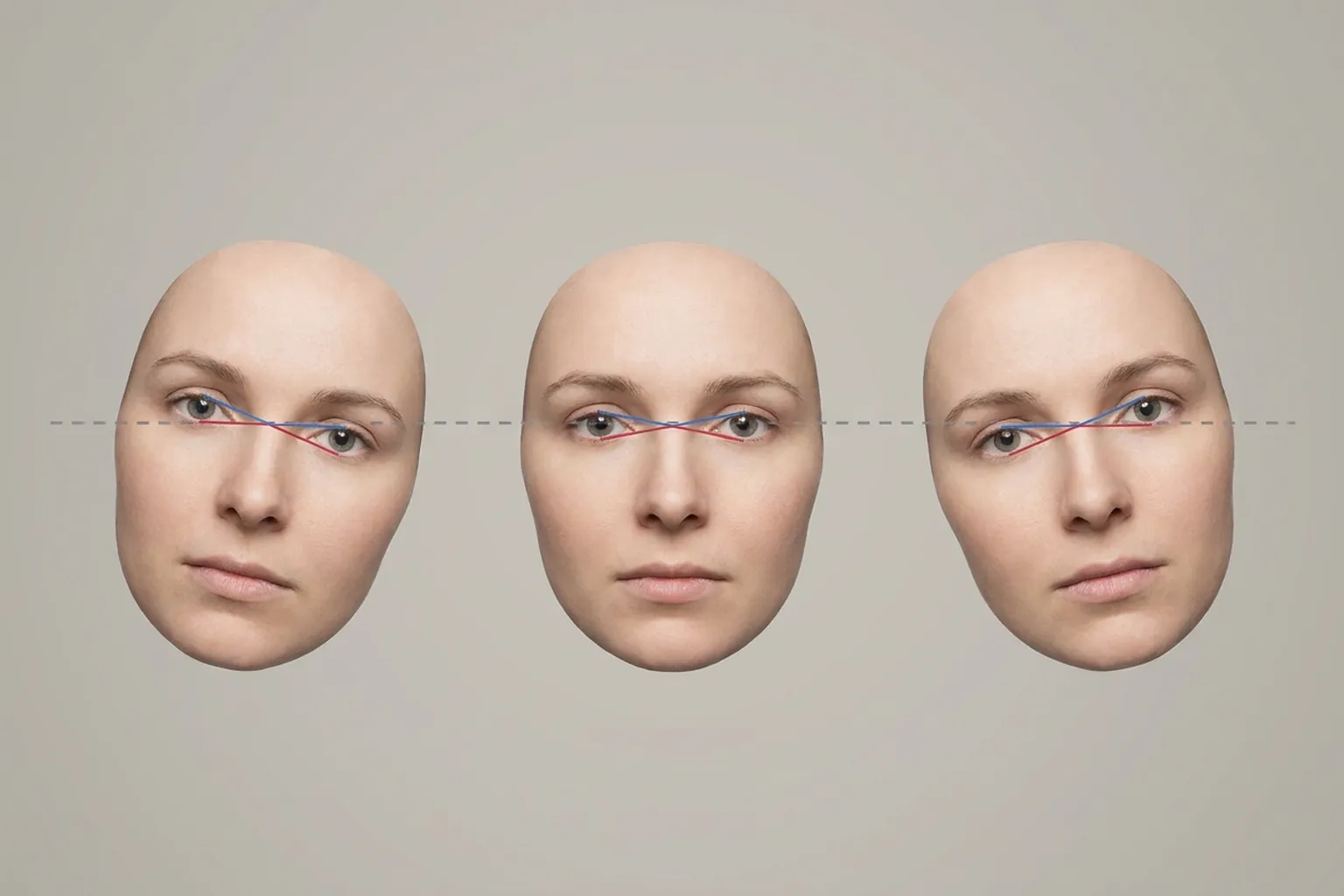
The FaceCoda calculator rotates the landmarks so the line between your two iris centers is level before it measures. That removes head roll, but it assumes your two eyes sit at the same height. One clinical study measured average vertical differences of 1.57 mm between pupils and 2.03 mm between outer corners in its 76 participants. [4] Spread across an interpupillary distance near 64 mm, the 1.57 mm pupil difference equals roughly 1.4° of roll (an illustrative calculation for this guide, not a result from either study), so a corrected reading can still carry about a degree of uncertainty. [3][4]
Turning, looking up or down, and lens distance
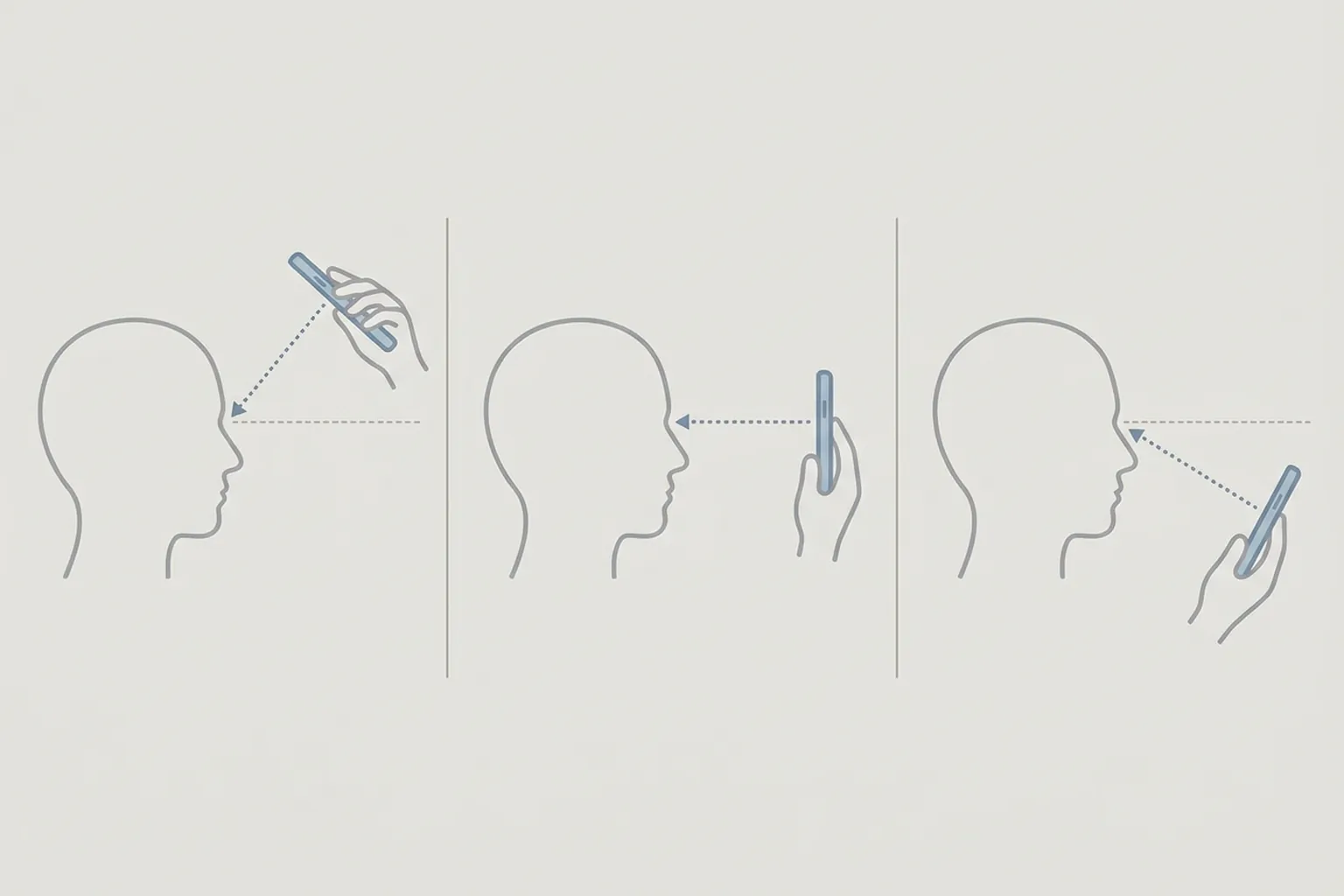
Turning your head sideways shortens the horizontal distance between the corners in the picture while the vertical difference stays the same, which makes the angle look steeper. A camera held above or below eye level changes how the face is foreshortened. A phone held very close adds perspective distortion, because the nose side of the face is nearer the lens than the temple side.
Research protocols control these factors. Studies photograph people in a natural head position looking straight ahead, with the camera aligned to the eyes or the head set on a standard plane, and without expression. [2][4][5] Even so, the authors of a three-dimensional study note that direct comparisons of two-dimensional measurements between studies are difficult, because equipment, environment, measurement personnel and methods all differ. [6]
Landmark placement
Small angles come from small pixel differences. On a photo where one eye is 100 pixels wide, moving one corner by a single pixel changes the angle by about 0.6°. In a study of 46 Caucasian volunteers, the authors’ landmark protocol gave very good reliability for two-dimensional measurements, but reliability is not the same as accuracy. [7]
How to photograph your eyes for a reliable reading
The aim is to copy a research setup in a simple way. The goal is a photo that you could repeat tomorrow and get the same angle.
Keep your head upright
Hold your head level and face the camera directly, without turning or tipping your chin. Look straight at the lens.
Put the lens at eye level
Raise a phone or camera until the lens is level with your eyes. Hold it at arm’s length or further to avoid close-up distortion.
Relax your face
Keep your eyes naturally open and your expression neutral. Smiling and squinting change the lid position near the outer corner.
Light both corners and clear the view
Use soft, even light from the front, remove glasses and keep hair off the outer corners. Avoid filters, which can alter the eye area.
Take several photos
Take two or three and compare the readings. If they disagree by more than a degree or two, the setup is the cause, so retake them.
To read the angle from a photo you already have, use the free Canthal Tilt Calculator. It reports each eye in degrees, shows whether the reading is positive, neutral or negative, and draws the corner lines on the photo so you can check where it placed them. It runs in your browser, unlike the Hunter Eyes Test, which sends the photo to FaceCoda’s server.
Positive tilt and eye shape words
Eye shape words mix three different things: the outline of the eyelid opening, its angle and how deep the eye sits. Canthal tilt covers only the angle.
Upturned is the everyday word for a clearly rising corner line. The upturned eyes page shows that shape, and the downturned eyes page shows the opposite direction. No source used here sets a degree cutoff for the word upturned, so a positive reading does not automatically put an eye in that category.
Almond describes the outline of the opening, which tapers toward both corners. An almond eye can be level or slightly lifted at the outer corner, and it can also be upturned, so almond and positive tilt can both be true at once. See the almond eyes page for the outline.
Positive tilt is also one of the four measurements people mean when they talk about hunter eyes, along with upper iris coverage, the height-to-width ratio of the eye opening and the brow gap. The tilt alone does not decide that label. For the full picture, read what hunter eyes are and the comparison of hunter eyes vs prey eyes.
Neutral and negative tilt, briefly
Zero degrees is the geometric boundary between the directions. A neutral tilt means the corners are close to level, and a negative tilt means the outer corner sits lower than the inner corner. The FaceCoda calculator uses a buffer: below -1° reads as negative, -1° to +1° as neutral and above +1° as positive. The buffer keeps small landmark variations from flipping a band, and it is a product rule, not a clinical standard.
A negative or neutral reading is as much a measurement of direction as a positive one. None of the three says anything about eye health or function. If you notice a new change in how your eyelids sit, or discomfort, an eye professional can assess it; a photo tool cannot.
The guide to negative canthal tilt explains the downward direction, its degree readings and the limits of photo measurements in more detail. A positive reading is also a different question from symmetry, and the Face Symmetry Test looks at the balance between the two sides of the face.
FAQ
Positive describes the direction of an angle. It does not grade a face.
What is canthal tilt?
Canthal tilt is the angle of the line that joins the inner and outer corners of an eye, measured against a horizontal reference. Clinical papers call it palpebral fissure inclination. The sign tells you the direction: positive when the outer corner is higher, negative when it is lower.
What is a positive canthal tilt?
A positive canthal tilt means the outer corner of the eye sits higher than the inner corner, so the line between them rises toward the temple. It is a measurement of direction in degrees. It does not say anything about health, and it is not a rating of a face.
What degree is a positive canthal tilt?
Geometrically, any angle above 0° is positive. FaceCoda's calculator labels readings above +1° as positive and treats -1° to +1° as neutral, which is a product buffer rather than a clinical range. Published group averages in the studies cited here run from about 4.7° to 8.8°, depending on the population and the method. Open the Canthal Tilt Calculator.
Why do my two eyes show different canthal tilts?
Head roll adds to one eye's angle and subtracts from the other's by the same amount. Natural differences between the two sides also exist: one clinical study measured average vertical differences of about 2 mm between the outer corners of the two eyes. Retake a straight-on photo before reading anything into a small difference.
Can a photo give an accurate canthal tilt?
A photo gives a repeatable estimate when the pose and framing are controlled, but it cannot be exact. Corner placement, head position, lens distance and expression all affect it. Treat a reading as an approximate direction, and compare photos taken under the same conditions.
Is a positive canthal tilt better than a negative one?
No source used here ranks one direction above the other. The sign describes where the outer corner sits relative to the inner corner. Opinions about which looks better differ between people and are not measurements.