

What are hunter eyes?
Hunter eyes is an informal internet term for an eye area that looks narrow and focused. Online descriptions usually mention an outer corner that sits higher than the inner corner, an upper eyelid that covers part of the iris, and a short distance between brow and eye. It is a nickname for how a set of features looks together, not a medical term and not a verdict on a face.
This guide explains where the term comes from, the four measurements that turn it into numbers, and how those numbers relate to real anatomy. It also says plainly what is not known, and you can measure those four numbers on your own photo with the Hunter Eyes Test. The photo-style illustrations are AI-generated educational examples, not photographs of real people.
What hunter eyes means
The phrase circulates in online appearance communities, such as looksmaxxing forums and social video, and not in ophthalmology or anatomy texts. No source used in this guide defines it or traces its first use, so every definition you find is an informal one. Descriptions differ from page to page, which is why this guide uses a fixed set of four measurements instead of a single picture.
The name borrows from animals. In a study of 321 mammal species, placental mammals that eat other animals had higher average orbit convergence, which means more forward-facing eye sockets, than mammals that do not. The same study describes primates as having forward-facing orbits. [8]
Humans are primates, so human eye sockets face forward. The contrast between side-set prey eyes and forward-set predator eyes therefore does not describe differences between human eyes. It works as a metaphor for appearance, and it does not sort people into types.
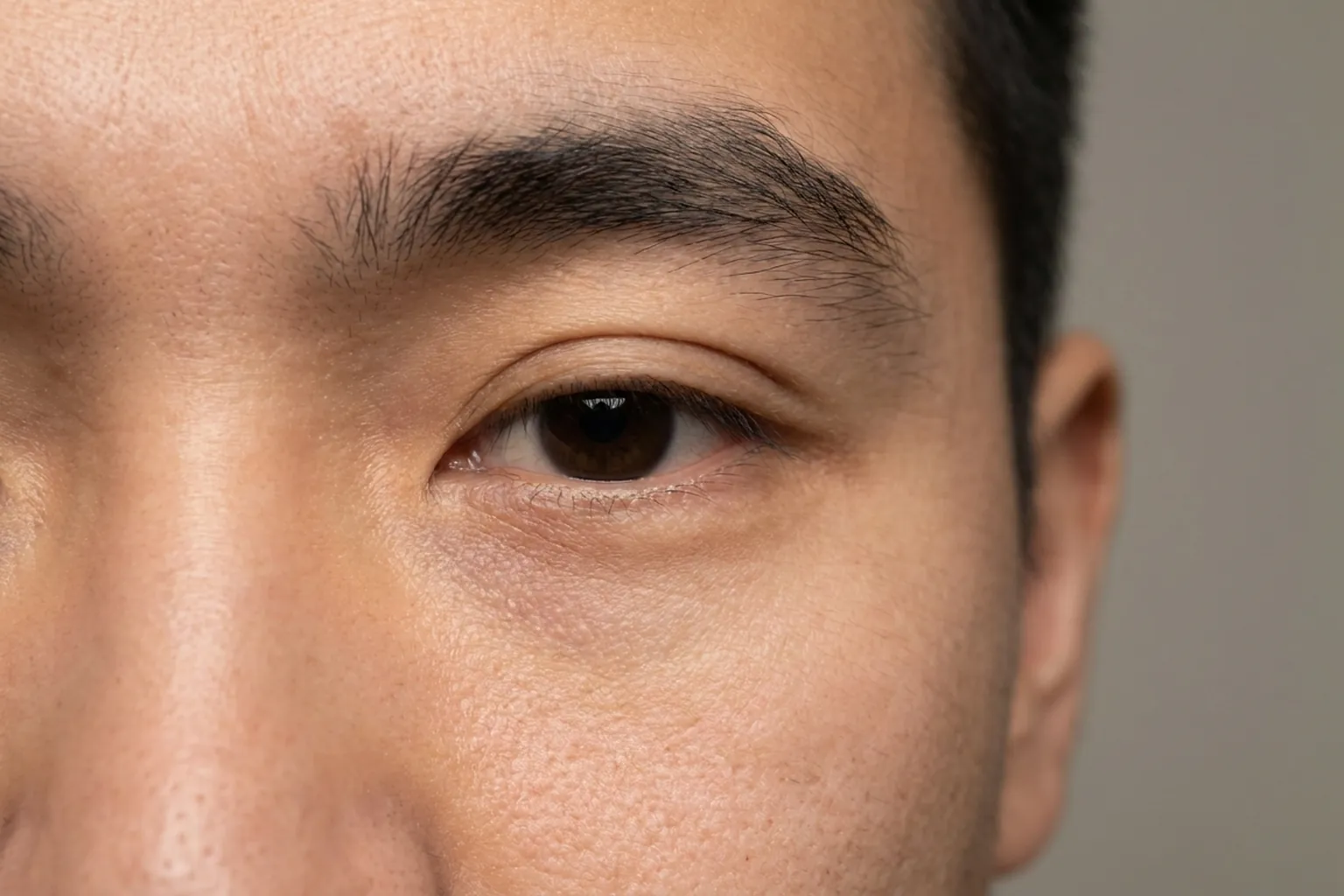
Most descriptions agree on the general look and disagree on the details. Some stress a deep-set impression, some stress the upturned corners, and some stress the lid. Treating these as separate dimensions is the most useful way to read the term.
The four measurements behind the term
The Hunter Eyes Test reports four numbers: canthal tilt, upper iris coverage, eye shape ratio and brow-to-eye distance. Each one has a counterpart in the anthropometric literature, where researchers measure eyes on photographs or directly on patients. The table gives the clinical counterpart and what published studies report, with the group each study measured.
On smaller screens, scroll the table to see every column.
| Measurement | What it describes | What published studies report |
|---|---|---|
| Canthal tilt | The angle of the line from the inner to the outer eye corner, against a horizontal reference. | Group means of 5.05° in men and 6.10° in women in 200 South Indian adults aged 18 to 26 [3], and 7.9° in men and 8.8° in women among adults in a study of 234 Asian men and 264 Asian women [4]. |
| Upper iris coverage | How far the upper eyelid margin sits over the iris. | Clinical sources describe it in millimetres: the upper lid normally covers 1.0 to 2.0 mm of the top of the cornea [2]. |
| Eye shape ratio | The height of the eyelid opening divided by its width. | About 0.30 to 0.31 from the means of one Asian sample, 0.36 to 0.39 from a South Indian sample and 0.32 to 0.33 from a Nigerian sample (ratios of group means, worked out for this guide) [1][3][4]. |
| Brow-to-eye distance | The space between the lid and the lower edge of the brow. | Mean brow height of 13.1 mm in men and 13.6 mm in women in 500 adults in Enugu, Nigeria, measured from the lash line to the lower border of the brow at its highest point [1]. |
These are group averages from different populations, ages and methods. They are not normal ranges, and they are not cutoffs for hunter eyes. FaceCoda’s reading bands and scoring curves are product rules, not clinical standards.
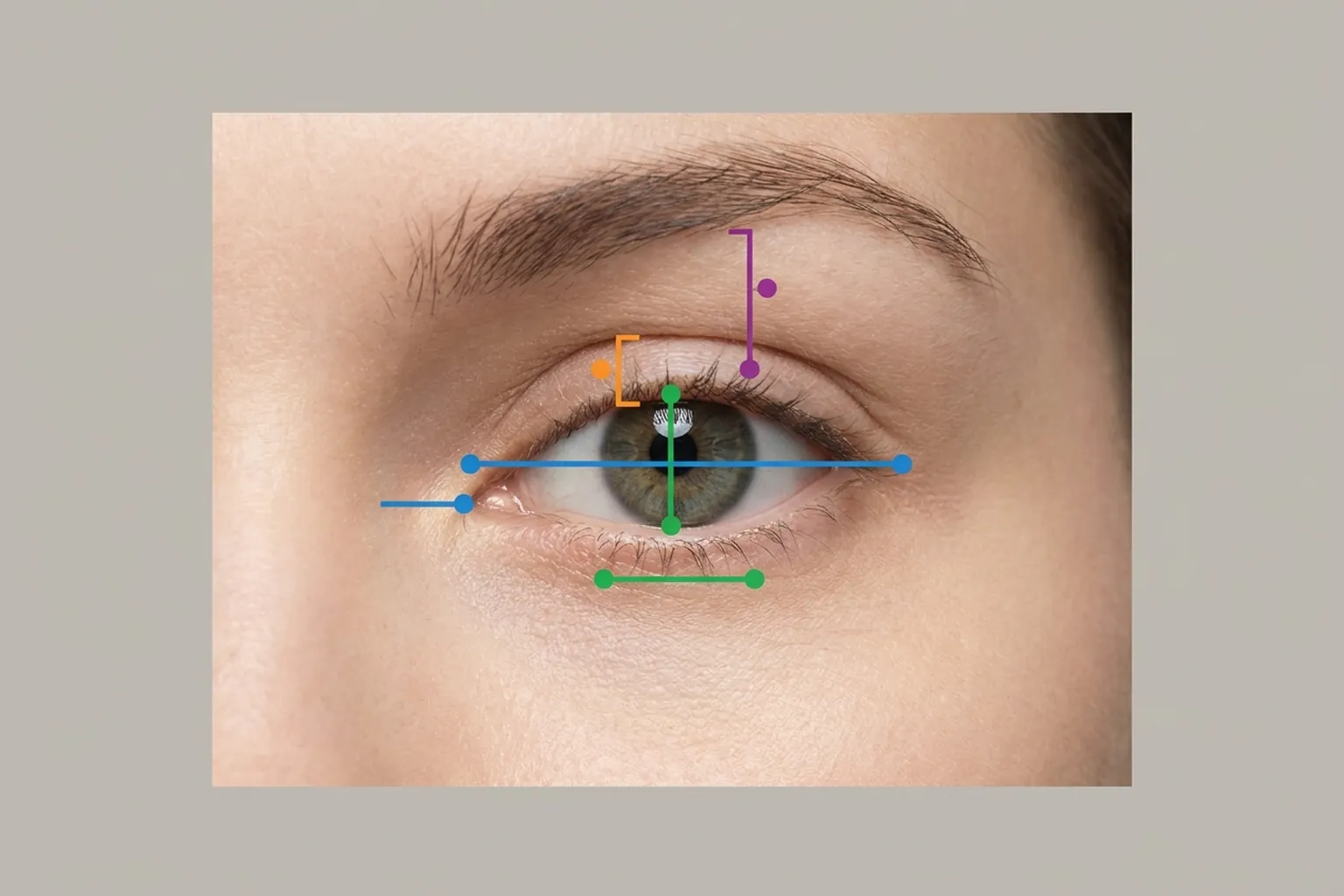
Two details matter when you compare numbers. First, studies define the vertical opening and the brow gap in slightly different ways, so values from different papers are not interchangeable. Second, the Hunter Eyes Test divides the brow gap by the width of the eye, so it does not depend on how far the camera was from your face.
Iris coverage deserves one more note. A lid margin that sits clearly lower than usual is called blepharoptosis, or ptosis, and the American Academy of Ophthalmology describes it as an abnormal low-lying upper eyelid margin. [2] A photo measurement cannot tell the two situations apart, and a new or one-sided change in how much of the eye your lid covers is a reason to see an eye professional, not to take a test.
For a detailed look at how direction and degrees are read, see the guide to negative canthal tilt, and the positive canthal tilt guide for the upward direction.
How the measurements relate to anatomy
Hunter eyes is not one anatomical feature, so it helps to keep the neighboring terms apart. Each of the following describes something different, and any of them can occur with or without the others.
Upturned corners and canthal tilt
An upturned outer corner is the visual side of a positive canthal tilt. Studies of adult groups report average tilts above zero, so an outer corner higher than the inner corner is a common finding in those samples. [3][4] An average cannot tell you how many individuals sit above or below zero, and a single photo reading carries its own error. The upturned eyes page shows the shape itself.
Deep-set eyes
Deep-set describes how far back the eye sits in the socket. Clinicians measure the position of the eyeball with an exophthalmometer, which records the distance from the outer rim of the eye socket to the front of the cornea. [6] A front photo cannot measure that depth. A short brow gap and the shadow it casts can make an eye look deep-set without showing anything about the socket, so treat deep-set as a visual impression here. FaceCoda’s deep-set eyes page explains the look.
Hooded eyes
Hooded describes a fold of skin that covers the eyelid crease. It concerns skin above the lid, while iris coverage concerns the position of the lid edge. Clinical sources treat redundant upper lid skin and a low lid margin as separate findings that can occur together. [2] The hooded eyes guide shows how to tell a fold from depth and from a monolid.
Almond eyes
Almond describes the outline of the eyelid opening, which tapers toward both corners. It does not say which way the corners point, so an almond eye can be upturned, level or downturned. See the almond eyes page for the outline.
What is known and what is not
The measurements are real and the label is informal. That difference decides what you can and cannot conclude from a reading.
- The term is informal. It has no clinical definition, and none of the sources here uses it.
- The dimensions can be measured. Researchers measure the corner angle, the opening and the brow gap in adults of many populations, and the values vary with sex, age and group. [1][3][4]
- No source ties it to personality or ability. People readily agree on the traits they read into faces, but a review of that research argues that the diagnostic validity of those judgments has been greatly overstated. [7] Nothing here suggests that a narrow eye predicts how someone thinks, acts or performs.
- Prevalence is unknown. The sources used here do not say how many people have hunter eyes, because the label has no agreed cutoffs.
- A photo has limits. It shows a two-dimensional view that depends on pose, light, expression and lens, and it cannot show bone, eyelid function or health.
The label also says nothing about whether an eye area is more or less attractive. Online lists often turn a description into a ranking, but a measurement is not a rating. This guide describes how an eye area looks and leaves out value judgments.
How to take a usable photo
A reading is only as good as the photo behind it. Research photographs are taken under controlled conditions for this reason. In one study of Malaysian South Indian adults, the camera sat on a tripod, was aligned with the subject’s eyes using a grid, and the subject held a natural head position with eyes open and looking straight ahead. [5] You can copy the spirit of that setup at home.
Square up to the camera
Hold your head upright and face the lens directly, with the lens at eye level. Do not look up or down, and do not turn your face to one side.
Use even, front light
Soft light from the front keeps shadows out of the eye corners and under the brow. A strong light from above deepens the shadow at the brow and can make the gap look shorter.
Relax your face
Keep your eyes naturally open and your brows relaxed. Smiling, squinting and raising the brows change the opening and the gap.
Keep the view clear
Remove glasses, keep hair off the eye corners, and skip filters and wide-angle close-ups. Hold the camera at arm’s length or further.
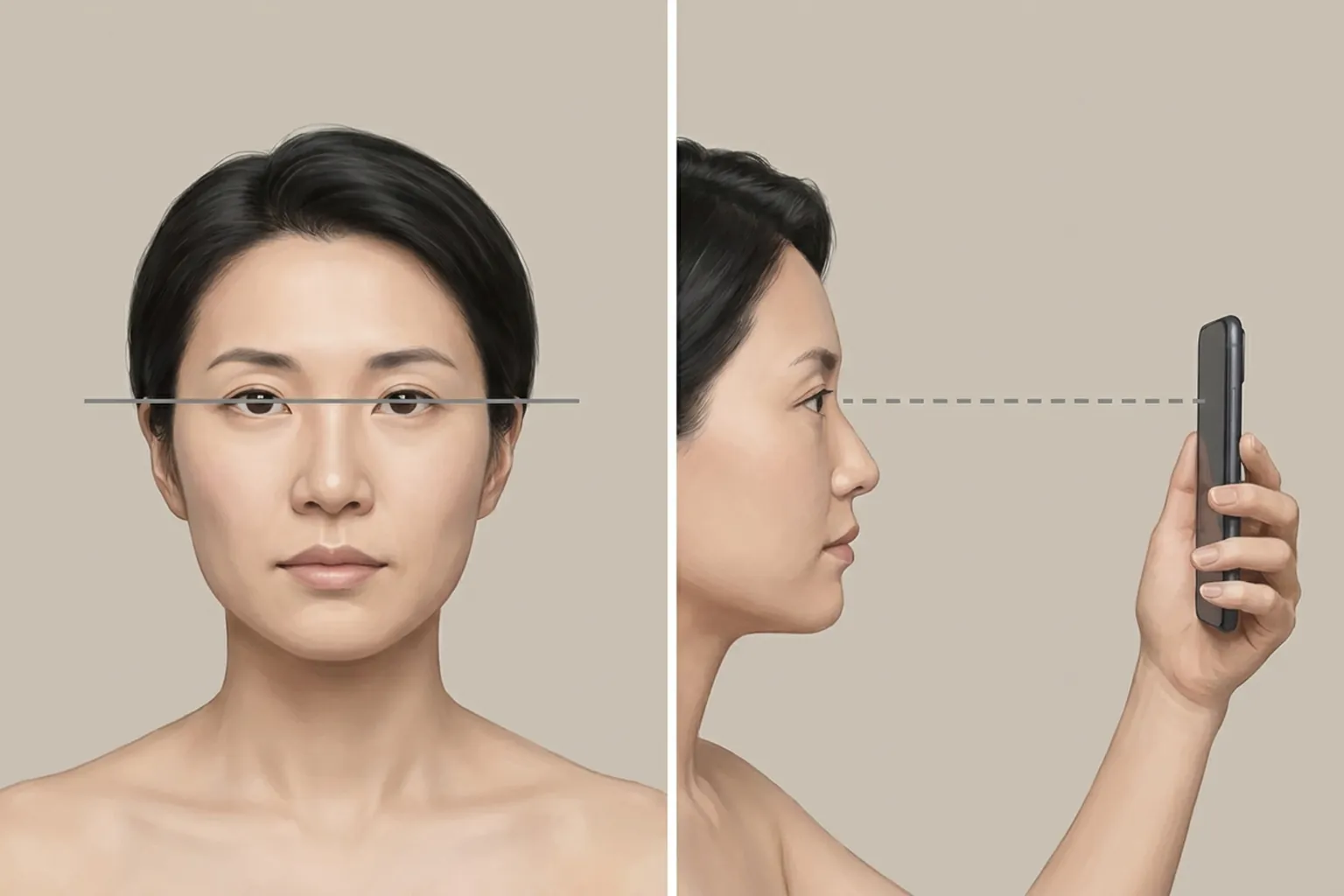
Take two or three photos and compare them. If the readings change a lot between photos, the setup is the cause, not your eyes.
How the Hunter Eyes Test reads a photo
The Hunter Eyes Test finds landmarks on your face and reports the four measurements above. It also gives an experimental 0 to 100 score that compares the readings with preset reference curves. The score is a product rule. It is not a probability, not a ranking and not a medical assessment.
It does not measure eyelid crease coverage, socket depth or any condition of the eye. Read the four numbers first, and treat the score as a summary of them. Mixed or in-between readings are ordinary and do not need a label.
Privacy works differently here than in most FaceCoda tools. The Hunter Eyes Test sends your photo to FaceCoda’s server for analysis, while the free canthal tilt calculator and the other tools run in your browser. The privacy policy describes how photos are handled.
Related terms and where to go next
Hunter eyes is usually set against prey eyes, a rounder and more open appearance. The hunter eyes vs prey eyes guide compares the two across the same four measurements and explains why a third, ordinary answer exists.
Two neighboring guides cover features that are often confused with the label. The hooded eyes guide covers the skin fold over the crease. The negative canthal tilt guide covers the opposite corner direction and how degrees are read.
For features beyond the eye area, the eye shapes guide covers outline and angle, the free tools measure other proportions, and the asymmetrical face guide covers the balance between the two sides of the face.
FAQ
Hunter eyes is a visual nickname, not a diagnosis, a personality type or a grade.
What are hunter eyes?
Hunter eyes is an informal internet term for an eye area that looks narrow and focused. Online descriptions usually mention an outer corner that sits higher than the inner corner, an upper eyelid that covers some of the iris, and a short distance between brow and eye. It is not a medical or anatomical category.
What causes hunter eyes?
The label combines several separate features, and each has its own anatomy. Corner direction, eyelid position, the shape of the eyelid opening and brow position vary between people and between populations. No source used here describes a single cause of the combination, and a photo cannot show which tissues contribute.
Do hunter eyes mean anything about your personality?
No source used here links these measurements to personality, ability or behavior. A published review of how people judge faces argues that the diagnostic validity of such judgments has been greatly overstated. Hunter eyes describes how an eye area looks, nothing more.
How can I tell if I have hunter eyes?
Use a straight-on photo with your head upright, even light and a relaxed expression, then check four things together: canthal tilt, upper iris coverage, the height-to-width ratio of the eye opening and the gap between brow and eye. No single measurement decides the label, and mixed readings are common. Take the Hunter Eyes Test.
Can women have hunter eyes?
Yes. The term describes four appearance measurements: upward canthal tilt, upper iris coverage, a narrow opening ratio and a short brow gap, and none of them belongs only to men. In the adult studies cited on this page, average canthal tilt was 6.10° in women versus 5.05° in men in a South Indian sample, and 8.8° versus 7.9° in an Asian sample, while eye-opening ratios and brow heights sat in similar ranges. The label describes how those features look together, regardless of sex.
Is the Hunter Eyes Test private?
The Hunter Eyes Test sends your photo to FaceCoda's server for analysis, unlike FaceCoda's other free tools, which run in your browser. The privacy policy explains what happens to photos. Read the privacy policy.