

Asymmetrical face
An asymmetrical face is the usual human pattern, not an exception. In one study that scanned 100 healthy volunteers in three dimensions, a face differed from its own mirror image by 0.80 mm on average, with a spread of 0.24 mm. [1]
A single photo often shows more asymmetry than the face has, because head turn, lens distance, expression and light all add differences of their own. This guide covers what studies of healthy people report, how to separate photo effects from real differences, how a symmetry measurement works and where it stops. It also lists the signs that need urgent medical care, because a photo cannot diagnose anything.
Is an asymmetrical face normal?
Yes. Researchers who measure healthy faces in three dimensions find left-right differences in every group they study. The size of the difference depends on the method, the landmark and the sample, so the numbers below describe each study rather than a single rule.
| Study | Who and how | What it reports |
|---|---|---|
| Taylor et al., 2014 [1] | 100 volunteers, three-dimensional photogrammetry, face at rest | Mean root mean square deviation from the mirrored face of 0.80 ± 0.24 mm |
| Hwang et al., 2012 [2] | 48 adults with normal occlusion, cone-beam CT models, 27 soft tissue landmarks | Left-right differences of 0.6 to 4.6 mm, larger for lower and more lateral landmarks |
| Linden et al., 2018 [3] | 191 volunteers aged 0.3 to 88 years, three-dimensional photogrammetry | Root mean square deviation clustered between 0.4 and 1.3 mm, with a mean of 0.8 ± 0.2 mm |
| Harnádková et al., 2023 [4] | 300 healthy adults aged 20 to 80, 28 landmarks | Directional asymmetry present in the whole sample |
The last study describes a pattern as well as a size. In its sample the average midline bent in a slight C shape, so the asymmetry was not random noise around a straight line. [4]
The same studies show where differences tend to sit. Hwang and colleagues found larger left-right differences lower on the face and further from the midline. [2] Taylor and colleagues classified where the greatest asymmetry was localized and reported 49% in the middle facial third, 41% in the lower third and 10% in the upper third. [1]
The studies do not agree on age. Linden and colleagues reported that asymmetry increased with age across their sample. [3] Harnádková and colleagues, studying adults from 20 to 80, wrote that they did not attribute an increase in asymmetry to age. [4] The samples and methods differ, so both can be reported without forcing a single answer.
No source here explains why any one person’s two sides differ. One research group describes human facial asymmetry as a complex interaction of genetic and environmental factors. [6]
Your own eye is also an unreliable measuring device. In Taylor’s study, observers who scored facial asymmetry by eye agreed poorly with each other (r = 0.56), while the quantitative measurements agreed closely (r = 0.91 to 0.95). [1] That is one reason a face can look more uneven in a mirror or photo than a measurement finds.
These studies used three-dimensional scans and clinical reference methods. Their values do not convert into a score from one phone photo, and none of them gives a cutoff you could apply to your own picture. The study that separated healthy volunteers from patients with a pathological process did so with three-dimensional photogrammetry, not with a single image. [1]
Real asymmetry or a photo effect?
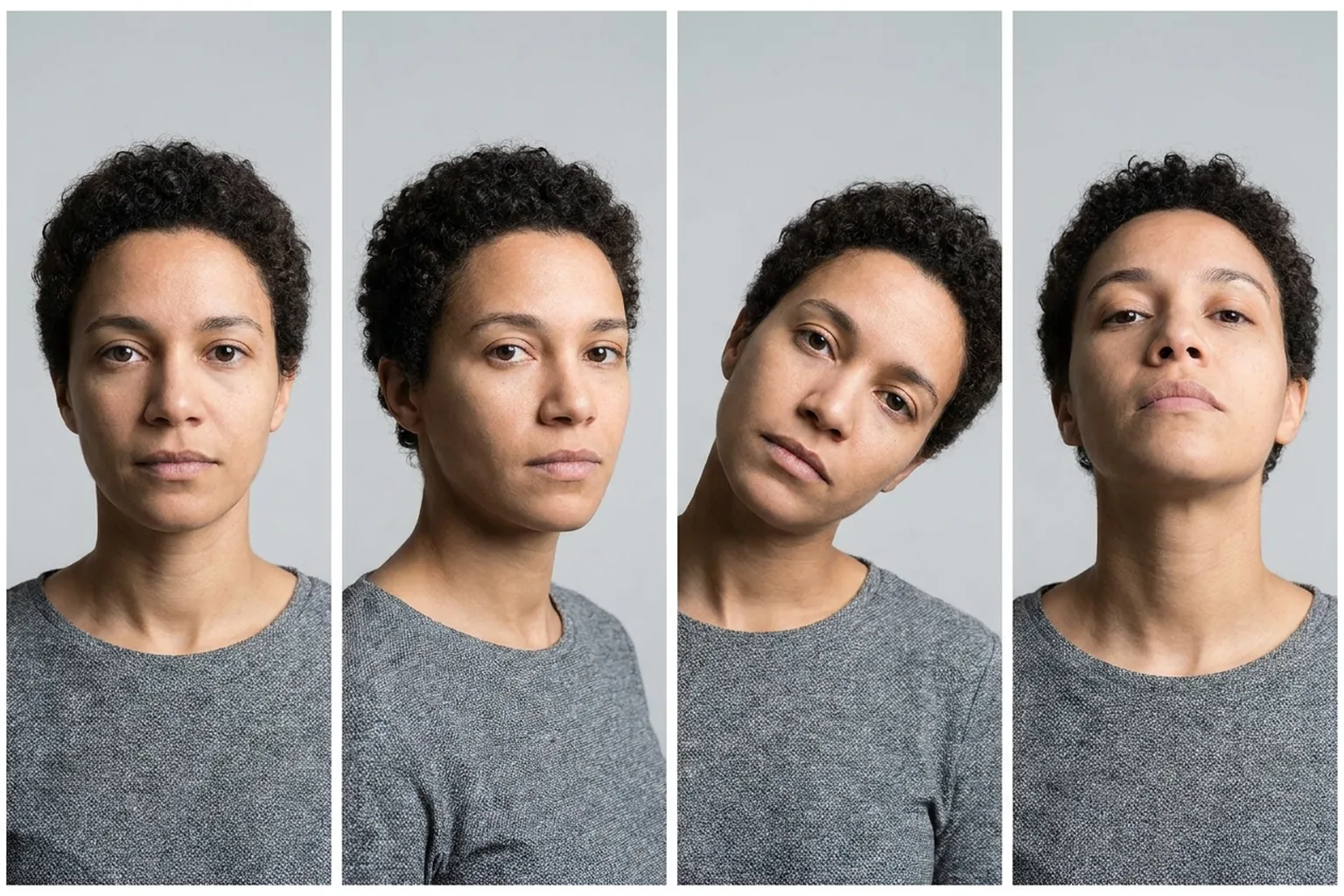
A photograph records one moment from one position. Before you read a difference as part of your face, check whether the photo could have created it.
| Factor | What it can change | How to check |
|---|---|---|
| Head turn | The near side looks wider, and jaw and cheek points shift apart | Keep both ears equally visible |
| Head tilt and camera height | A phone below the chin lengthens the jaw and changes the brow pairs | Put the lens at eye level |
| Lens distance | Features nearest the lens are exaggerated | Hold the camera farther away |
| Expression | A half smile, raised brow or squint moves points on one side | Relax and keep the mouth closed |
| Lighting | Strong side light hides an eye corner or jaw edge | Use soft, even front light |
| Hair and accessories | Hair over a brow or jaw hides the points being compared | Pull hair back |
Lens distance has the clearest evidence. A study of 12 subjects photographed with a smartphone and a full-frame camera at six distances, with the 60 inch full-frame photo as the reference. At 8 inches the smartphone stretched the midface vertically by 18%, and at 12 inches by 12%. [5]
That study measured vertical stretching of the midface, not left-right differences. It shows that a close selfie changes facial proportions. When the head is also turned, one side sits nearer the lens than the other, so the same effect could differ between sides. That last point is a geometric inference; the study did not measure it.
The other factors in the table come from how FaceCoda’s own test reads a photo, not from a clinical study. They are the conditions that most often move landmarks in practice.
A simple check helps. Take three photos in the same setup and compare them. A difference that moves, shrinks or switches sides between photos came from the capture. A difference that appears in all three is a stable feature of how your face looks in a straight-on photo, which still says nothing about its cause.
Also check the photo’s orientation. Some front cameras save a mirrored selfie, so the left of the image shows the left side of your face instead of the right. If you compare the sides, confirm which version you are looking at.
How a symmetry measurement works
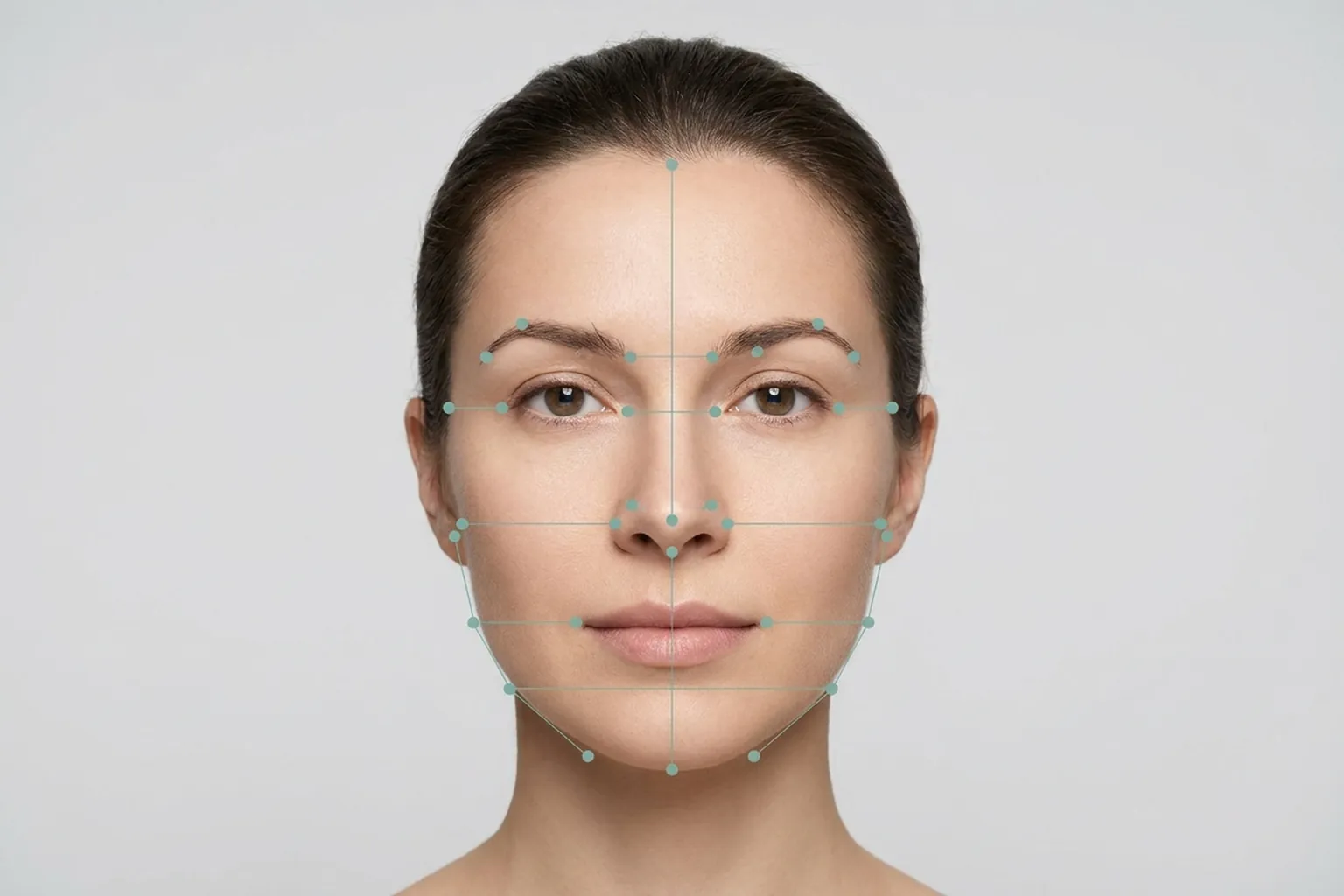
A symmetry measurement turns the question “do the two sides match?” into distances between pairs of points. The Face Symmetry Test follows these steps.
Find the landmarks
Google’s MediaPipe Face Landmarker finds 478 facial landmarks on your photo. This runs in your browser, so the photo does not need to be uploaded for this tool.
Fit a midline
The test fits a line through five central points: the top of the face, the forehead, the bridge of the nose, the nose base and the chin. The photo’s vertical centre is not used, because a face can sit off-centre in the frame or be slightly turned.
Mirror twelve pairs
For each of twelve left-right landmark pairs, one point is mirrored across the midline. The gap between the mirrored point and its real partner is measured. That gap is expressed as a share of how far the pair sits from the midline, so a wide jaw and a narrow mouth are judged on the same footing.
Combine the groups
Each gap becomes a 0 to 100 reading, the pairs are averaged within their feature, and the five features are combined with fixed weights. The result is one overall score plus a reading for each feature.
| Feature | Pairs | Weight | What is compared |
|---|---|---|---|
| Eyes | 4 | 25% | Outer and inner corners, upper and lower lids |
| Eyebrows | 3 | 15% | Inner, peak and outer brow points |
| Nose | 1 | 10% | The two sides of the nose near the nostrils |
| Mouth | 1 | 15% | The two mouth corners |
| Jawline | 3 | 35% | Temple, cheekbone and lower-jaw points |
The weights are a product choice, not a finding from the studies above. They mean the jawline group has the largest effect on the total, and the jaw pairs are also the most sensitive to a small head turn. Read the per-feature readings before the overall number. They show whether a lower score comes from one feature or from the whole face.
The 0 to 100 score and its reading bands are reading aids for this tool. They are not medical categories and not a ranking of attractiveness. Symmetry is also one of the four components of the attractiveness test score, next to facial thirds, fifths and face ratio, which answer different questions.
What a photo measurement cannot tell you
A symmetry score describes how a set of points lined up in one picture. Several limits follow from that.
- It has no depth. Hwang and colleagues found that overall differences came from transverse, sagittal and vertical components, and they concluded that three-dimensional evaluation is essential. [2] A front-facing photo has no depth, so it cannot see the sagittal part.
- Points are not bones. The landmarks sit on the skin surface and the outline of the face. They cannot separate bone, muscle, fat and skin, so a reading does not say what makes a difference.
- Small changes move the score. A few degrees of head turn or a different expression can shift the reading, so compare scores only between photos taken the same way.
- The bands are not clinical. The studies above give reference values from three-dimensional scans, and none of them defines a cutoff for a score from one phone photo. [1][2]
- It cannot tell you why. The cause of a left-right difference is outside what a landmark reading can say.
For other aspects of the same photo, separate tools answer separate questions. The Golden Ratio Face Test measures proportions down and across the face, and the Canthal Tilt Calculator reports an angle for each eye. Because it reports each eye separately, you can see how the negative or positive direction compares between the two sides.
How to take a fair photo
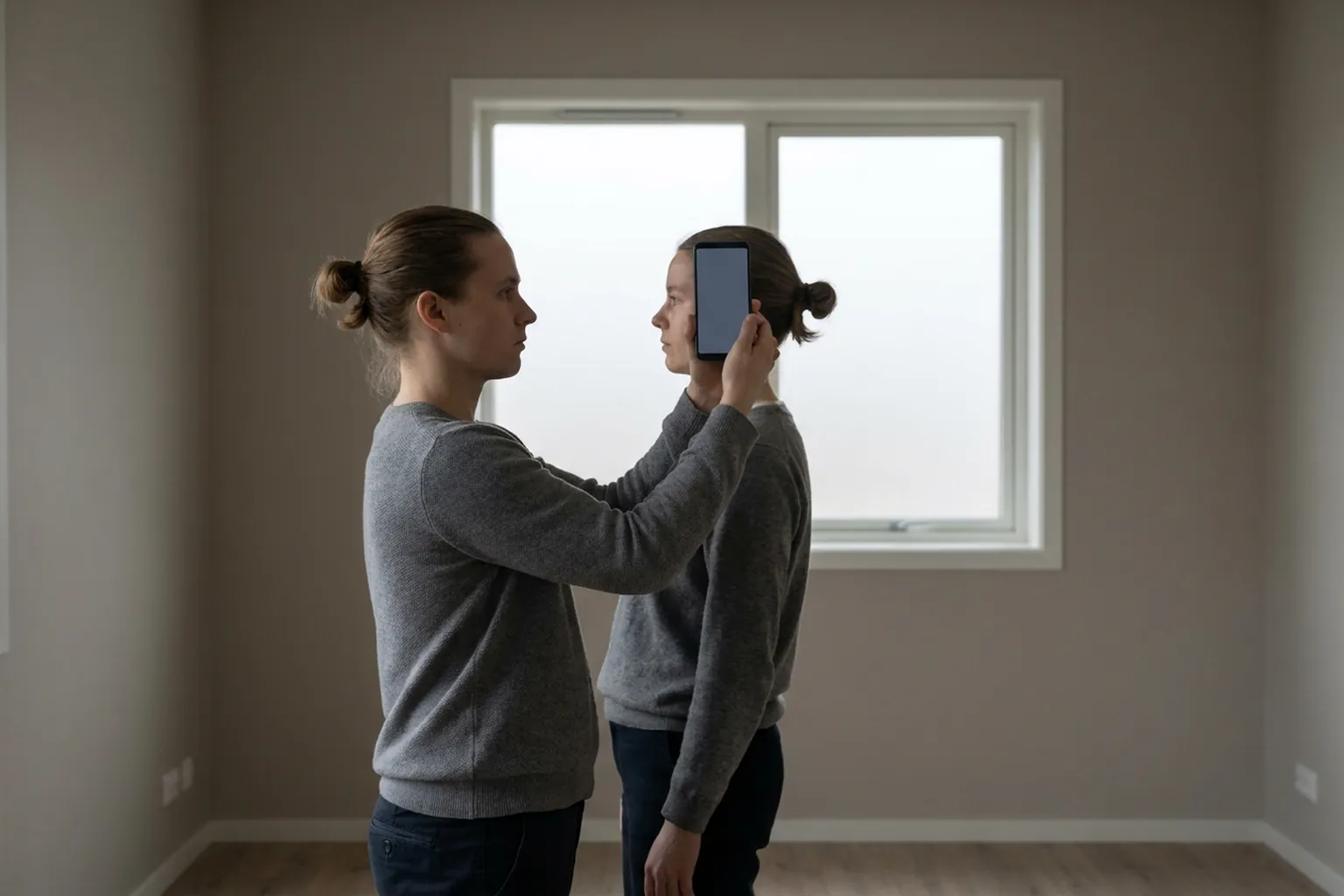
The aim is to remove as many photo effects as you can, so that what remains is more likely to be a stable feature of your face.
Face the camera directly
Keep your chin level and both ears equally visible. Do not turn toward one side.
Put the lens at eye level, at arm’s length or farther
The distortion study found changes at 8 and 12 inches, so a camera held much closer than arm’s length is the wrong setup. [5] Do not hold the phone below your chin.
Relax your face
Use a neutral expression with your mouth closed. Smiling, squinting or raising one brow moves the points the test compares.
Use soft light from the front
A window behind the camera works well. Avoid a strong light from one side.
Clear the hair and accessories
Pull hair back from your forehead, brows and jawline. Remove glasses if they hide the eye corners.
Take three photos and compare
If a feature reads the same in all three, treat it as stable for that setup. If it changes from photo to photo, the setup is the cause.
When a change in your face needs medical care
A lifelong, familiar difference between your two sides is a different situation from a new change. This page cannot tell which one you have, and a symmetry score cannot either.
Get urgent help for these signs
- A face that droops or sags on one side: the NHS lists this as a sign of stroke, and says it may be hard to smile. [7]
- An arm that will not lift: you may not be able to fully lift both arms and keep them there. [7]
- Speech that changes: slurred words, trouble finding words or sounding confused. [7]
- A sudden change in sight: blurry sight or no sight in one eye or both. [7]
- Loss of strength or sensation along one side of the body, an intense headache, or dizziness or unsteadiness: these are on the same NHS list of stroke symptoms. [7]
The NHS advice is to phone 999 straight away if you think you are having or have had a stroke. It also says to call 999 if you had signs within the last 24 hours, even if they have gone, and not to drive yourself to A&E. [7]
Sudden weakness on one side of the face has other causes too. The NHS describes Bell’s palsy as temporary weakness or lack of movement that usually affects one side of the face, and says that without the stroke signs above you should ask for an urgent GP appointment or contact NHS 111. [8] That advice follows the symptoms, not a photo.
The same applies to a one-sided drooping eyelid, which the hooded eyes guide separates from a fold of skin. This page offers no treatment, surgery or exercise advice, and it makes no judgement about whether a face is better or worse. If a difference is new, growing, painful or follows an injury, ask a clinician rather than a tool.
For more on face geometry, browse the FaceCoda guides, the face shapes and eye shapes pages, or the full set of free tools.
FAQ
Facial asymmetry is a measurement of difference between the two sides, not a diagnosis or a grade.
Is an asymmetrical face normal?
Yes. Studies that scanned healthy volunteers in three dimensions found left-right differences in the whole group, not in a few people. A small difference between the two sides is the ordinary pattern, so having one is not a sign that something is wrong.
How much facial asymmetry is normal?
In one study of 100 healthy volunteers, the average difference between a face and its own mirror image was 0.80 mm, with a spread of 0.24 mm. Another study of 48 adults found left-right differences of 0.6 to 4.6 mm, depending on which landmark was measured. These are millimetre values from three-dimensional scans, so they do not translate into a photo score.
Why does my face look more asymmetrical in photos?
A photo records one angle, one lens distance, one expression and one lighting setup. A small head turn, a camera held below the chin, a half smile or strong side light can each add a difference that is not in your face. Two or three photos taken the same way show which differences stay.
Does facial asymmetry increase with age?
The studies do not fully agree. A study of 191 volunteers aged 0.3 to 88 years found asymmetry rose with age. A study of 300 adults aged 20 to 80 did not attribute an increase to age. Differences in sample and method may explain part of the gap.
Which side of my face is bigger?
A symmetry tool shows where the two sides differ most in that photo, but not why. In a standard photo the left of the image is the right side of your face. Some front cameras save a mirrored selfie, which swaps the sides.
When should I see a doctor about an uneven face?
Get urgent help for a face that has suddenly drooped on one side, especially with weakness in an arm, slurred speech or a sudden change in sight. The NHS says to call 999 for these signs, even if they have stopped. A photo or a symmetry score cannot tell you whether a change is harmless.