

Free eye shape test
What eye shape do I have?
Upload one front photo to measure your eye opening (width ÷ height) and corner direction in your browser, with an eye shape chart and per-eye readings.
Choose a Photo to Begin
Drop your photo here or choose a file.
Use a straight-on photo of one adult with the full face visible.
JPG, PNG or WebP · Max 10 MB · See Photo Tips
Free · No sign-up · Photos are deleted after 14 days.
Example reading from our almond eyes illustration
- Eye shape
- Almond, level
- Width ÷ height
- 3.00
- Corner tilt
- +4.0°
- Style word
- None
How the eye shape detector works
Most eye shape tests ask you to guess in a mirror whether your eyes look round or almond. This eye shape detector measures the geometry instead. MediaPipe Face Landmarker places 478 facial landmarks on your photo right inside your browser, with no server call required for the measurement itself. From those points, the detector first rotates the coordinate frame so the line connecting your two iris centers is horizontal. Leveling on the iris line prevents a slight head tilt from changing the corner angle.
In that levelled frame, the tool measures two traits for each eye separately and then averages them: opening ratio (corner-to-corner eye width divided by lid opening height at the center) and corner direction (the inner-to-outer corner angle in degrees). It reuses the exact same angle math as our Canthal Tilt Calculator, so both tools always agree on the degrees. It also reads brow-to-lid space divided by eye width, shown strictly as a reference number rather than a shape conclusion.
Our bands - round, almond and elongated for opening, and downturned, level and upturned for corners - are FaceCoda product labels designed to group real-world photo proportions cleanly. They are not clinical norms or medical diagnoses. When a measurement sits close to a cutoff (within 0.10 of an opening edge or 0.5° of a tilt edge), the result tells you plainly that your reading sits between the two bands instead of forcing a brittle label.
| Dimension | Band | Measured range | What it describes |
|---|---|---|---|
| Opening (width ÷ height) | Round | Below 2.6 | Shorter width relative to lid opening; lids arch higher over the iris |
| Opening (width ÷ height) | Almond | 2.6 to 3.3 | Balanced width-to-height proportion with gently tapered corners |
| Opening (width ÷ height) | Elongated | Above 3.3 | Longer horizontal span relative to lid opening height |
| Corner direction (tilt) | Downturned | Below 0° | Outer corner sits lower than the inner corner |
| Corner direction (tilt) | Level | 0° to 8° | Horizontal or slightly positive corner line covering the common adult range |
| Corner direction (tilt) | Upturned | Above 8° | Outer corner sits clearly higher than the inner corner |
Eye shape chart: opening and corner direction
Visual guides often mix outline, angle and eyelid depth into one list, which makes comparisons confusing. The chart below pairs our four AI-generated educational eye illustrations with the exact numbers the analyzer measures on each one. Notice how almond eyes measure near 3.00 in opening and +4.0° in tilt, upturned eyes lift past +8° (+9.9°), downturned eyes dip below 0° (-1.9°), and deep-set eyes share an almond outline while standing out by their smaller brow-to-lid space (0.34).
If you want to explore each shape in depth, visit the eye shapes hub to see all four guides side by side, or inspect the individual almond, upturned, downturned and deep-set pages. For a four-metric eye-area breakdown including iris coverage, you can also try the Hunter Eyes Test.
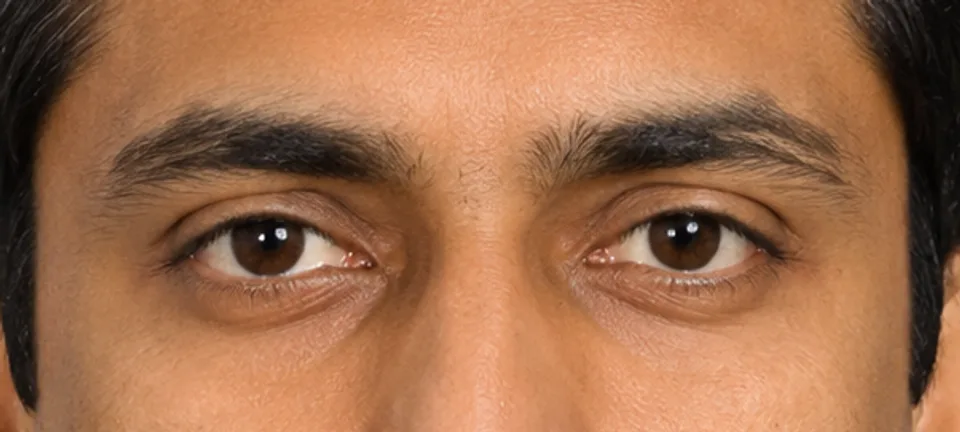
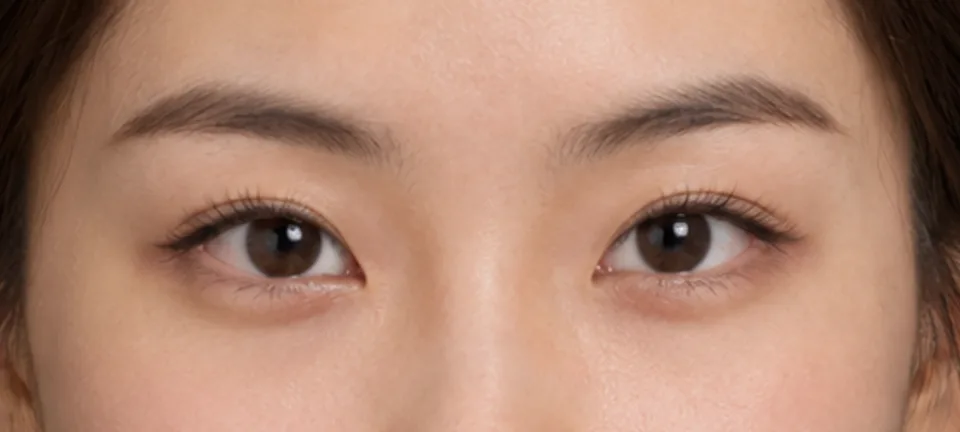
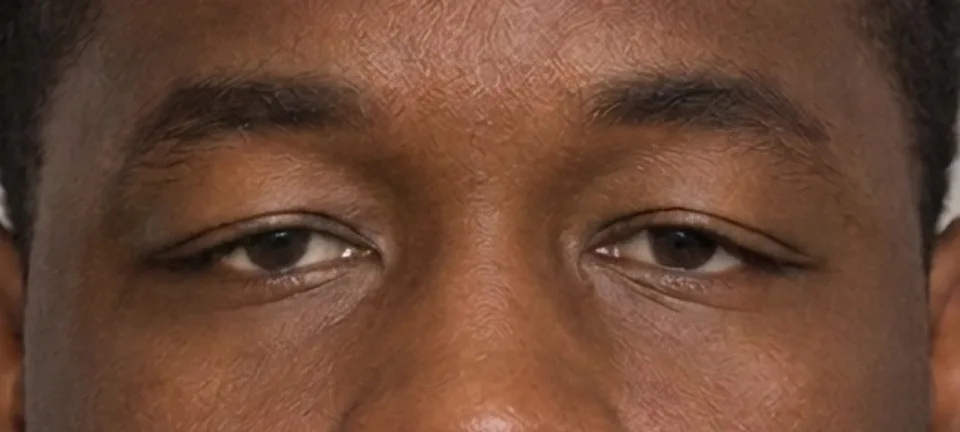
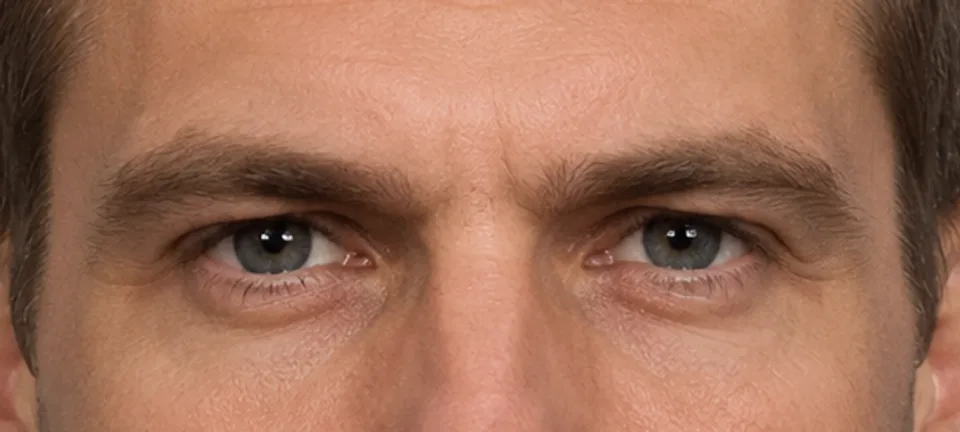
| Opening \ Corner | Downturned (< 0°) | Level (0° to 8°) | Upturned (> 8°) |
|---|---|---|---|
| Round (< 2.6) | Round, downturned (style: doe) | Round, level (style: doe) | Round, upturned (no style word) |
| Almond (2.6 to 3.3) | Almond, downturned (no style word) | Almond, level (no style word) | Almond, upturned (style: siren) |
| Elongated (> 3.3) | Elongated, downturned (no style word) | Elongated, level (no style word) | Elongated, upturned (style: fox) |
Doe, fox and siren eyes: what the style words mean
Terms like doe eyes, fox eyes and siren eyes come from social media and styling communities rather than anatomy or ophthalmology. People use them as shorthand for how an eye's openness and outer-corner slant feel together. Because they are informal labels, two guides can disagree on where one stops and the next begins.
In this eye shape test, we map those informal words with one transparent rule based purely on your opening and corner bands, and we label any match as informal. Doe eyes correspond to a rounder opening (below 2.6) paired with level or downturned corners (up to 8°). Fox eyes correspond to an elongated opening (above 3.3) paired with upturned corners (above 8°). Siren eyes correspond to an almond or elongated opening (2.6 or higher, never round) with upturned corners (above 8°).
Many common eye shapes do not match any of those three internet terms, and readings that sit within a small margin of a band edge skip the style word altogether instead of guessing across the boundary. Classic almond eyes with level corners (0° to 8°) or downturned corners also sit outside doe, fox and siren, so the detector plainly shows no style word rather than forcing a trend label onto your photo. That is normal and says nothing about appearance quality: style words describe a visual combination, not a score or ranking.
What a photo cannot tell you
A single straight-on photograph is flat, and the 478-point landmark mesh tracks the lid margins and eye corners rather than eyelid creases or bone projection. Because of those two limits, the detector explicitly marks three common descriptions as not measured instead of guessing them:
- Hooded eyes: MediaPipe has no landmark for the upper eyelid crease or skin fold, so a front landmark reading cannot verify whether skin drapes over the lid.
- Monolid eyes: Whether an upper eyelid has a visible crease or not cannot be read reliably from the lid edge landmarks alone.
- Deep-set eyes: A flat front image cannot measure how far back the eyeball sits inside the orbit relative to the brow bone.
How to take a photo for a fair reading
Small shifts in expression, lens distance or camera height can move your opening ratio by several tenths and your corner tilt by a degree or two. Follow these steps for a consistent eye shape test:
- Look straight at the camera lens at eye level, with your head upright and facing forward.
- Keep a relaxed, neutral expression. Smiling pushes the lower lid upward, narrowing the opening ratio and raising the outer corner angle; widening your eyes drops the ratio toward round.
- Hold the camera at arm's length or farther, using even front lighting so both inner and outer corners are crisp and unshadowed.
- Remove glasses and pull hair back away from the outer corners and temples.
- Check each eye row individually. Natural asymmetry between left and right eyes is common, and our detector reports both eyes separately so you can spot when one eye leans across a band boundary.
Frequently asked questions
01How does this eye shape detector know what eye shape I have?
It places 478 facial landmarks on your photo in your browser, levels the coordinate frame on the line between your iris centers, and measures two geometry values per eye: width divided by lid opening height, and the corner-to-corner tilt angle in degrees. Those numbers map to product bands (round, almond, elongated; downturned, level, upturned) and informal style words where they fit.
02Why does the detector say hooded, monolid and deep-set are not measured?
The landmark model marks the upper and lower lash lines and the eye corners, not the eyelid crease fold or the depth of the eye socket. Guessing hooded, monolid or deep-set from lid height or brow space alone would conflate different features, so we state plainly what a front photo cannot measure. Brow-to-lid space is shown only as a reference reading.
03Why did my two eyes get different readings?
Small left-right differences in eyelid opening or corner height are completely normal, and a slight head turn or uneven lighting can widen them in a single photo. The detector measures each eye separately and highlights when your two eyes fall into different bands or differ noticeably.
04Do my corner tilt degrees match the Canthal Tilt Calculator?
Yes. Both tools use the same iris-levelled inner-to-outer corner angle in degrees. The Canthal Tilt Calculator uses a narrow ±1° neutral band around zero, while the Eye Shape Detector uses a 0° to 8° level band to reflect the typical slightly positive adult range.
05Is my photo uploaded or stored when I run the eye shape test?
Your photo is analyzed locally inside your browser using WebAssembly and never sent to a server for measurement. If photo saving is enabled in your region, a copy is kept for 14 days to improve measurement quality and then deleted, and you can delete it immediately from the result page.