

Doe eyes
Doe eyes is an informal beauty and styling term for eyes that look large, vertically open and softly rounded. People usually use it when the upper eyelid forms a high arch, the iris is clearly visible and the outer corners sit near level or gently lowered rather than sharply swept up. In geometric terms, that impression comes from a taller eye-opening height relative to width, combined with eyelid contour and how much sclera shows around the iris.
This guide explains what the phrase describes in measurable eye-area features, how to check your own eyes from a fair photo and how doe eyes differ from almond eyes and siren eyes. It also explains what FaceCoda tools actually measure and when eyelid appearance is a medical question instead of a styling label. AI-generated educational illustrations are used throughout because no real visitor photos are shown.
Doe eyes meaning: the anatomy behind the label
Medical textbooks do not use the phrase doe eyes. Ophthalmologists and anthropometric studies describe the visible opening between the upper and lower eyelids as the palpebral fissure, and they measure it with three main dimensions: horizontal width from the inner corner to the outer corner, vertical height above the center of the pupil and the inclination between the two corners. [1][2][3]
What people casually call doe eyes happens when three measurable traits line up in a relaxed, straight-ahead gaze. First, the vertical palpebral fissure height is relatively tall compared with the horizontal width, giving a higher height-to-width ratio. [2] Second, the upper eyelid margin sits high enough above the pupil light reflex (a clinical measure called margin reflex distance 1, or MRD1) that most of the iris stays uncovered, while the lower lid sits low enough (MRD2) to show a clean arc below the pupil. [1][4]
Third, the outer corner (lateral canthus) usually appears soft and near horizontal rather than steeply angled upward. When the outer corner sits slightly below or level with the inner corner, or has only a gentle positive angle, the overall contour reads as wide and open rather than elongated.
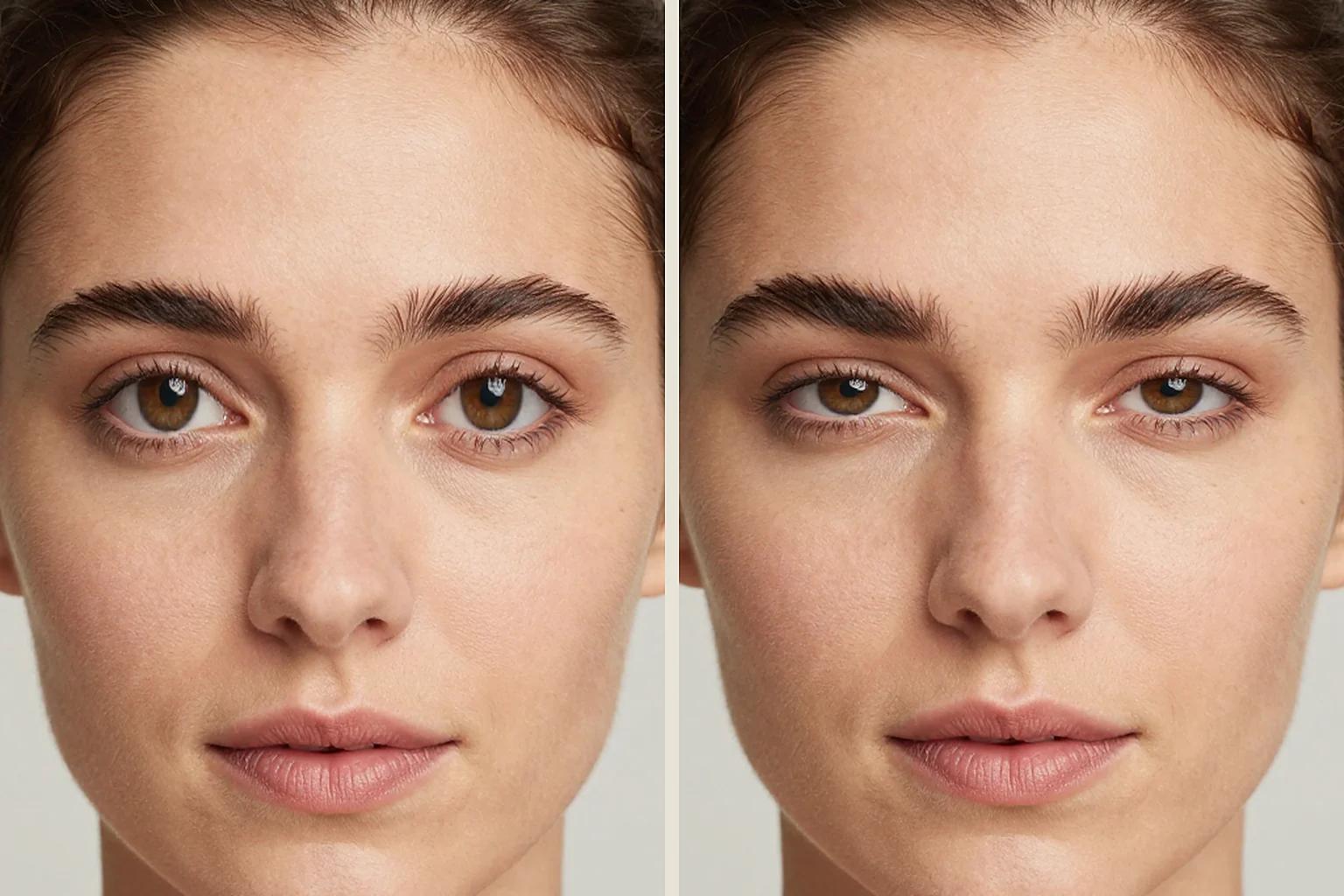
Visible white of the eye (sclera) below the iris is often mentioned online as part of the doe-eye look. In an observational study of 123 healthy adults aged 20 to 80, researchers measured inferior scleral show alongside eye protrusion and the orbital vector (whether the eyeball sits ahead of or behind the cheek rim). [5] Roughly half of the participants (49.6%) had measurable inferior scleral show above 0 mm even with no eyelid disease, while 46.3% had zero or negative values where the lower lid met or covered the bottom edge of the cornea. [5] That means visible lower sclera can simply reflect normal bony socket and globe geometry rather than any abnormality.
Researchers have also studied how eye size and openness shape social impressions. In a computational morphometrics study analyzing 5,500 standardized portraits, larger eyes were consistently linked with higher visual salience in the upper face. [6] At the same time, psychologists caution that snap personality impressions drawn from facial proportions - such as assuming someone with wide, rounded eyes is softer or more approachable - have weak diagnostic validity and say nothing reliable about character. [7]
How to tell if you have doe eyes
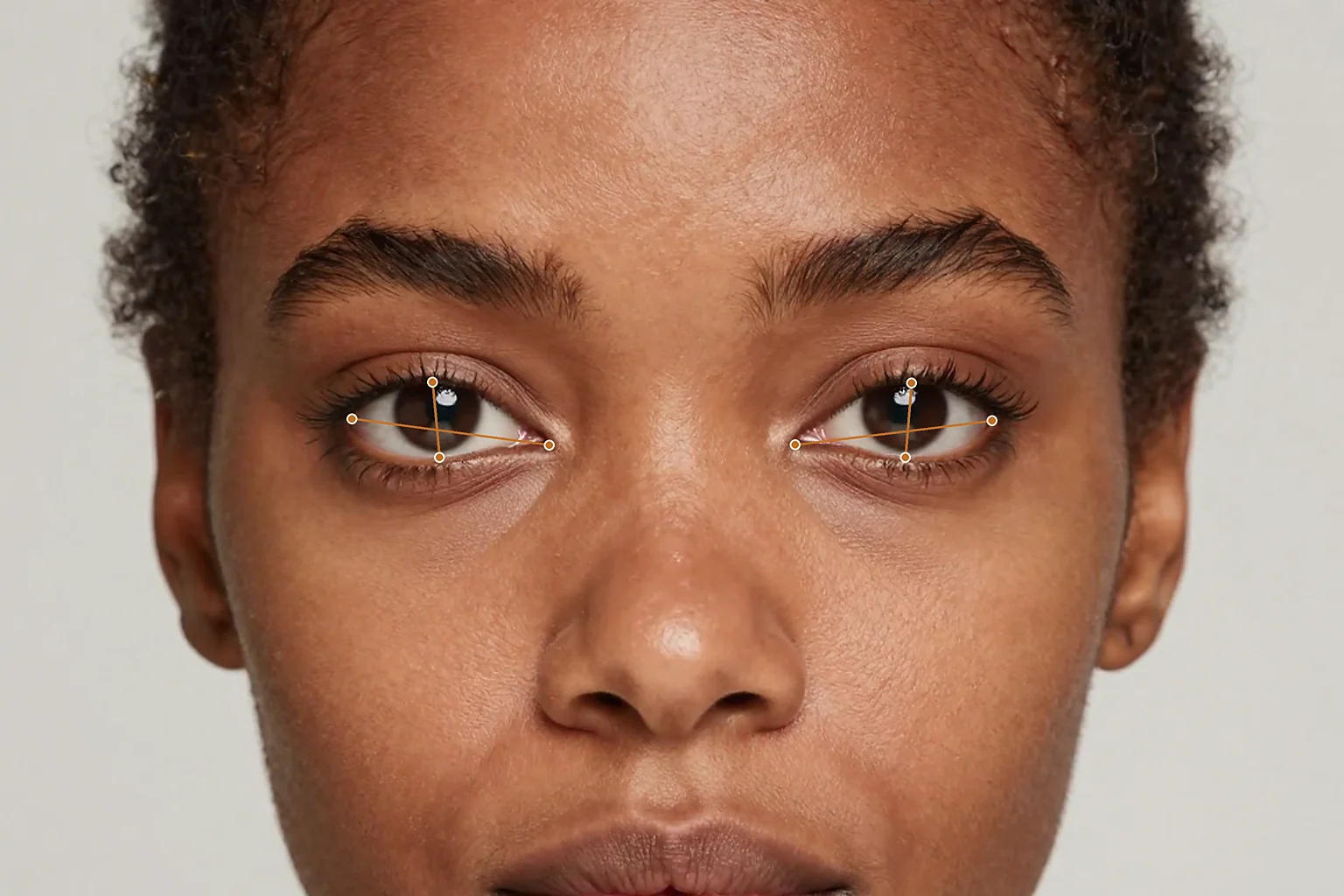
Checking your own eye shape by eye in a bathroom mirror often misleads you, because raising your eyebrows or tipping your chin slightly downward exposes more of the upper iris and creates artificial roundness. A repeatable check starts with a neutral, eye-level photograph.
Check the eye height-to-width ratio
Look straight ahead with your forehead relaxed so your brows are not lifted. In a 3D periocular study of 147 young adults aged 18 to 30, average palpebral fissure height-to-width ratios were 0.36 to 0.40 across male and female groups, meaning the opening height is roughly 36% to 40% of the eye’s corner-to-corner width. [2] Eyes that read as doe eyes sit toward the rounder, taller end of normal variation, with a generous central vertical gap compared with narrow, slit-like openings.
Look at the upper-lid curve and iris coverage
Notice where the upper lid rests against the top of the colored iris in primary gaze. If the upper lid arches smoothly and leaves most of the upper iris visible, the eye looks taller and rounder. If a heavy skin fold rests near the lashes and hides the crease, compare with hooded eyes, because fold coverage is separate from vertical aperture.
Inspect the lower lid and visible sclera
Check whether the lower eyelid touches the bottom edge of the iris or drops slightly below it to reveal a thin band of white sclera. A curved lower margin that drops at the center makes the eye appear larger vertically, whereas a tight, flat lower margin keeps the opening compact.
Measure corner direction
Trace a mental line from the inner corner (medial canthus) to the outer corner (lateral canthus). Published adult averages for palpebral fissure inclination sit a few degrees positive - for example, 4.71° in men and 7.05° in women in a Malaysian South Indian cohort of 300 young adults. [3] Doe eyes generally have a modest, neutral or slightly downward corner tilt rather than a steep upward slant.
Camera setup matters as much as anatomy when you inspect a photo. In an automated eyelid study of 540 healthy Chinese participants aged 0 to 79, mid-pupil lid distances peaked in the 20s and 30s and gradually decreased in older decades, showing that eyelid openness shifts naturally across adulthood. [1] For the cleanest reading, hold the camera at eye level at arm’s length and avoid smiling, which pushes the lower lid upward and shrinks vertical aperture.

Doe eyes vs siren eyes vs almond eyes
Social media guides often treat doe eyes, siren eyes and almond eyes as rigid categories, when they actually mix natural geometry with styling choices. Separating outline, vertical height, corner angle and makeup makes the terms much clearer.
On smaller screens, scroll the table to see every column.
| Feature | Doe eyes | Almond eyes | Siren eyes |
|---|---|---|---|
| Primary meaning | Informal look emphasizing large, tall, rounded openness | Classic outline wider than tall with pointed corners | Makeup and styling aesthetic emphasizing length and lift |
| Height-to-width balance | Relatively tall opening relative to width | Balanced elongated oval, roughly three times as wide as tall | Narrower vertical opening, horizontally stretched |
| Corner angle | Level, mild positive or slightly negative tilt | Level or mildly lifted outer corner | Visually lifted outer corner, natural or drawn with liner |
| Iris and sclera | Upper iris mostly open; lower sclera sometimes visible | Iris typically touches or nearly touches both lids | Upper lid sits slightly lower; minimal lower sclera |
The clearest distinction in the table is between almond eyes and doe eyes. Almond describes a tapered horizontal outline where both corners end in crisp points and the iris meets the upper and lower lids. Doe eyes have a softer, more circular central curve where the vertical aperture dominates how you read the eye.
Doe eyes vs siren eyes is a contrast between vertical openness and horizontal length. Siren eyes rely heavily on eyeliner extended outward and upward from the lateral corner and inner-corner shading to mimic a sharp fox eyes contour, whereas doe-eye styling highlights the middle of the lash line to emphasize roundness. If you want to compare natural eye structures side by side, browse the eye shapes guide, or read how monolid eyes and deep-set eyes affect lid visibility independently of tilt.
What FaceCoda actually measures around your eyes
FaceCoda measures the eye geometry behind informal labels like doe eyes rather than claiming a clinical cutoff, and it does not measure whether you have an upper eyelid crease. Focused FaceCoda tools let you inspect your eye shape, corner angles and proportions from a straight-on photo:
- Eye opening shape and corner direction: The Eye Shape Detector runs in your browser, levels landmarks on the line between both iris centers and reports per-eye opening shape from width divided by height (round below 2.6, almond 2.6 to 3.3, elongated above 3.3) and corner direction (downturned below 0°, level 0° to 8°, upturned above 8°). When neither the opening nor the corner reading sits near a cut-off, it shows an informal closest style word (doe, fox or siren), while leaving hooded lids, monolid lids and deep-set eyes unmeasured.
- Canthal tilt in degrees: The Canthal Tilt Calculator runs locally in your browser, levels your photo on the line between both iris centers to remove head roll and reports each eye’s corner angle as positive (above +1°), neutral (-1° to +1°) or negative (below -1°).
- Eye opening ratio and upper iris coverage: The Hunter Eyes Test (which sends the photo to FaceCoda’s server for analysis) measures four traits separately: canthal tilt, upper iris coverage, eye height-to-width ratio (with live result bands labeled narrow below 0.26, medium from 0.26 to 0.30, and rounder above 0.30) and brow-to-eye distance.
- Horizontal spacing: If you also wonder whether eye spacing makes your eyes look larger or further apart, the Golden Ratio Face Test reports your five horizontal fifths across eye level, covered in detail in our wide-set eyes guide.
Together, those numbers let you see why your eyes look taller or more elongated instead of guessing from a single trend name. For instance, an eye with a rounder height-to-width reading, low upper iris coverage and a neutral or mild tilt reflects the open proportions behind the doe-eye look.
Remember that small pose changes shift every eye reading. Looking slightly down increases upper iris coverage, while opening the eyes wide in surprise raises the upper lid and enlarges the vertical opening ratio. Always judge your readings across two or three relaxed, straight-on photos.
Normal appearance vs eyelid changes to discuss with a clinician
Having naturally large or rounded eyes with a sliver of white below the iris is a normal variation in healthy people. [5] However, a photo tool measures surface geometry in one frame and cannot evaluate eye health, thyroid status or eyelid muscle function.
When to seek an eye or medical check
- New or one-sided eyelid changes: The NHS advises seeking an urgent GP or optician appointment or contacting NHS 111 if an eyelid droops suddenly, cannot open or close properly or looks newly uneven. [8]
- Pain, redness or vision changes: Pain inside the eye, sensitivity to light, blurred vision or sudden bulging appearance requires prompt clinical evaluation rather than a photo check. [8]
- Gradual protrusion or widening: Noticeable widening of both eyes over months with dry, gritty discomfort can be linked to medical conditions such as thyroid-related eyelid retraction, which only a clinician can assess.
If your eye shape has looked consistent for years and your eyes feel comfortable, differences in lid roundness or corner tilt are simply part of normal human variation across ages and populations. [1][2][4] For more background on how eye angles and eyelid folds work together, read our guides to positive canthal tilt and negative canthal tilt, or explore all FaceCoda tools.
FAQ
Doe eyes is an informal descriptive phrase for eye shape and openness, not an anatomical diagnosis or a beauty grade.
What does doe eyes mean?
Doe eyes is an informal term for eyes that appear large, wide open and gently rounded, with a curved upper lid and noticeable iris height. People also associate the look with soft outer corners and sometimes a hint of white sclera visible beneath the iris. It is a visual description of shape and openness rather than a clinical term.
How do I tell if I have doe eyes?
Look straight into a mirror or at an eye-level front photo with a relaxed face and neutral expression. Check whether the vertical opening is tall relative to the horizontal width, whether the upper lid forms a high rounded arch and whether the corners look soft rather than sharply tapered. You can pair that visual check with a measurement of eye ratio and canthal tilt. Open the Canthal Tilt Calculator.
What is the difference between doe eyes and siren eyes?
Doe eyes describe a taller, rounder eye opening with a high upper-lid arch and open lower margin. Siren eyes is a makeup and styling look built around a narrower, horizontally elongated eye opening with a lifted outer corner. The first describes natural lid openness and curvature, while the second usually relies on angled liner and outer-corner shading.
What is the difference between doe eyes and almond eyes?
Almond eyes are wider than they are tall and taper to pointed inner and outer corners where the lids generally touch or nearly touch the iris. Doe eyes have a taller vertical opening relative to their width and a rounder upper-lid curve. Because both terms are informal, some eyes sit between the two descriptions. Read the almond eyes guide.
Does visible white under the iris always mean doe eyes?
No. A small strip of visible sclera below the iris can occur as a normal variation in people whose cheek rim sits slightly behind the front of the eyeball. However, new or increasing scleral show or a sudden change in eyelid position should be checked by an eye professional rather than a photo tool.