

Long philtrum
A long philtrum refers to a taller vertical distance between the base of the nose and the top border of the upper lip, whereas a short philtrum leaves a smaller strip of skin there. In anthropometric studies, philtrum length is measured on the facial midline from subnasale (where the nasal base meets the skin) to labiale superius (the center peak of the upper lip border), and adult group averages sit roughly between 13.8 and 18.1 mm depending on sex, age and population. Whether a philtrum looks long depends less on a fixed millimeter rule than on how that height balances with the upper lip vermilion, lower lip and chin.
This guide explains how researchers measure philtrum length and lower-face ratios, why philtrum height changes with age and expression, what FaceCoda’s Golden Ratio Face Test actually reports in the lower third, and why photo proportions are not medical findings. It offers no lip-lift, filler or surgical advice. AI-generated educational illustrations are used throughout instead of photographs of real people.
Philtrum length in anatomy and published adult ranges
The philtrum is the vertical midline strip of skin stretching from the bottom of the nasal septum down to the upper lip’s Cupid’s bow. Clinicians and craniofacial researchers separate three distinct vertical intervals below the nose so they do not confuse skin length with lip fullness: [1][2][4]
- Philtrum length (cutaneous upper lip height, sn-ls): The vertical distance from subnasale (sn) to labiale superius (ls), where the skin meets the colored upper lip border. [1][2]
- Total upper lip height (sn-sto): From subnasale down to stomion (sto), where the relaxed upper and lower lips meet; this combines the cutaneous philtrum plus the upper vermilion height. [1][4]
- Lower facial third (sn-me or sn-gn): From subnasale all the way down to the bottom edge of the chin (menton or gnathion). [3][4]
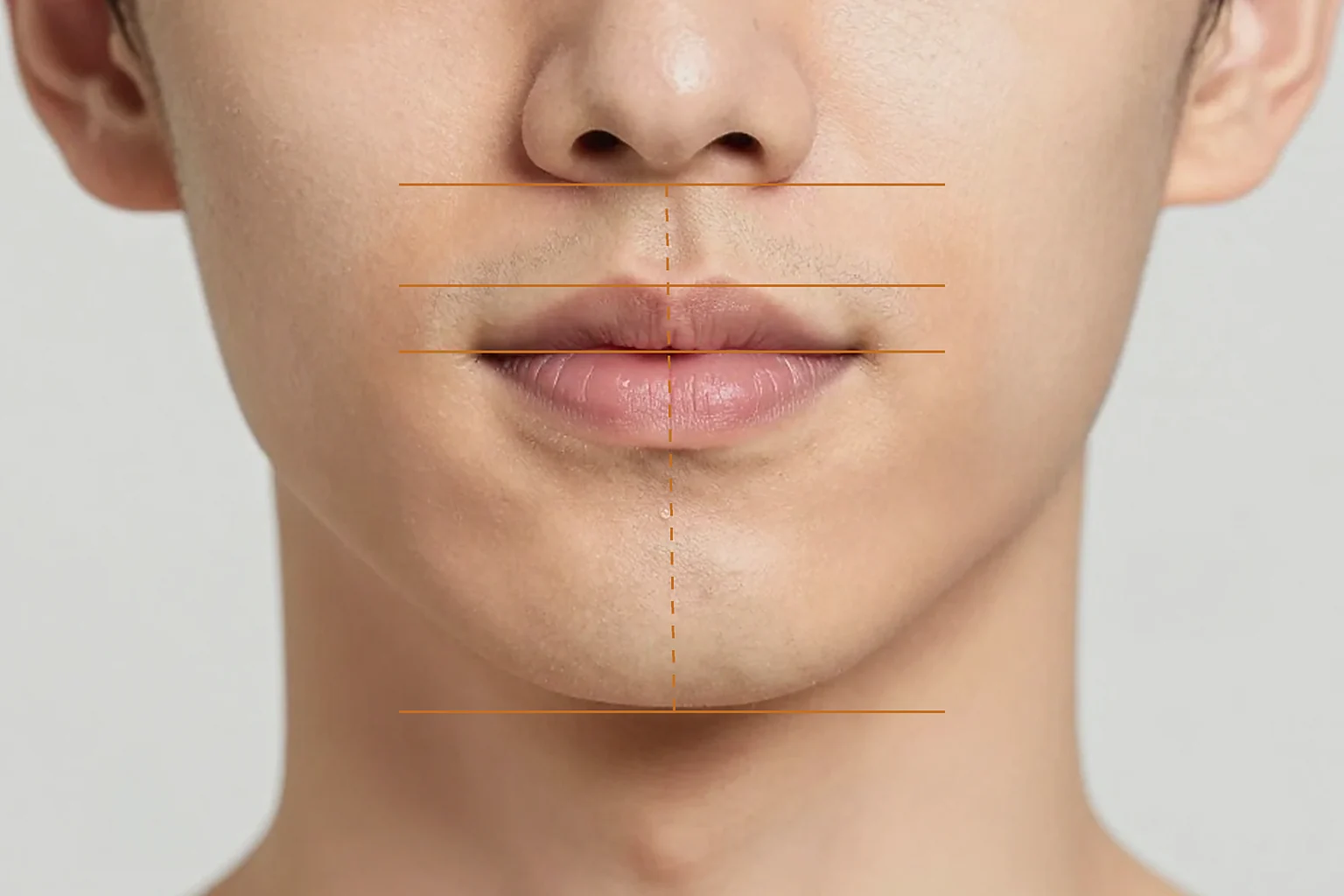
Published adult surveys show why there is no single millimeter cutoff for a “long” or “short” philtrum. Men typically measure slightly longer than women in absolute millimeters, older adults measure longer than young adults, and different populations vary alongside overall lower-face height.
On smaller screens, scroll the table to see every column.
| Study and cohort | Landmark measured | Reported average |
|---|---|---|
| Hasibuan et al., 2024 · 100 Indonesian adults aged 20–35 [1] | Philtrum length (sn-ls) | 15.85 ± 2.67 mm in men; 13.86 ± 2.32 mm in women (p < 0.001) |
| Chong et al., 2020 · 169 Chinese women aged 20–60 [2] | Cutaneous upper lip height (sn-ls) | 13.75 ± 1.82 mm (20s), rising to 16.74 ± 1.66 mm (50s) |
| Jokar et al., 2025 · 225 Persian women aged 20–50 [3] | Philtrum length (sn-ls) | 16.20 ± 2.05 mm (20s), rising to 18.10 ± 1.95 mm (40–50s) |
| Virdi et al., 2019 · Kenyan vs NAW young adults [4] | Total upper lip height (sn-sto) | 25.5 mm vs 22.3 mm (men); 24.0 mm vs 20.1 mm (women) |
Notice two patterns in the table. First, within the Indonesian cohort of 100 young adults, philtrum lengths spanned 10.00 to 20.70 mm in men and 8.30 to 17.60 mm in women even inside a single age group. [1] Second, aging shifts the ratio between skin and vermilion: in Chong and colleagues’ 3D study of 169 women, cutaneous upper lip height grew by nearly 3 mm from the 20s to the 50s while upper vermilion height decreased from 8.10 mm to 6.57 mm, making the philtrum look longer relative to the colored lip even though total face height barely changed. [2][5]
Long philtrum vs short philtrum, and the philtrum-to-chin ratio
Because millimeter rulers vary with overall body and face size, people often compare ratios inside the lower third instead of raw millimeters. Online discussions frequently mention the “philtrum-to-chin ratio” - dividing chin height below the lower lip by philtrum length - alongside upper-to-lower lip proportions.
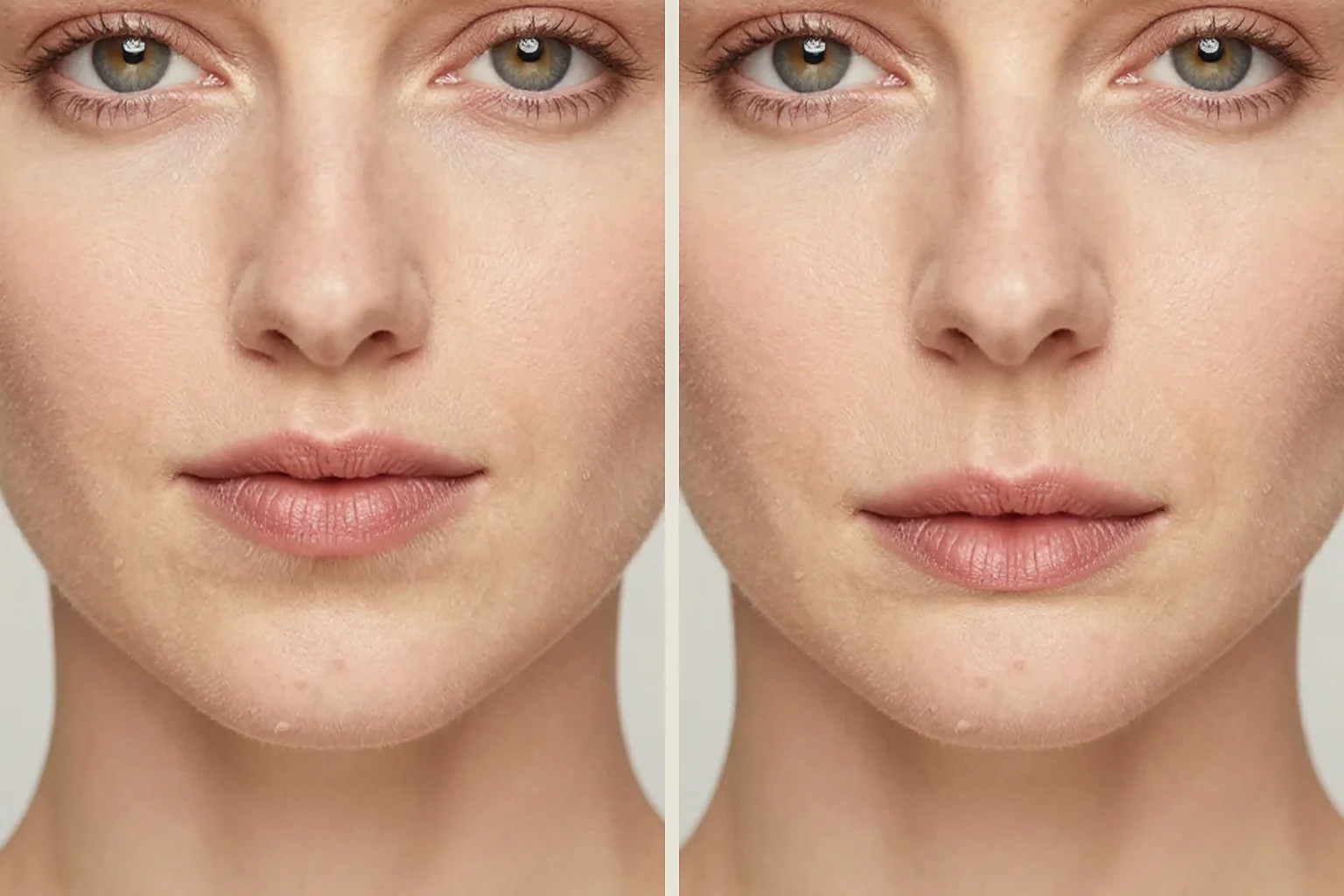
In scientific papers, researchers track slightly different ratios depending on what they are evaluating:
- Philtrum length to upper vermilion height (sn-ls / ls-st): In Hasibuan and colleagues’ study of 100 young Indonesian adults, this ratio averaged 2.53 ± 0.72 in men and 2.18 ± 0.17 in women. [1] A thin upper vermilion makes a normal-length philtrum appear longer visually because there is less colored lip below it.
- Upper lip height to lower lip height (sn-st / st-sl): In the same cohort, total upper lip height averaged roughly 1.36 times lower lip height in men and 1.32 times in women. [1]
- Lower facial third share: Relative to total face height, a tall lower facial third (sn-me) gives extra vertical room to both the philtrum and the chin, whereas a short lower face compresses them.
When people compare philtrum height to chin height (for example from labiale inferius or the labiomental crease down to menton), two features interact: a taller philtrum lowers the ratio, and a vertically short or tucked chin lowers it as well. No peer-reviewed source cited here fixes a single universal philtrum-to-chin number that every adult face should hit, because lip thickness, ethnic variation in upper-lip height and chin vertical height vary widely across normal faces. [1][3][4]
On smaller screens, scroll the table to see every column.
| Ratio or feature | How researchers define it | What published studies report |
|---|---|---|
| Philtrum / upper vermilion (sn-ls / ls-st) | Cutaneous upper lip divided by colored upper lip height | 2.53 ± 0.72 in men, 2.18 ± 0.17 in women (Indonesian cohort) [1] |
| Upper lip / lower lip (sn-st / st-sl) | Total upper lip height divided by lower lip height | 1.36 ± 0.16 in men, 1.32 ± 0.19 in women [1] |
| Age shift in skin vs vermilion | Cutaneous upper lip vs upper vermilion across decades | Cutaneous lip lengthened 13.75 to 16.74 mm (20s to 50s) as vermilion thinned [2] |
| Lower facial third (sn-me) | Nose base to bottom of chin across groups | 65.08–67.22 mm (Persian women); 69.5–76.4 mm (Kenyan adults) [3][4] |
Looking at these ratios side by side clarifies why a single millimeter rule misleads: an average philtrum on someone with a thinner upper vermilion or a shorter chin can look long visually, while the exact same philtrum measurement on someone with a taller chin or fuller upper lip reads as balanced. [1][2][5]
Why photos and expressions exaggerate philtrum length
Before concluding from a selfie that you have a long philtrum or a short philtrum, check whether your expression or phone distance changed the landmarks.
Relax the mouth completely
Smiling pulls the upper lip upward and exposes the teeth, shrinking apparent philtrum height dramatically, whereas pressing or pursing the lips inward rolls the vermilion out of sight and stretches the skin above it. Keep your lips gently touching in repose, with teeth un-clenched.
Keep the camera at eye level, not below
Holding a smartphone low and angling upward tilts the nose tip up and foreshortens the forehead, making the upper lip and chin occupy more of the frame. Keep the camera level with your eyes and your chin horizontal.
Step back to arm’s length or farther
In Derakhshan and colleagues’ digital photography study of 12 volunteers, smartphone photos taken at 8 inches stretched central facial vertical dimensions by 18% and photos at 12 inches stretched them by 12% compared with 60-inch reference photos. [6] Close selfies distort midface and lower-face vertical ratios every time.
What FaceCoda actually measures in the lower third
FaceCoda does not compute a separate millimeter philtrum measurement or a standalone philtrum-to-chin ratio, because automated 2D web landmarks do not place clinical subnasale and vermilion-border calipers at sub-millimeter precision. Instead, the Golden Ratio Face Test measures two closely related proportions in the lower face right in your browser:
- Nose-to-chin vs lips-to-chin ratio: One of the four ratios in the golden ratio test divides the total distance from the nose base to the chin by the distance from the center of the lips to the chin, comparing it with φ (1.618). When the upper lip and philtrum area sit taller relative to the chin below the lips, that ratio increases; when the lips sit closer to the nose base, it decreases.
- Lower facial third share: The same tool reports your lower facial third (nose base to chin) as a percentage of measured face height against FaceCoda’s 41% reference (with 18% for the visible forehead and 41% for the middle third, as explained in facial thirds).
- Mouth-to-nose width ratio: Because lip proportion also interacts with width, the golden ratio test compares mouth corner width with nose wing width, while the face shapes guides explain how chin height and taper affect overall face shape.
All of these readings are neutral geometric comparisons from a single photo, not beauty scores or medical evaluations.
Medical perspective and what this guide does not advise
For the vast majority of adults, a longer or shorter philtrum is simply an inherited family trait or a normal gradual aging change in upper-lip soft tissue. [2][5] In clinical genetics and pediatrics, clinicians sometimes observe a long, smooth or short philtrum alongside dozens of other physical traits during an in-person developmental exam, never in isolation from a selfie.
Important limits and clinical guidance
A photograph or proportion tool cannot diagnose any medical or genetic condition. If you have concerns about facial development, lip function, dental occlusion or sudden swelling around the upper lip, speak with a qualified physician or dentist. This guide provides measurement and anatomy facts only and does not recommend lip lifts, dermal fillers or surgery.
For related proportion and lower-face guides, explore facial thirds, recessed jawline, upturned nose or the full collection of FaceCoda tools.
FAQ
Philtrum length varies naturally by sex, population and age; a ratio describes proportions in one photo rather than a defect.
What is considered a long philtrum?
The philtrum is the vertical groove from the base of the nose (subnasale) to the top edge of the upper lip (labiale superius). In adult anthropometric studies, average philtrum length typically sits around 13.8 to 18.1 mm depending on sex, age and population, so a philtrum looks long when that gap takes up a noticeably larger share of the lower facial third than the lips and chin below it. There is no universal millimeter cutoff that separates a normal philtrum from a long one.
What is a short philtrum?
A short philtrum means the cutaneous upper lip sits closer to the base of the nose, leaving a shorter vertical strip of skin above the upper lip vermilion. In proportion terms, it shifts more of the lower third below the upper lip border toward the mouth and chin.
How does the philtrum-to-chin ratio work?
People online often compare the height of the philtrum with the height of the chin below the lower lip to judge lower-third balance. Anthropometric studies more commonly report total upper lip height against lower lip and chin height, or philtrum height against upper vermilion height, because those landmarks are standardized in clinical research. Remember that FaceCoda's golden ratio tool measures nose-to-chin against lips-to-chin, not the philtrum groove on its own. Open the Golden Ratio Face Test.
Does philtrum length change with age?
Yes, in cross-sectional adult studies. Both a 3D stereophotogrammetry study of 169 women aged 20 to 60 and a photographic study of 225 women aged 20 to 50 found that cutaneous upper lip height increased significantly with age while upper vermilion height thinned.
Can a photo tool diagnose a medical condition linked to philtrum shape?
No. Clinicians sometimes note philtrum length or smoothness during physical exams for congenital conditions, but a photo proportion reading cannot diagnose any syndrome or health issue. Ask a physician if you have medical questions about facial development.