

Nose types
Nose types are the descriptive terms used for nose shape. From the side, the bridge line is called straight, convex or concave. From the front, you describe how wide the bridge is, how the tip is shaped and how wide the nostrils are.
To work out what nose shape you have, compare one straight-on photo and one side photo with those terms. A front-facing photo cannot show your profile, so any tool that reads only a front photo can describe widths but not profile. The photo-style illustrations are AI-generated educational examples, not photographs of real people.
What nose types actually are
There is no official catalogue of nose types. The words come from surgical and anthropometric papers, and each paper picks the features it needs. Some names are everyday labels that those papers do not define. This guide treats them as vocabulary for describing a nose, not as boxes that sort people.
A nose has at least five features you can describe separately. The bridge line in profile, the width of the bridge from the front, the shape of the tip, the width of the nostrils and the angle at which the tip points all vary independently. Two noses with the same profile can look different from the front.
That is why one type name rarely fits. A written description such as “straight bridge, rounded tip, narrow nostrils” says more than a single label. It also keeps the description neutral, because each term names where something is, not whether it is good.
Side-view and front-view terms
Side-view terms: straight, convex, concave
Profile terms describe the line from the top of the nose to the tip. A systematic review of nasal profile analysis summarizes a 1986 study of 123 White American females that described nasal shape as straight, convex or concave. [2]
A straight bridge runs without a bulge or a dip. A convex bridge bulges outward, and the review calls this a convex or hump dorsum. A concave bridge dips inward between the top of the nose and the tip. [2]
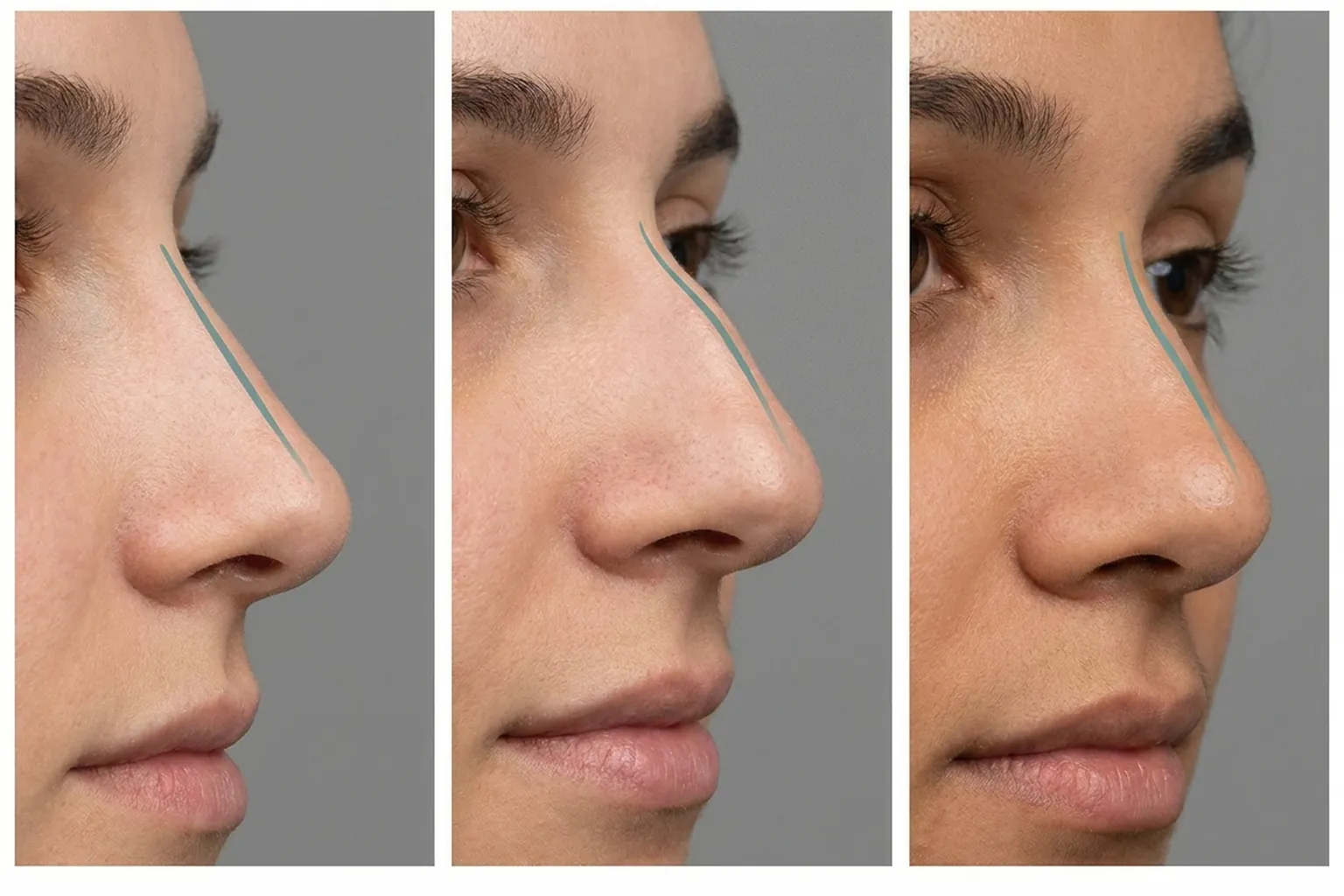
The tip adds a separate profile description. Surgical literature describes tip rotation through the nasolabial angle, the angle between the upper lip and the columella, which is the strip of tissue between the nostrils. [1][2] A tip that points upward more is informally called upturned, and one that points downward more is called downturned, though the papers cited here define the angle rather than those everyday words.
Front-view terms: bridge, tip and nostrils
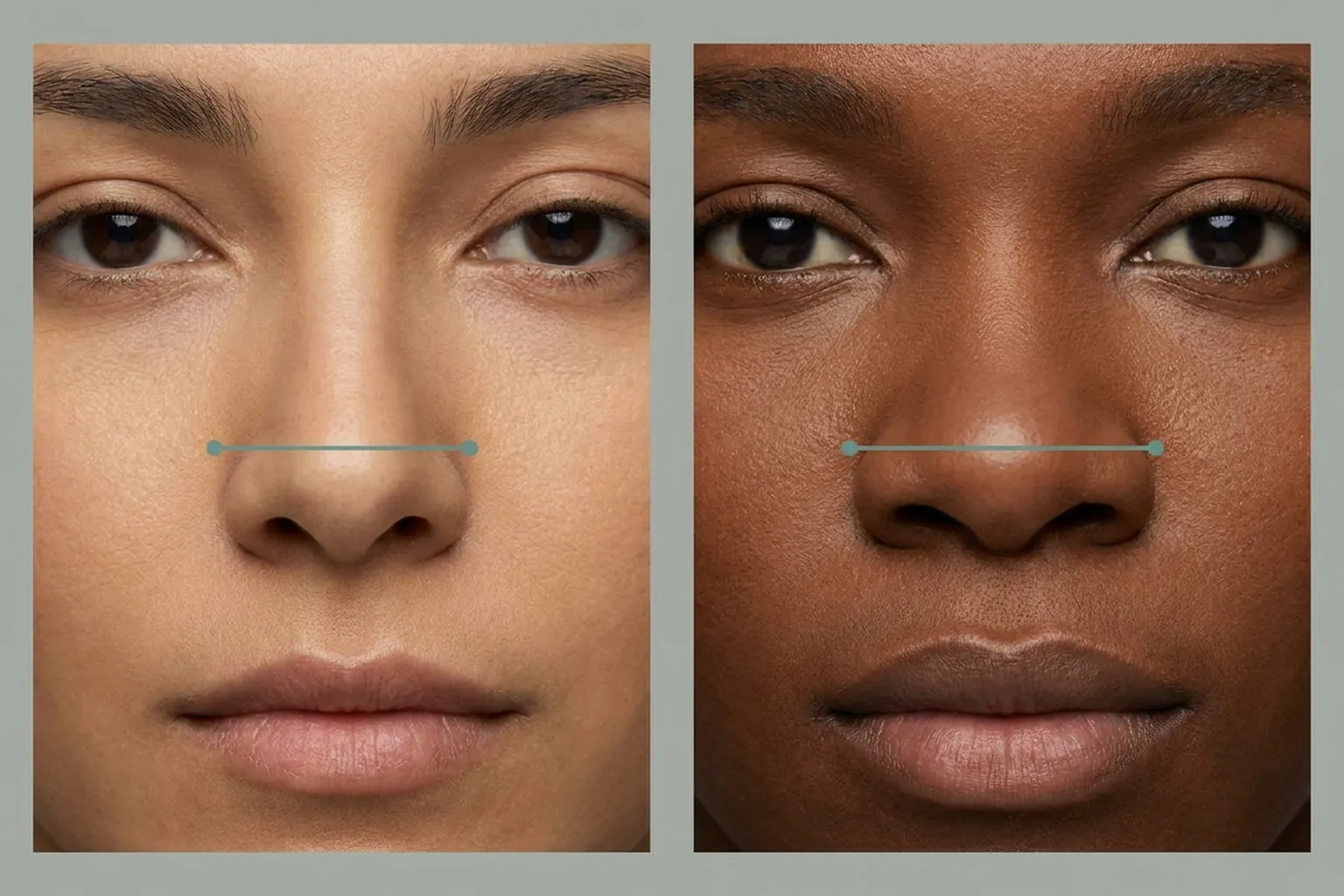
From the front, three things can be described without a side photo: bridge width, tip shape and the nostril region. Surgical papers call the width of the bridge the width of the dorsal aesthetic lines, the two soft lines that run down the sides of the bridge. [1]
For the tip, a rhinoplasty planning paper names a bulbous tip, described as rounded and ill-defined, and a boxy tip, described as square and wide. [1] For the nostrils, the same paper defines alar base width and alar flare, the greatest width of the ala (the outer wing of the nostril), and describes nostrils as symmetric and teardrop-shaped from below. [1] That paper is a surgical planning guide that proposes ideal values; this article uses its vocabulary only.
| Term | View that shows it | What it describes |
|---|---|---|
| Straight, convex, concave bridge | Side | Whether the bridge line runs straight, bulges outward or dips inward. |
| Tip rotation | Side | How far the tip points up or down, measured by the nasolabial angle. |
| Bridge width | Front | How wide the nose looks between its two side lines. |
| Tip shape | Front | Rounded and ill-defined, or square and wide, or between. |
| Nose-wing and nostril width | Front or below | How wide the base of the nose is across the wings. |
The nasal index relates nose width, measured from wing to wing, to nose height, measured from the top of the bridge to the base, as one number. One study of 140 dental students in Nepal grouped it into narrow, medium and broad noses (leptorrhine, mesorrhine and platyrrhine) using cut-offs below 69.9, 70 to 84.9 and above 85. [3] Other studies may use other limits.
Roman nose
Roman nose is an informal everyday name, often paired with aquiline, for a nose with a prominent, outward-curving bridge line. Clinical papers do not define “Roman nose” as a medical category; instead, nasal profile analysis describes a convex or hump dorsum and notes where any dorsal hump sits and whether it involves bone, cartilage or both. [1][2] In some faces, a convex bridge appears alongside a tip that angles slightly downward, though a dorsal bulge can occur with a level tip as well.
The side view (profile) is the view that shows a Roman nose, because bridge convexity, hump height and tip angle are visible only from the side. [1][2] A straight-on front photo shows bridge width and symmetry along the dorsal aesthetic lines, not how far the bridge curves outward in profile. [1]
Button nose
Button nose is an informal label for a shorter, compact-looking nose with a straight or gently concave bridge, a soft rounded tip and a slightly lifted tip angle. In clinical vocabulary, those traits map to shorter nasal length relative to midfacial height, a concave or smooth dorsal profile, a rounded tip outline rather than a square boxy tip, and upward tip rotation measured through the nasolabial angle. [1][2] It overlaps with an upturned nose, though “upturned nose” refers specifically to upward tip rotation at the nasolabial angle, while “button nose” emphasizes compact overall length and a rounded tip as well.
Both views contribute to describing a button nose. The side view shows the concave or straight bridge contour, overall length and upward tip rotation, while the front view shows the rounded tip outline and the width across the nose wings. [1][2]
Where the terms come from and how nose shape varies
Anthropometry and surgical vocabulary
The terms come from anthropometry, which measures the head and face with fixed landmarks, and plastic and reconstructive surgery, which needs words for bridge, tip and wings when planning care. A systematic review notes that 19th and early 20th century researchers often used the nasal index to classify human races, but concludes that while nasal proportions vary between ethnic groups, the size and shape of the nose does not define Caucasian, Asian and African races. [5] So these words work for describing an individual nose, not for sorting people.
Variation across ancestry and age
Average nose measurements differ between populations, and so does the spread within each group. An international anthropometric study measured 1,470 healthy adults aged 18 to 30 in Europe, the Middle East, Asia and Africa against norms for North American white adults. [4] Relative to that reference, the nose measured significantly wider in both sexes in the Asian and Black groups, matched the reference in width with greater height in the Middle Eastern groups, and differed in height in three Caucasian groups. [4] The authors called those findings preliminary and based on small samples, and the reference group is simply a researcher choice rather than a standard. [4]
A genetic study comparing 3D face scans across West African, North European, East Asian and South Asian ancestry found that nostril width and alar base width differed across populations more than chance drift would predict and correlated with temperature and humidity, though the authors called climate a simplified explanation and the review above says it remains to be proven. [5][6] A single nose therefore cannot show where someone’s ancestors came from. [5]
Age changes nose measurements as well: a CT study of 200 Asian patients aged 20 to 35 and 65 to 80 found a thicker skin and soft-tissue envelope, a lower nasal tip and thinner nasal bone in the older group, concluding that aging leads to drooping of the nasal tip. [7] Those findings describe that clinical sample rather than a rule for everyone, and mean a nose can look different across decades.
How to describe your own nose from photos
You need two photos, one from the front and one from the side. Take both the same way so that you can compare them.
1. Set up the photos
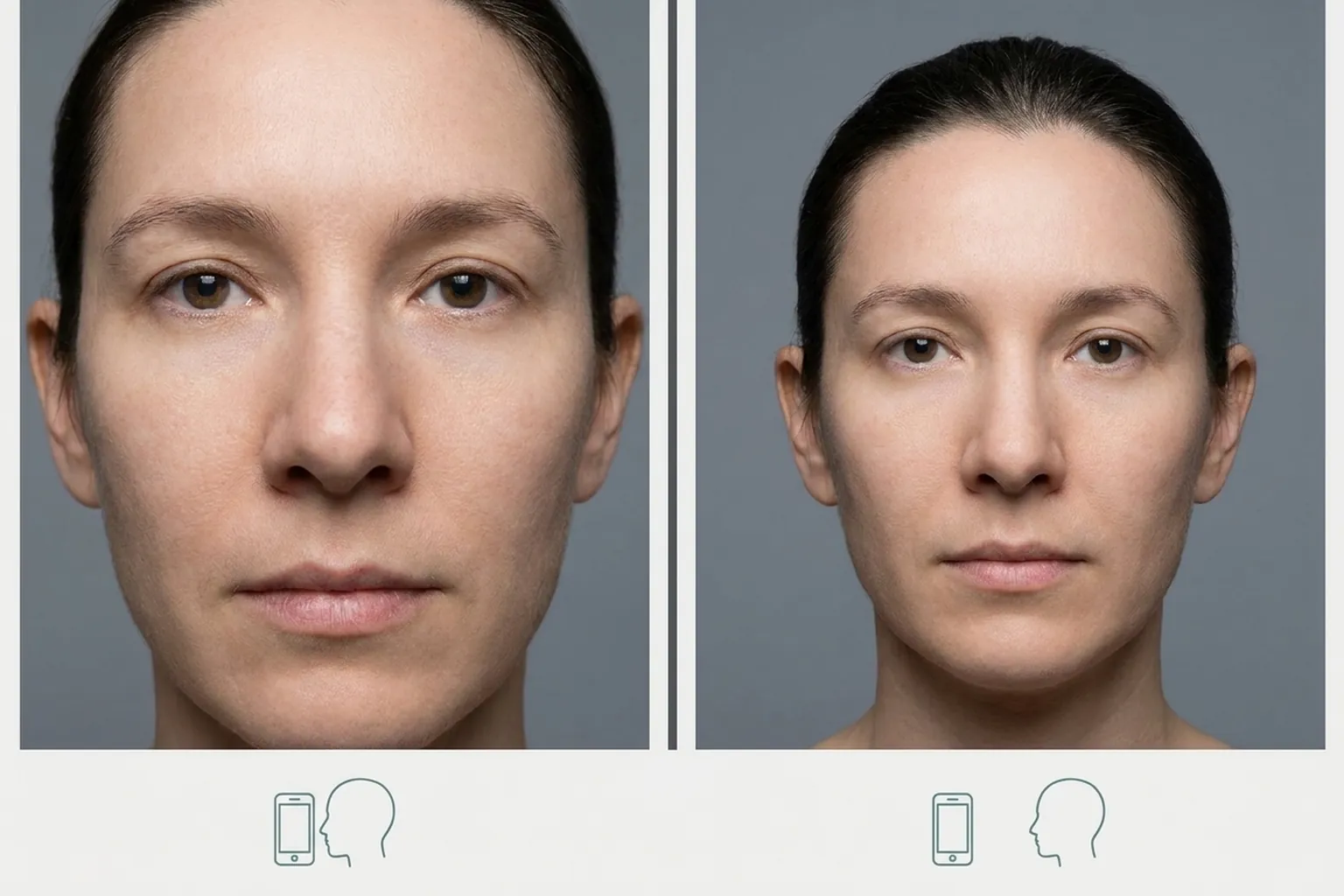
Hold the camera level with your nose at arm’s length or farther, and keep your head upright. Use soft light from the front, relax your face and keep your mouth closed. For the side photo, turn your head so that your nose points straight sideways, and ask someone to take it or use a timer on a stand.
Camera distance changes the picture. In a study of 30 volunteers, nasal length measured 6.4 percent longer in selfies taken at 12 inches and 4.3 percent longer at 18 inches than in photos taken at five feet, and the ratio of alar base width to facial width decreased by 10.8 and 7.8 percent. [8] The width of the nose wings itself did not change significantly, but how big the nose looks compared with the face did.
2. Read the side photo
Run your eye along the bridge from the top of the nose to the tip. Decide whether the line is straight, bulges outward or dips inward, and note where, because a nose can change direction near the top or near the tip. Then note whether the tip points more up or more down.
3. Read the front photo
Look at the width of the bridge, the outline of the tip and the width across the nose wings compared with the rest of your face. Compare with your own face, not with someone else’s, and not with an image from an ad. If the two nostrils or the two sides of the bridge look different, that is common and a normal photo cannot tell you why.
4. Write it down in a sentence
For example: “straight bridge in profile, tip pointing slightly downward, moderately wide bridge, rounded tip, narrower nose wings.” Leave a feature blank if the photo does not show it clearly. Take a new photo instead of forcing a label.
For a nose that has changed shape recently, or is blocked, painful or hard to breathe through, a photo comparison is not the right tool, and a clinician can assess it. Questions about changing a nose are likewise a matter for an individual assessment, and this guide does not cover them.
What FaceCoda can and cannot tell you about your nose
FaceCoda reads one photo with the Google MediaPipe Face Landmarker, which places 478 landmarks on the face. The golden ratio tool uses them for one nose reading, the ratio of mouth width to nose width. Mouth width runs from one mouth corner to the other, and nose width runs across the nose wings from one to the other.
The tool compares that ratio with 1.618, the golden ratio, as a historical reference and not as a target. The number describes the proportion in that photo, and it is not a grade for a nose. It also changes with a smile, which widens the mouth, and with camera distance, so keep both the same when you compare photos.
The tool cannot classify your nose profile. A front-facing photo does not show whether the bridge is straight, convex or concave, how far the tip projects or how it points. It also does not read tip shape or nostril shape, and the result does not tell you a type.
So use the side-view and front-view terms above for your description, and use the ratio as one width comparison. The face shape detector compares forehead, cheekbone and jaw widths and face length with six shapes, and it does not read the nose. For other features, the face symmetry test, the asymmetrical face guide and the high cheekbones guide each cover a separate measurement. The face shapes pages and the tools overview show how the free tools fit together.
The golden ratio tool is free, needs no account and runs in your browser.
FAQ
Nose types are descriptive vocabulary for shape, not categories of people and not a ranking.
What are the main nose types?
There is no single official list. Side-view terms describe the bridge line as straight, convex or concave. Front-view terms describe bridge width, tip shape and nostril width. Everyday names such as upturned or aquiline are informal labels for parts of those descriptions.
What nose shape do I have?
Take one straight-on photo and one side photo at the same distance with your head level. Describe the bridge line in the side photo, then the bridge width, tip and nostril width in the front photo. A written description of several features is more accurate than one type name.
Can a front-facing photo show my nose profile?
No. Whether the bridge is straight, convex or concave is visible only from the side. A front photo can show widths, such as the distance across the nose wings, but not how far the nose projects.
Does nose shape show where someone's ancestors came from?
Average nose measurements differ between populations, but a review of the evidence found that the size and shape of the nose does not define Caucasian, Asian or African races. A single nose is therefore not a reliable guide to a person's ancestry.
Does your nose change as you get older?
Yes, in the group studied. A CT study of 200 Asian patients found a thicker skin and soft-tissue envelope, a lower tip and thinner nasal bones in the older group. Camera distance and angle can also change how a nose looks in a photo without any change in anatomy.
What nose measurement does FaceCoda use?
The golden ratio tool reports one nose reading, the ratio of mouth width to nose width, measured from nose wing to nose wing. It does not classify nose profile or tip shape. Open the golden ratio tool.